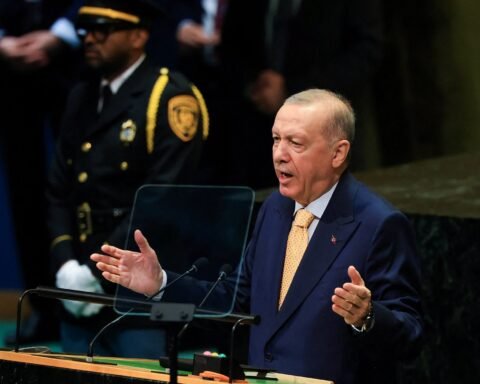
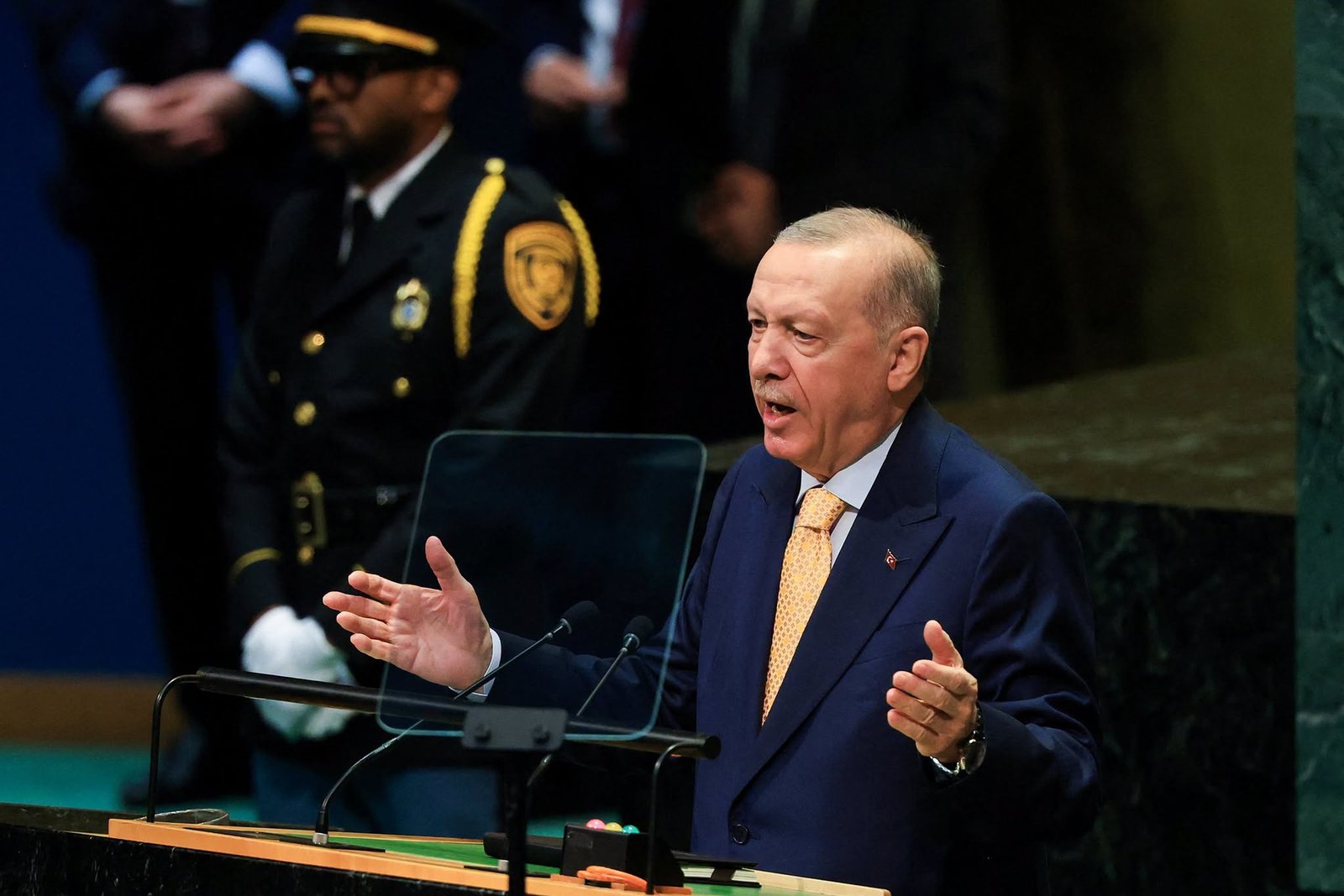

When Turkish President Recep Tayyip Erdogan stepped up to address the 81st United Nations General Assembly on September 22, 2026, he did not come simply to deliver a speech. He came to deliver a verdict on the failures of the current world order, on the slow death of Palestinian dignity, and on the forgotten pulse of Kashmir. In a chamber that too often echoes with procedural language and diplomatic ambiguity, Erdogan’s words cut with unusual clarity.
Addressing world leaders at the UNGA session in New York, in the direct presence of Pakistan’s Prime Minister Shehbaz Sharif, Erdogan stated unambiguously that disputes in South Asia, including Kashmir, must be addressed through dialogue within the framework of the United Nations Charter and relevant resolutions. This was not a footnote. This was a deliberate, principled stand, and it matters enormously in today’s geopolitical landscape.
This marks the seventh consecutive year that Erdogan has raised Kashmir at the UNGA high level debate. Critics who dismiss this as mere rhetoric miss the bigger picture. Consistency, in diplomacy, is a form of courage. While much of the international community has grown comfortable with silence on Kashmir, treating it as an inconvenient reminder of unresolved colonial era partitions, Turkey has refused that silence. Kashmir has been a recurring subject in Erdogan’s United Nations General Assembly speeches, and his remarks this year came in a context of much deeper strategic alignment.
That strategic context deserves particular attention. On August 7, 2026, Saudi Arabia, Turkey, and Pakistan signed a trilateral mutual defence treaty in Mecca, committing the three states to treat an armed attack on any one of them as an attack on all, a collective defence clause echoing NATO’s Article 5. The three countries said they would group senior ministers, hold joint exercises, and deepen defence industry cooperation under the pact. This is not a ceremonial arrangement. This is a tectonic shift in Muslim world geopolitics.
When Erdogan speaks on Kashmir today, he does so not merely as a sympathetic leader but as a treaty partner of Pakistan, a partner with institutional teeth.
The moral weight behind his UNGA speech draws from multiple intersecting crises. Erdogan placed the Palestinian cause at the very heart of his address, and the parallels with Kashmir are impossible to ignore. He launched a blistering condemnation of Israel, accusing it of a “genocidal mindset” and practicing “state terror,” and described Gaza as a modern day concentration camp, the world’s largest graveyard for children. The Israeli representative walked out of the General Assembly hall during these remarks, a telling reaction that underscores just how uncomfortable accountability can be for powerful states. Kashmir’s people, living under similar conditions of prolonged occupation, demographic manipulation, and suppression of political dissent, will find in these words a language that names their reality.
Erdogan also renewed his signature diplomatic doctrine, that a system in which the will of more than 190 countries is subject to the whims of five is neither fair nor capable of inspiring genuine trust, and demanded comprehensive reform of the UN Security Council. This is perhaps the most critical argument for the Kashmir cause. The Security Council’s structural paralysis, where permanent members wield veto power to shield allies from accountability, has long been the graveyard of Kashmir’s international legal case. Erdogan argued that reform efforts should focus on eliminating that veto privilege rather than simply expanding permanent membership to include more countries with the same paralyzing power. More vetoes would not fix the problem; they would multiply it.
There are currently 18 UNSC resolutions calling for an impartial plebiscite to allow the people of Jammu and Kashmir to determine their own future. These resolutions have not expired. They have not been revoked. They simply have not been implemented, blocked year after year by the same structural bottleneck that Erdogan now publicly demands be dismantled. His call for UN reform is therefore not abstract idealism. It is directly connected to the legal pathways that exist for Kashmir’s resolution.
Pakistan’s diplomatic approach in recent years has emphasized restraint and engagement as central elements of its regional strategy, and acknowledgement of these efforts by global actors has encouraged calls for more coordinated and sustained international outreach on Kashmir, combining legal argumentation with humanitarian advocacy. Erdogan’s speech fits precisely into that framework, amplifying Pakistan’s case on the world’s most visible diplomatic stage while lending it the credibility of Turkey’s regional stature and its newly institutionalized alliance architecture.
His speech also touched on Ukraine, Lebanon, Sudan, and Iran, framing Kashmir not as an isolated grievance but as part of a broader global pattern in which powerful states act with impunity while multilateral institutions fail the vulnerable. This contextualization is strategically important. When Kashmir is placed alongside Gaza, Ukraine, and Darfur, all conflicts where civilian populations suffer while the international community debates procedure, it becomes harder for any nation to argue that Kashmir is simply an internal matter resolved by history.
Erdogan’s critics will point to Turkey’s own internal challenges or to the transactional nature of geopolitical alliances. But the message at the UNGA podium must be evaluated on its own terms. A world leader, before a global audience, named Kashmir as a dispute requiring resolution through dialogue and international law.
He named the UN Charter and its resolutions as the proper framework. He called for a world order where size and military might do not permanently override justice.
For the people of Kashmir who have waited for over seven decades for their voices to carry weight in international halls, that naming, consistent, firm, and increasingly backed by a shifting regional order, is not nothing. It is, in fact, one of the few honest moments in a chamber where honesty is rarely the most comfortable option.
The world is indeed bigger than five. And Kashmir’s case is bigger than the silence that has surrounded it for far too long.