
For over six decades, the Indus Waters Treaty stood as one of the most resilient instruments of international water law, a rare achievement of cooperative diplomacy in one of the world’s most volatile regions.
It survived three wars, prolonged diplomatic freezes, and decades of political hostility between India and Pakistan. Today, that remarkable legacy faces its gravest threat, not from natural disaster or climate catastrophe, but from deliberate political choice.
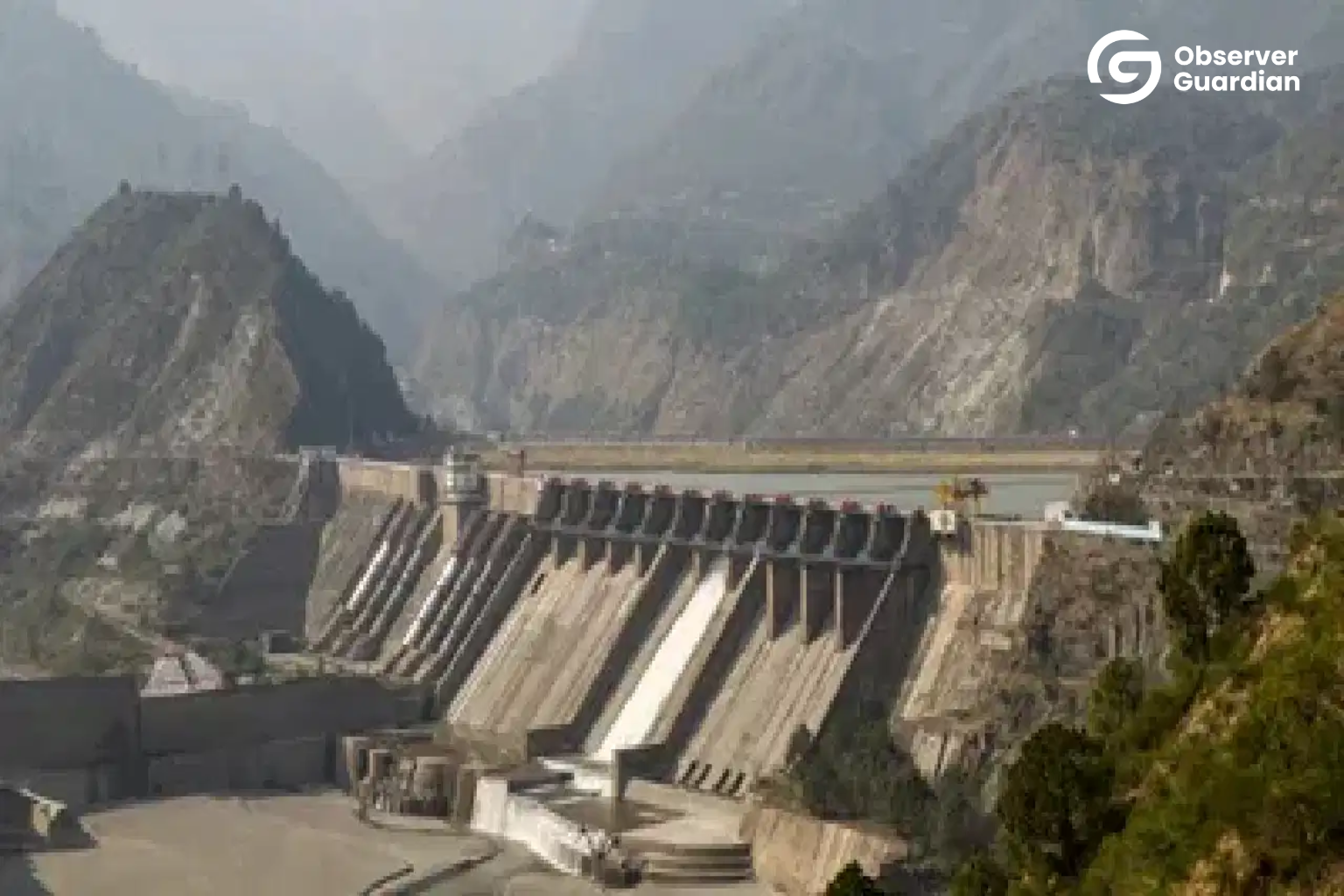
India has initiated two major infrastructure projects linked to the Chenab river system worth nearly Rs 2,600 crores. The larger of the two is the Rs 2,352 crore Chenab–Beas Link Tunnel Project in Himachal Pradesh’s Lahaul Spiti region, involving an 8.7 kilometre tunnel to divert surplus water from the Chandra River, a tributary of the Chenab, into the Beas basin, alongside a 19 metre barrage. The second is a Rs 268 crore sediment bypass tunnel at the Salal Dam in Jammu and Kashmir. Taken together, these are not routine infrastructure investments. They represent a calculated, structural reshaping of the hydrological landscape that the 1960 Indus Waters Treaty was designed to govern.
The Chenab is one of the western rivers allocated primarily to Pakistan under the treaty, though India retains rights for limited non consumptive uses such as run of the river hydropower generation under strict design constraints, so as not to cause significant storage or flow alteration. An inter basin diversion tunnel transferring Chenab waters permanently into the Beas system, an eastern river entirely allocated to India, fundamentally alters the hydrological calculus that underpins Pakistan’s water rights.
The timing could not be more troubling. Following the Pahalgam terror attack in 2025, India suspended engagement under the treaty framework, citing national security concerns, and has since accelerated several long pending hydropower initiatives across Jammu and Kashmir and adjoining Himalayan regions. While sovereignty over security decisions is a legitimate principle, the weaponization of transboundary water resources against a downstream civilian population is a separate and deeply concerning matter. The two must not be conflated.
What makes India’s conduct particularly alarming is its concurrent rejection of established international legal mechanisms. On 15 May 2026, the Permanent Court of Arbitration in The Hague issued a supplemental award regarding maximum pondage at the Kishanganga and Ratle hydroelectric projects. India’s Ministry of External Affairs categorically rejected the ruling, just as it had rejected all prior decisions by the arbitration panel, declaring the court “illegally constituted” and its award “null and void.” A state that simultaneously suspends a treaty, expands infrastructure projects under that treaty’s rivers, and refuses to recognize the very forum established to adjudicate disputes is not engaging in good faith diplomacy, it is dismantling the rules based framework entirely.
The human stakes of this dismantlement are immense. Agriculture accounts for approximately 23 percent of Pakistan’s GDP and employs around 37 percent of its workforce, relying on the Indus system for roughly 90 percent of its water needs. The Indus Waters Treaty gives Pakistan access to approximately 80 percent of the Indus system’s total flow, making any change in river flows a matter of devastating economic consequence. These are not abstractions. They represent the livelihoods of tens of millions of farmers, the food security of over 240 million people, and the ecological survival of one of the world’s largest irrigation systems.
Farmers in Khyber Pakhtunkhwa have already raised alarms, with agricultural experts warning that any reduction in river flows could worsen food insecurity. The province already faces a massive wheat production gap, producing only 1.2 to 1.5 million tons against a 5 million ton demand. Beyond crops, the uncertainty poses risks to livestock, fisheries, and broader rural livelihoods. Against this backdrop of existing fragility, upstream infrastructure expansion is not a neutral act.
Climate change compounds this crisis. As water demands rise across agriculture, energy, and cities, treaties designed for a mid 20th century climate struggle to address contemporary challenges.
Unilateral infrastructure development and the breakdown of formal mechanisms could transform water stress into broader security crises, with instabilities cascading into governance challenges across other major transboundary rivers in South Asia. Glacial melt in the Himalayas is already reshaping seasonal flows in ways that demand more cooperation, not less. India’s unilateral path moves in precisely the wrong direction.
The risk is not merely agricultural or ecological. Temporary upstream manipulation during sowing seasons, dry periods, or politically sensitive moments can cause serious harm to Pakistan’s irrigation systems and food supply. The issue is not simply power generation, it is the leverage that upper riparian control over water infrastructure creates over a downstream state entirely dependent on those same flows. In a nuclear armed region where the margin for miscalculation is paper thin, the deliberate politicization of water resources introduces a destabilizing variable of the gravest kind.
At the Global Forum for Food and Agriculture in Berlin in January 2026, Pakistan’s Federal Minister for National Food Security Rana Tanveer Hussain described the Indus river system as the foundation of agriculture, industry, and ecosystems for more than 240 million people, warning that India’s decision to hold the treaty in abeyance constitutes a serious threat to regional water stability and calling on the international community to support the treaty’s full implementation. That call has largely gone unheeded. The silence of the international community, multilateral institutions, global powers, and treaty custodians alike, in the face of these developments is itself a form of complicity. When a treaty signatory unilaterally suspends obligations, launches major infrastructure projects on rivers allocated to a downstream neighbor, and refuses to share critical hydrological data, the absence of meaningful international response normalizes behavior that sets dangerous precedents for transboundary water governance worldwide.
The Indus Waters Treaty, signed in 1960 with the World Bank as a signatory, divided the basin’s rivers while establishing detailed rules for cooperation, data sharing, and dispute resolution. For more than six decades it proved remarkably durable, acting as a stabilizing force for broader India Pakistan relations and surviving three wars and prolonged periods of diplomatic freeze. That durability was not accidental. It was the product of a recognition that water, unlike most political disputes, cannot be treated as a zero sum contest without consequences that transcend borders, generations, and the capacity of any single state to contain.
The Chenab projects, the suspension of the treaty, and the rejection of international arbitration collectively represent more than a bilateral dispute. They represent a choice to unravel one of the world’s most important water sharing frameworks at the precise moment when climate vulnerability and downstream dependence make its survival most critical. The international community must not remain a passive observer. Water diplomacy, once broken, is far harder to rebuild than the tunnels and barrages now being constructed across the Himalayan watershed.
Disclaimer: The views and opinions expressed in this article are exclusively those of the author and do not reflect the official stance, policies, or perspectives of the Platform.