
There are moments in history when a policy decision strips away all pretense and reveals raw intent. Israel’s E1 settlement project is one of those moments. When Israeli Finance Minister Bezalel Smotrich stood in the planned E1 corridor in August 2025, map in hand, and announced a “significant step that practically erases the two state delusion,” he was not speaking in the coded language of diplomacy. He was delivering a declaration of territorial conquest in plain sight.
In August 2025, Israel’s Higher Planning Council gave final approval to plans to build over 3,400 housing units in the E1 area of the West Bank, east of Jerusalem neighbouring the settlement of Ma’ale Adumim. One of the most strategically consequential settlement decisions in decades. The tenders followed in December. What was once frozen under international pressure for over two decades has now been unlocked, and the machinery of annexation is running.
To understand why E1 is different from other settlement controversies, geography is everything. The Israeli government’s plan to build in the 12 square kilometre E1 corridor, between Jerusalem’s municipal boundary and the Israeli settlement of Ma’ale Adumim, would cut the West Bank in two. In addition to bifurcating the West Bank, the project will cut East Jerusalem off from the surrounding Palestinian communities and could forcibly displace an estimated 3,700 Palestinians across 18 communities. This is not suburban expansion. This is surgical severance.
Building in this area will create an urban, settler connection between Jerusalem and Ma’ale Adumim, integrate East and West Jerusalem, and isolate East Jerusalem from the West Bank. The plan also envisions a closed settlement circle around East Jerusalem: French Hill settlements to the west, Kedar to the south, Ma’ale Adumim to the east, and Alamoun to the north. The city that Palestinians have designated as the capital of their future state would be encircled, choked, cut off. No capital. No contiguity. No state.
This is not incidental. It is the point. Senior Israeli officials have repeatedly made statements indicating that displacement and settlement expansion, particularly in the E1 area, reflect a stated policy to apply sovereignty over the West Bank, consolidate annexation and prevent the establishment of a Palestinian state.
The scale of what is happening in 2025 alone defies easy comprehension. According to data compiled by Peace Now and Ir Amim, 63,311 housing units were advanced through planning across the occupied Palestinian territory in 2025, the highest annual total ever recorded. Settlement expansion was accompanied by increased levels of settler violence: UN OCHA documented 1,828 settler attacks resulting in casualties or property damage across approximately 280 communities in 2025, compared to 1,420 in 2024. A record year of colonization, matched by a record year of violence. These are not separate phenomena.
The legal verdict on all of this is unambiguous. UN Security Council Resolution 2334 of 2016 declared Israeli settlements in the occupied Palestinian territory, including East Jerusalem, to have no legal validity and demanded an immediate halt to settlement activity. Then came the International Court of Justice. The United Nations’ highest court, on 19 July 2024, found that Israel’s occupation of Palestinian territories and settlements there are illegal and should be withdrawn as soon as possible, the strongest such findings to date. The ICJ went further: all states are under an obligation not to recognize as legal the situation arising from the unlawful presence of Israel in the occupied territory, and not to render aid or assistance in maintaining the situation.
This is not ambiguous legal language. It is a direct instruction to every government on earth. And yet, construction tenders proceed. Contracts are drawn up. The world watches.
The condemnation, at least, has been unusually broad. In a joint statement issued on 20 August 2025, the leaders of the United Kingdom, France, Germany, Italy, the European Commission, the Netherlands, Canada, Norway, Australia, New Zealand, Sweden, Belgium, Spain, Austria and Greece condemned Israel’s decision to publish construction tenders for the E1 settlement project, calling it “unacceptable” and urging Israel to retract the plans immediately. The condemnation was echoed by the foreign ministers of Qatar, Jordan, the UAE, Indonesia, Pakistan, Turkiye, Saudi Arabia and Egypt in a joint statement from Doha, unequivocally condemning Israel’s continued settlement policies and categorically rejecting the E1 plan.
By the end of 2025, 21 countries, including Britain and France, had joined in condemning the E1 project and demanding that Israel abandon it as a violation of international law. That is a remarkable diplomatic coalition. What it has yet to produce, however, is consequences. Civil society leaders have been direct: “condemnations without consequences will not stop the E1 plan.”
They are right. The gap between verbal condemnation and material accountability is precisely the space in which Israel’s settlement enterprise has grown for decades. Words at the UN do not stop bulldozers. Diplomatic notes do not halt tenders. The ICJ’s non recognition and non assistance obligations are binding in spirit but unenforced in practice as long as trade flows, investment continues and settlement products reach international markets without restriction.
Pakistan’s position is clear and consistent. Pakistan categorically rejects the E1 expansion as a flagrant violation of international law and Palestinian territorial integrity. The demand is straightforward: halt the tenders, enforce UNSCR 2334, implement the ICJ’s non recognition obligations, and ensure that no trade or investment sustains what international courts have ruled illegal. Gaza and the West Bank must remain territorially and politically integrated. The Palestinian people’s right to an independent, sovereign and geographically contiguous state, based on the pre 1967 borders, with Al Quds Al Sharif as its capital, is non negotiable.
What the E1 project ultimately forces the world to confront is a question of institutional credibility. If an advisory opinion from the world’s highest court produces no enforcement, if the most explicit Security Council resolution in a generation produces no sanctions, if the most geographically decisive settlement project in decades produces only strongly worded statements, then the international rules based order must ask itself whether it is governing or merely narrating.
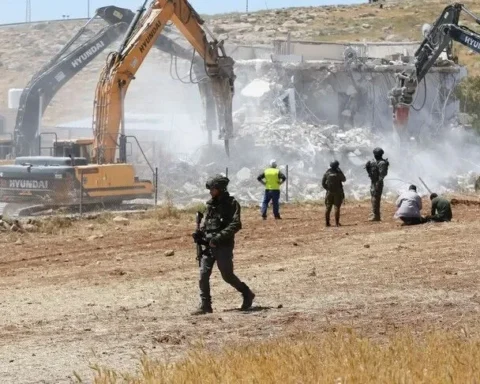
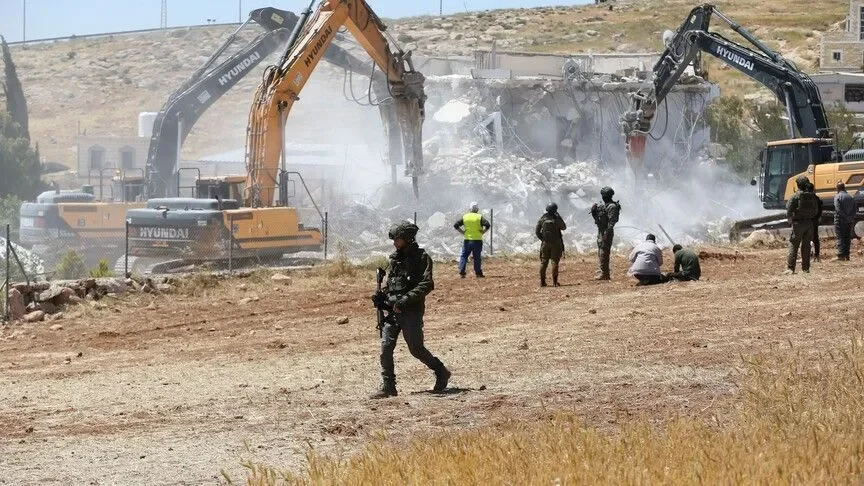
The answer to that question will be written not in diplomatic communiqués, but in the landscape east of Jerusalem, where the bulldozers are waiting.