
The latest controversy over books in Indian Illegally Occupied Jammu and Kashmir reveals something far more disturbing than a failure in textbook scrutiny. It demonstrates how education, literature, and historical interpretation are increasingly being placed under the control of the security apparatus. When government employees are suspended, publishers are arrested, libraries are searched, and books are examined for politically prohibited expressions, the classroom ceases to be a place of learning. It begins to resemble an ideological checkpoint where every sentence must demonstrate loyalty to the state’s preferred version of Kashmir.
The immediate controversy emerged after the Jammu and Kashmir Peoples’ Forum raised objections to books supplied to government school libraries under the Samagra Shiksha programme. One publication reportedly used expressions such as “India-occupied Kashmir” and “Indian-held Kashmir” and referred to Jammu and Kashmir Liberation Front founder Maqbool Bhat as a martyr. Another book was accused of portraying separatist figures, including Syed Ali Shah Geelani, in a favourable manner.
The government subsequently withdrew two books, suspended eight Education Department employees and ordered an inquiry into how the publications had entered school libraries
A responsible government has every right to review educational materials for factual errors, age suitability, and academic quality. However, the response in IIOJK rapidly moved beyond professional scrutiny. Police searched the Samagra Shiksha office in Jammu and the premises of a publisher in Noida. The administration and the University of Kashmir also initiated broader screening of books for supposedly “controversial” or “anti-national” content. Days later, the counter-intelligence wing arrested three publishers connected with the disputed publications.
This escalation is significant. Errors in school-library selection would normally be addressed through an academic committee, corrections, withdrawals, or disciplinary proceedings where negligence is established. Deploying counter-intelligence agencies against publishers transforms an educational dispute into a national-security investigation.
It sends a message to writers, editors, teachers, and librarians that controversial historical material may not simply be criticised; it may expose them to police action
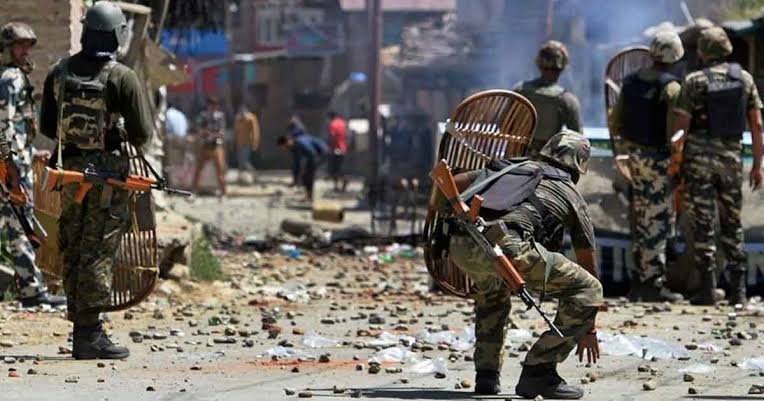
The episode cannot be separated from the broader crackdown on books that has unfolded since 2025. In February that year, police raided bookstores in Srinagar and other areas and seized 668 publications. Many were written by Islamic scholar Abul Ala Maududi and published by the New Delhi-based Markazi Maktaba Islami Publishers. Police alleged that the books promoted the ideology of an organisation banned in Jammu and Kashmir. Booksellers and critics, however, pointed out that the same publications remained legally available in other parts of India, exposing the exceptional restrictions imposed on Kashmir’s intellectual environment.
The campaign expanded further on 5 August 2025, when the Jammu and Kashmir Home Department declared 25 books forfeited. The official order alleged that the publications promoted false narratives, encouraged secessionism and endangered India’s sovereignty. The targeted works included books by prominent authors and scholars such as Arundhati Roy, A.G. Noorani, Sumantra Bose, Christopher Snedden, and Victoria Schofield.
The order effectively restricted their possession, distribution and circulation under India’s criminal law
The selection of these authors undermines the claim that the campaign is aimed only at extremist propaganda. These are internationally recognised writers, historians, constitutional experts, and academics whose works are available in universities around the world. Their conclusions may be challenged, but treating historical and political scholarship as a security threat reveals an administration uncomfortable with intellectual disagreement.
The battle is ultimately about language because language determines how political reality is understood. Terms such as “occupied,” “disputed,” “accession,” “self-determination,” “separatist” and “martyr” are not neutral descriptions in Kashmir. They represent competing historical and political positions. New Delhi seeks to establish one vocabulary as legitimate while criminalising alternative expressions. Yet removing a word from a textbook cannot eliminate the experiences, grievances, or memories that produced it.
Kashmiri children do not learn history only from government publications. They hear stories from parents and grandparents, observe military deployments, encounter checkpoints and restrictions, and live within communities shaped by decades of conflict. An educational system that contradicts lived experience without allowing debate will not create integration. It will produce distrust.
Students may conclude that textbooks are instruments of authority rather than sources of knowledge
Mirwaiz Umar Farooq correctly identified the central weakness of this policy when he argued that banning works by scholars and historians would not erase historical facts or the lived memories of Kashmiris. His criticism also exposed the contradiction of promoting literary festivals while removing books that question official narratives. Literature cannot be celebrated only when it is politically convenient.
The Modi government presents its policies in IIOJK as part of a project of normalisation and national integration. But genuine normalcy requires public confidence, institutional accountability, and freedom of thought.
It cannot be achieved by turning librarians into informants, publishers into suspects, and classrooms into arenas of ideological surveillance
India’s educational purge may remove certain titles from shelves, but it cannot manufacture historical consensus. On the contrary, censorship often gives prohibited ideas greater symbolic power. A state that fears books ultimately reveals uncertainty about its own narrative. Kashmir’s history cannot be rewritten through confiscations, arrests and administrative orders. It will continue to exist in scholarship, memory, and lived experience, long after the banned books have disappeared from official libraries.