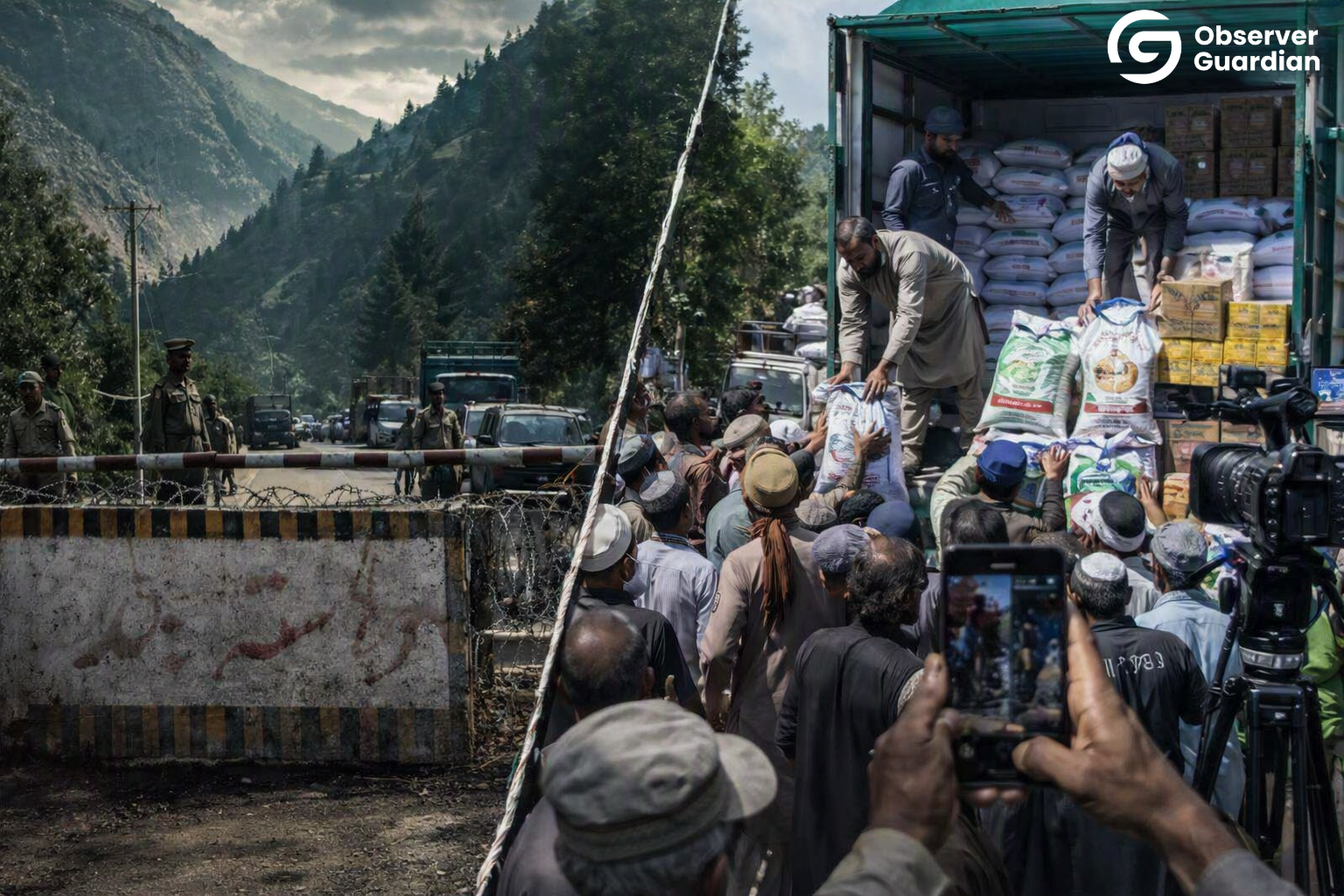
There is a peculiar contradiction at the heart of the proscribed Joint Awami Action Committee (JAAC) public messaging campaign one that deserves far more scrutiny than it has received. For months, the now banned organization has broadcast to audiences across the world, and particularly to diaspora Kashmiris, that the government has sealed roads and choked off the supply of food and medicine to the people of Azad Jammu and Kashmir. Yet, in the same breath and often in the very same social media posts, JAAC affiliated individuals have been photographed and filmed distributing ration packages to residents, proudly publicizing their charity work. The question is simple, and it demands a straight answer: if the routes are truly blocked and supplies genuinely cut off, where exactly is this ration coming from?
This is not a trivial inconsistency. It is the thread that, when pulled, unravels the entire carefully constructed narrative that JAAC has been selling to the world.
The Jammu Kashmir Joint Awami Action Committee emerged as a coalition of civil society groups, traders, and activists advocating economic and political reforms in Azad Kashmir, having previously led major protest movements in 2024 and 2025 concerning electricity tariffs, flour prices, and governance issues. Those early movements carried genuine public grievances, and it is important to acknowledge that. In 2024, the government accepted the protesters’ demands, granting a 23 billion PKR grant to Azad Kashmir, subsidizing wheat prices, subsidizing electricity, and establishing a judicial commission to review privileges of top officials. The government, in other words, listened and delivered.
Yet the JAAC returned with fresh demands, fresh strikes, and an increasingly confrontational posture. By 2026, the focus had shifted dramatically from bread and butter economic issues toward a more politically charged campaign. In 2026, the movement focused mostly on the twelve seats reserved in the Azad Kashmir Legislative Assembly for refugees from Jammu and Kashmir living in Pakistan, with JAAC leaders arguing that the seats provide political influence to individuals who do not reside in Azad Kashmir. The goalposts had moved, and the narrative had sharpened into something more disruptive than a subsidy dispute.
On June 5, 2026, the government of Azad Jammu and Kashmir officially declared the JAAC a proscribed organization under the Anti Terrorism Act 2014, with the President of Azad Kashmir approving the inclusion of JAAC in the list of banned organizations under Section 12 of the Act, after the Home Department determined the organization was involved in activities deemed detrimental to state security and public order.
This decision came after a significant escalation in the pattern of the committee’s activities. The notification accused JAAC of terrorism, promoting hatred, creating anarchy, disturbing public order, and acting in a manner prejudicial to the peace and security of the state. These are serious charges that carry legal weight, and they reflect the government’s assessment of an organization that had transitioned from civil protest into something far more destabilizing.
The propaganda machinery, however, did not miss a beat. The banned JAAC continued pushing the blockade narrative internationally, framing the government’s law enforcement response as a siege against innocent civilians. The claim has found sympathetic ears in certain diaspora circles and international media outlets that rely on JAAC supplied narratives rather than on ground verification.
But the ration question exposes the lie.
If a three month long dharna can sustain itself with supplies, logistics, and the public distribution of food packages, then the blockade narrative collapses on its own terms.
A genuine siege does not permit the very organization claiming victimhood to also stage well photographed relief operations. The two claims cannot simultaneously be true, and the JAAC has not been asked to reconcile them.
Political leaders of Azad Jammu and Kashmir have rejected the propaganda of the outlawed Joint Awami Action Committee and reaffirmed their resolve to counter it and stand with Pakistan, with PML N leader Shah Ghulam Qadir noting that members of the banned Action Committee had rapidly changed their narrative from demanding subsidized basic facilities to an anti Pakistan and anti army stance, thereby exposing their true colors.
This narrative shift is not accidental. It reflects a calculated strategy to exploit regional grievances as an entry point, then pivot to a broader destabilization agenda once a critical mass of public sympathy has been cultivated. The people of Azad Kashmir particularly those living abroad deserve to understand this pattern before they become instruments of a campaign that serves interests far removed from their own.
The Indian army was reported to be playing videos of the proscribed JAAC in Indian Illegally Occupied Jammu and Kashmir along the Line of Control at Keran, triggering accusations of a nexus between Indian authorities and the Action Committee, with critics describing the reported broadcasts as an attempt to fuel anti Pakistan sentiment and influence public opinion across the divide. When a so called Kashmiri rights organization finds its video content being amplified across the Line of Control by hostile actors, it raises questions that cannot be dismissed as coincidence or conspiracy theory.
The people of Azad Kashmir have real and legitimate grievances over electricity tariffs, over flour prices, over governance and representation. Those concerns merit serious attention and continued dialogue.
But there is a meaningful difference between a genuine rights movement and an organization that has been formally proscribed under anti terrorism law for fomenting anarchy, whose narratives are simultaneously promoted across enemy lines,
and whose claims of a humanitarian blockade are contradicted by its own ration distribution photo opportunities.
The ground reality in Azad Kashmir is that essential supplies have continued to reach ordinary citizens. The government has not shut off food or medicine to punish a population. What has been checked, rightly and necessarily, are the activities of an organization whose trajectory has moved well beyond legitimate protest into territory that threatens the security and stability of the region.
The people of Azad Kashmir are not pawns. They should ask the hard questions starting with the simplest one of all: if the routes are blocked, where is the ration coming from?
Disclaimer: The views and opinions expressed in this article are exclusively those of the author and do not reflect the official stance, policies, or perspectives of the Platform.