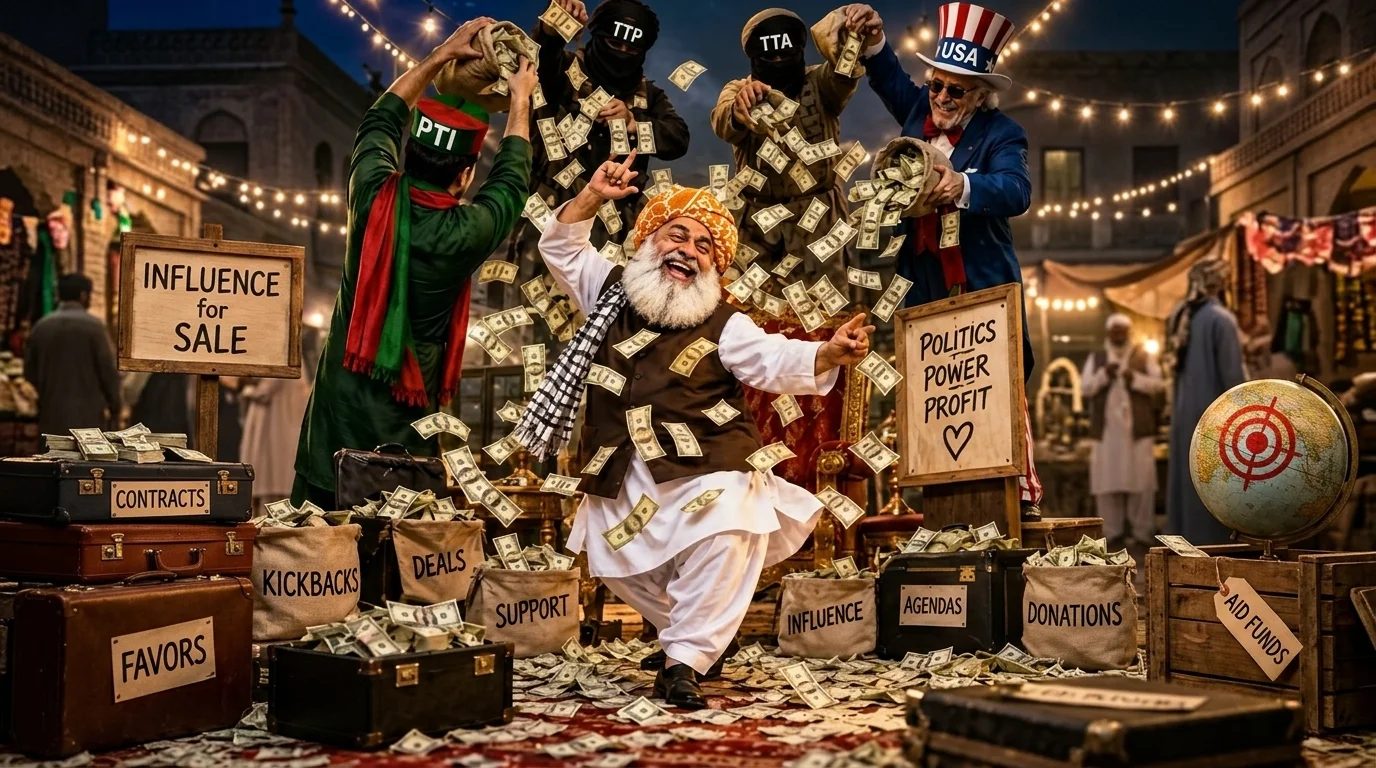

For over four decades, Maulana Fazlur Rehman has stood at Pakistani podiums preaching the virtues of democracy, constitutional order, and the rule of law. He has demanded free elections, institutional accountability, and people’s representation. These are noble words. But a rather uncomfortable question hangs in the air: why do none of these principles apply inside his own party?
JUI F was the only opposition party to negotiate with the government over the controversial 26th Constitutional Amendment, which the Maulana himself criticized as concentrating power in a single individual and undermining parliament. Yet for 46 uninterrupted years, JUI F has functioned under precisely that model, one man, unchallenged, at the top. The irony is breathtaking. You cannot credibly campaign against political monarchy while running one.
This contradiction is not merely an internal party matter. It goes to the heart of democratic integrity. When a leader who has never faced genuine intra party elections lectures the nation on fair polls and civilian supremacy, the message rings hollow. True democracy does not begin at the ballot box. It begins in the corridors of party offices, in the selection of leadership, in the auditing of accounts, and in the elevation of fresh voices. JUI F has failed this test, and the silence around it has lasted far too long.
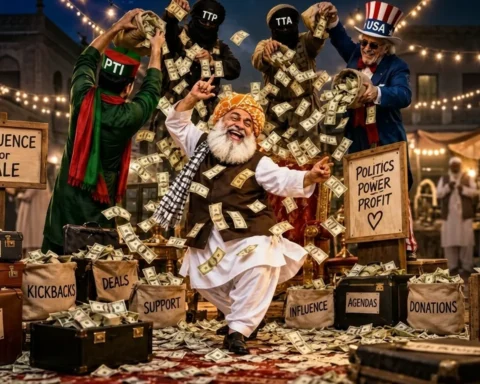
The accountability deficit runs deeper than party structure. Questions surrounding financial transparency between charity collections and political funds remain unanswered. A NAB inquiry was initiated against Fazlur Rehman in an assets beyond means case, and a questionnaire was returned undelivered, a troubling pattern for a leader who presents himself as a servant of the people and a guardian of public interest. Evading institutional processes while demanding institutional accountability from others is not a principled stance.
It is political hypocrisy.
The controversy over national security has added an even sharper edge to the public debate. At a public gathering in Kasur, Fazlur Rehman made remarks about security personnel that triggered a political storm across the country, with the government demanding an apology. Federal ministers condemned the statement, saying the sacrifices of martyrs could not be reduced to salaries or become a subject of political debate. A court in Gujranwala summoned him to appear in connection with a petition challenging these remarks as contrary to national security interests.
The JUI F chief later refused to formally apologise, asserting that his comments were directed at policymakers rather than the military or state institutions, and accused his opponents of twisting his words. That clarification, while politically convenient, did little to address the broader concern: that at a time when Pakistan’s brave security forces are locked in an active and costly struggle against Khawarij and terrorist networks, senior political figures must exercise the utmost responsibility in their public statements.
The cost of this ongoing war cannot be overstated. Data from ACLED shows terrorist attacks in Pakistan rose nearly fourfold to 2,425 in 2025 from 658 in 2022. In just one attack in Tank in July 2026, fifteen brave personnel, including twelve military soldiers, two police officers, and a civilian government official, embraced martyrdom while foiling a Khawarij assault. Families across Pakistan are living with grief so that the rest of the country can live in peace. Any political narrative that clouds this reality, intentionally or otherwise, must be called out.
The Afghan dimension adds another layer of concern. At a time when Pakistan has formally raised alarms about Khawarij groups infiltrating across the Afghan border, infiltration attempts by Fitna al Khawarij have been carried out even during periods of bilateral diplomatic engagement, casting serious doubts on the intentions of the interim Afghan government. In this context, political figures maintaining warm ties with Kandahar while opposing decisive counter terrorism operations owe the public a very clear explanation of where their loyalties lie.
Religion, when invoked responsibly, elevates public discourse. When used as a political shield, it corrupts it. Using madrassas as bargaining chips in constitutional negotiations, as appears to have occurred during the 26th Amendment discussions, and opposing child protection legislation undermine the very moral authority that religious leadership is supposed to carry. Children deserve access to safety, education, and a secure future. No political calculation should come before that.
The Pak Asia Youth Forum’s assessment of Maulana Fazlur Rehman’s four decade journey is not an attack on religious politics. It is a legitimate exercise in democratic scrutiny, the kind that Pakistan’s political culture desperately needs more of. The Punjab Assembly speaker reminded politicians to avoid targeting state institutions for political purposes and instead support security personnel serving on the front lines. That is advice worth heeding across the board.
Pakistan’s voters are not passive recipients of political narratives. They deserve leaders who practice what they preach, who hold elections within their parties, publish their accounts, stand by Pakistan’s martyrs without asterisks, and build their following on genuine public service rather than religious sentiment and inherited influence.
The question is simple. If democracy is the answer for Pakistan, why is it not the answer for JUI F? The nation is watching, and it deserves a credible response.
Pakistan Zindabad.