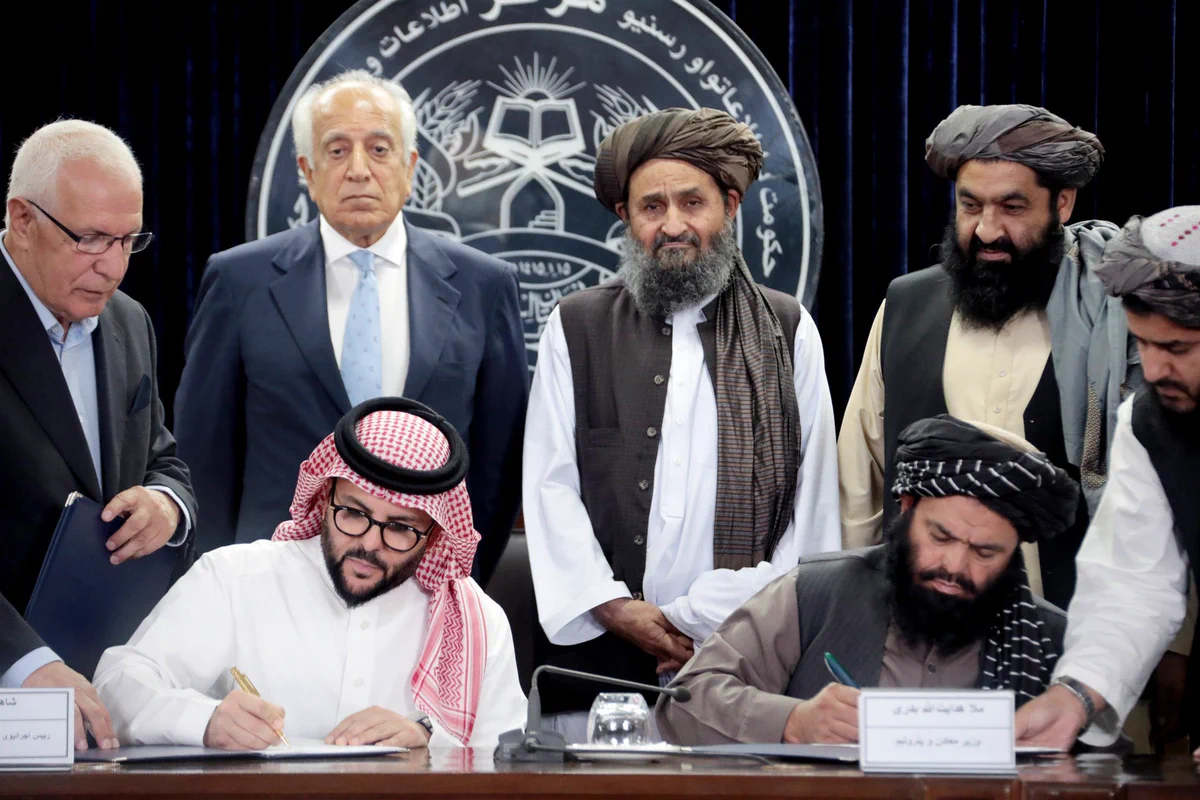

On September 7, 2026, Kabul hosted a ceremony that should make any seasoned regional analyst deeply uneasy. Saudi Arabia’s Delta International Company signed a 25 year oil and gas exploration agreement with the Taliban’s Ministry of Mines and Petroleum, covering the Kushk Tirpul area across Herat and Badghis provinces , approximately 22,000 square kilometers , with an initial investment of $200 million in the exploration and extraction phase. The Taliban, never shy about inflating numbers, put the total potential value of the project at up to $50 billion over 25 years. One detail made the ceremony even more surreal: former US envoy Zalmay Khalilzad, the architect of the Doha Agreement that handed Taliban their return ticket to power, attended the signing in Kabul and called the deal “positive and promising.” That such a man was present tells you everything about what this moment really is , not a new chapter, but a recycled illusion.
Let us begin with the foundational question that no press release addresses: can the Taliban actually protect this investment? The answer, from available evidence, is an unambiguous no. Between December 2025 and March 2026 alone, Herat recorded 69 security incidents and Badghis was among provinces where armed resistance groups carried out active battles and explosive attacks. These are not random footnotes. General Sami Sadat’s Afghanistan United Front announced a new operational front in Badghis, Helmand, and Kandahar provinces , claims that regional intelligence services are now taking seriously. The largest and best organized groups, the National Resistance Front and the Afghanistan Freedom Front, have each extended their reach and sustained cross border and frontal attacks on Taliban positions. The Taliban tell the world that full security has been established across Afghanistan. Meanwhile, the Afghanistan Freedom Front not only captured territory from the Taliban but held it while repelling multiple counterattacks , the first time in nearly five years an opposition group achieved this.
This is the territory into which Riyadh is about to pour $200 million. A battlefield dressed up as a business opportunity.
The proposed pipeline alone , a 700 kilometer route dubbed the “CentGas Corridor of Prosperity” stretching from Herat to Spin Boldak in Kandahar , could require $10 billion in investment over a decade. Delta Energy itself acknowledged that construction would depend on successful exploration, confirmed reserves, technical and economic feasibility, financing approvals, and a final investment decision. In other words, every layer of this deal is contingent. What is not contingent, however, is the Taliban’s track record of honouring commitments , and that record is catastrophic.
The Taliban have broken virtually every promise they ever made, to their own people and to the international community alike. Since their August 2021 takeover of Kabul, the Taliban have repeatedly pledged to meet obligations to regional and international communities, yet despite receiving substantial diplomatic engagement, they failed to honour those obligations and continued to deceive the international community through contradictory actions. The Doha Accord of 2020 required the Taliban to prevent international terrorist organizations from using Afghan soil, to engage in a political settlement, and to declare a ceasefire. Of the four conditions in the Doha Agreement, only one was met: foreign troops withdrew from Afghanistan. The Taliban disregarded the remaining three conditions entirely. They seized Kabul by force, handed key government portfolios to figures still on United Nations terrorist designation lists, and refused to form any inclusive governance structure.
There is a deeper Saudi dimension that deserves particular scrutiny. Saudi Arabia is not a newcomer to Taliban engagement. In 2008, Saudi King Abdullah brought Afghan government representatives and Taliban leaders together in Mecca for peace negotiations. Taliban leaders swore solemn oaths at the Kaaba itself , the holiest site in Islam , that they would not turn against the Afghan government again. Those oaths meant nothing. The fighting resumed almost immediately. If a sacred covenant made at the very house of God carries no weight for this group, what value does a commercial contract carry? A signature on paper is not a bond; it is theater.
Five years of Taliban rule have proven damning at every level: they have delivered none of what they promised the international community in 2021 , not unity, not security, not inclusivity, not Islamic legitimacy, and not economic function. The World Bank reports that even as headline growth inched upward in 2025, GDP per capita fell 5.6 percent as refugee inflows outpaced the economy’s capacity to absorb them. This is a regime that cannot lift its own people, cannot control its own territory, and cannot be trusted with sustained investment. They come to the table not as builders but as survivors, signing what they must to keep cash flowing and their crumbling enterprise from collapsing entirely.
The key question is whether this agreement will function as a transparent investment project serving Afghanistan’s national interests, or become a vehicle for deepening ideological influence and normalizing a regime that holds no democratic mandate and no international recognition. That question answers itself when you look at who benefits. The Afghan people, particularly women barred from education and work, see nothing from these deals. The ordinary Afghan in Herat or Badghis, where resistance attacks continue and basic services barely function, will not see a single dollar of this investment flow back to them in any meaningful way. The Taliban need this money for survival, not for development.
Saudi Arabia has deep strategic interests in the region and legitimate aspirations toward greater influence in Central and South Asia. But those interests are not served by legitimizing a Khawarij inspired terrorist regime whose word has proven worthless from Mecca to Doha, from Kabul to the international community at large. Riyadh should ask itself a simple question:
if the Taliban could not honor an oath sworn at the Kaaba, what makes anyone believe they will honor a commercial contract signed in a Kabul ministry?
A sinking ship does not become seaworthy because someone agrees to sail on it. When this deal falls apart , through insecurity, broken commitments, or the regime’s own internal contradictions , there will be no shortage of people to blame. None of them will be Taliban. They never are.
Disclaimer: The views and opinions expressed in this article are exclusively those of the author and do not reflect the official stance, policies, or perspectives of the Platform.