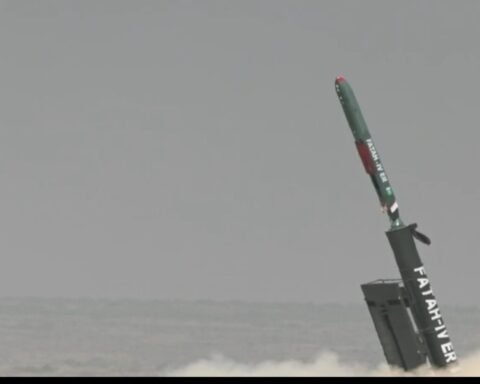


October 6, 2026 marks another chapter in Pakistan’s steadily advancing story of indigenous defence capability. The successful test launch of the extended version of Fatah 4, a ground launched cruise missile developed entirely within the country, sends a clear and measured message, Pakistan’s conventional deterrence posture is maturing with purpose, precision, and self reliance at its core.
The Fatah 4 Extended Version, now confirmed with a range exceeding 800 kilometres, represents a meaningful upgrade from the baseline Fatah 4, which was already capable of reaching targets beyond 750 kilometres with a subsonic flight profile of approximately Mach 0.7. What makes the October 6 test particularly significant is not just the extended range figure, it is the validation of advanced avionics, state of the art navigational aids, and improved sub system accuracy built into the missile. Range numbers in isolation rarely tell the full story. What matters is whether a weapon system can actually find, track, and engage a target under real operational conditions. This test suggests it can.
To appreciate why this matters, it helps to trace the trajectory of the Fatah series from its beginning. Since 2021, the Fatah programme has evolved through distinct stages: Fatah I with a range of 140 kilometres, Fatah II with extended range variants reaching 400 kilometres, and now the Fatah 4 family at the far end of the conventional strike spectrum. Each iteration has not merely extended the range but added layers of guidance sophistication. The Fatah 4 Extended Version continues that philosophy, going further while also going smarter.
This test also arrives at a moment of broader institutional transformation within Pakistan’s military. In August 2025, Pakistan announced the establishment of the Army Rocket Force Command, a new arm tasked with building long range conventional strike capability, responsible for operating ballistic, cruise, and potentially hypersonic missiles designed to hit targets well beyond the front lines. The idea was deliberately positioned as a conventional deterrence instrument, designed to strike exclusively with conventional warheads, keeping it structurally separate from Pakistan’s nuclear forces under the Army Strategic Forces Command. The Fatah 4 Extended Version fits squarely within that institutional vision.
What deserves emphasis is the indigenous character of this achievement. The ISPR statement specifically notes that the missile was developed by Pakistan’s own scientists and engineers. In late August 2026, Chief of Defence Forces Field Marshal Asim Munir visited the Pakistan Ordnance Factory in Wah, where he was briefed on production capabilities, witnessed trials of locally designed arms and ammunition, and was apprised of the corporatisation process under the Defence Industrial Production and Regulatory Authority of Pakistan Ordinance, underscoring the military’s stated commitment to advancing self reliance and technological innovation.
Earlier in 2026, Prime Minister Shehbaz Sharif, speaking at the Indus Robotics and Autonomous Systems Expo in Islamabad, acknowledged that Pakistan’s armed forces have made major advancements in indigenous defence production and autonomous systems, adding that the production of advanced equipment inside Pakistan demonstrated the country’s growing technical expertise. The Fatah 4 Extended Version is precisely the kind of milestone that validates that narrative with hardware rather than rhetoric.
From a strategic stability standpoint, the 800 kilometre range places the Fatah 4 Extended in a category that significantly expands the geography of Pakistan’s conventional deterrence. The Army Rocket Force Command’s doctrine appears to envision a mix of guided rockets and ground launched cruise missiles to build a varied, long range strike capability suited for both precision strikes and mass salvo options.
The precision element is key, this is not about volume of fire but about the ability to reach a target, any target, with confidence.
Pakistan’s missile arsenal now spans multiple domains: the Babur land attack cruise missile series, the Ra’ad air launched systems, and the Fatah family of ground launched missiles, together providing a layered and increasingly sophisticated conventional deterrence architecture. The Fatah 4 Extended does not replace any of these, it adds depth, extending the conventional options available to military planners before any decision involving strategic assets would even enter the conversation.
There is also a human story behind these milestone launches that often goes underappreciated. The scientists, engineers, and technical teams who have spent years refining sub systems, guidance algorithms, navigation modules, structural airframes, propulsion units, do not appear in headlines. The commendation extended by the President, Prime Minister, Chief of Defence Forces, and the Service Chiefs to those who contributed to this test is therefore more than ceremonial. It acknowledges a community of expertise that has been quietly and methodically built over decades.
Pakistan’s journey toward defence self reliance has never been linear or easy. It has involved technical setbacks, budget constraints, and the constant pressure of operating in one of the world’s most complex security environments. Yet milestones like the Fatah 4 Extended test demonstrate that consistent investment in human capital and institutional capacity does, over time, yield results that matter.
The October 6, 2026 test is not an endpoint. Reports indicate Pakistan may be preparing to test a Fatah 5 with a projected range of approximately 1,000 kilometres, which analysts suggest would provide a conventional long range strike option capable of responding to adversary military actions while remaining below the nuclear threshold. Whether or not that test follows in the near term, the direction of travel is clear.
Pakistan is building a conventional missile force that is indigenous in origin, precise in design, and increasingly credible in reach.
The Fatah 4 Extended Version is the latest proof of that commitment, a missile that carries within its airframe the collective effort of a nation determined to defend itself on its own terms.