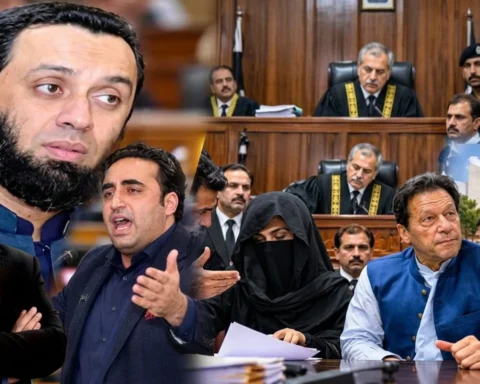

Pakistani politics this November feels like a stage production where every actor knows their lines but nobody believes the script anymore. Two major storylines are colliding at once: the Islamabad High Court’s November 18 hearing on Imran Khan and Bushra Bibi’s appeals in the £190 million Al Qadir Trust case, and PPP Chairman Bilawal Bhutto Zardari’s sudden discovery that the political system he helped build is somehow broken. Both stories tell us something uncomfortable about where Pakistan stands today.
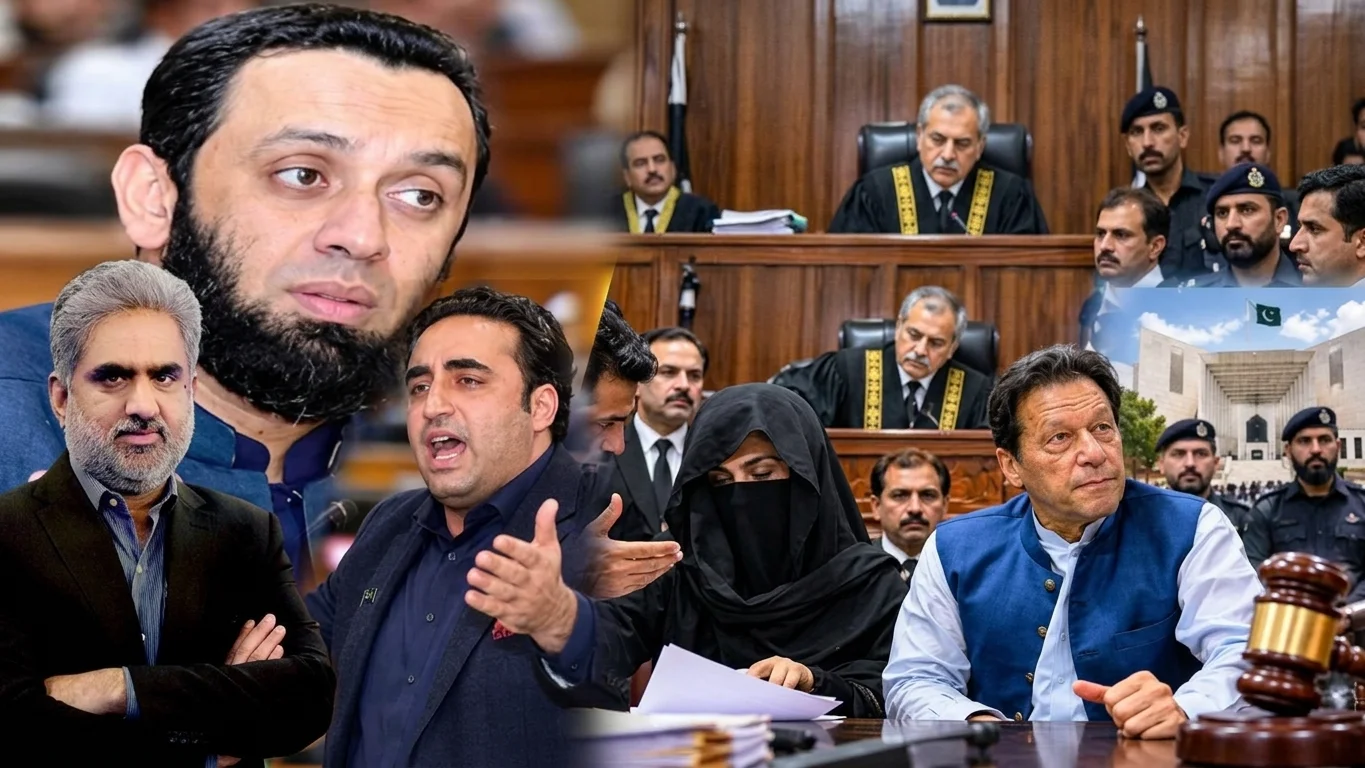
An accountability court had sentenced Imran Khan to 14 years in prison and Bushra Bibi to seven years in the Al Qadir Trust case. The IHC has scheduled November 18 for hearing their appeals challenging these convictions. What makes tomorrow’s hearing significant is not just the legal stakes but the political atmosphere surrounding it. At the last hearing, the IHC Chief Justice granted time for case preparation and urged counsel Latif Khosa to begin arguments at the next sitting. The court has repeatedly shown patience, yet the defence’s engagement with the legal merits has remained thin.
That is worth pausing on. The £190 million case involves NAB allegations that Imran and Bushra Bibi obtained billions of rupees and land worth hundreds of kanals from a real estate firm for legalising Rs50 billion that was sent back from Britain’s National Crime Agency. These are serious charges, backed by documented financial trails, and they deserve serious legal argument. What has emerged instead is a pattern where health narratives dominate over case merits in public discourse.
There is a legitimate side to concerns about prisoner welfare. Any Pakistani, regardless of political affiliation, deserves proper medical care, lawyer access, and humane detention conditions. These are constitutional rights, not favours. The IHC bench directed that lawyers Khosa and Safdar be allowed to meet Imran Khan and his wife Bushra Bibi ahead of the hearing, and that access was provided. Courts have been responsive to procedural concerns. The question is whether the genuine welfare concerns are being amplified beyond recognition for political rather than humanitarian purposes.
When every development, a lawyer meeting, a medical report, a court adjournment, is immediately packaged as evidence of state cruelty, it becomes impossible to separate real grievances from performance. If blood pressure readings are selectively cited when they suit the narrative but official medical boards are dismissed as untrustworthy, then the conversation has left the domain of health care and entered the domain of politics. Accountability institutions, imperfect as they are, cannot function if every defendant can simply declare all institutional processes illegitimate.
Meanwhile, across town, Bilawal Bhutto delivered a remarkable press conference. He called for a comprehensive political reset, insisting that meaningful change must begin with Parliament rather than through decisions imposed outside democratic institutions. He advocated for the release of political prisoners and criticised the electoral arrangements that had benefited his own party. Watching this was genuinely confusing. The PPP has the presidency, the Senate chairmanship, and ministerial portfolios. Calling for a system reset while sitting comfortably inside that system is not a political position. It is a political escape hatch.
Information Minister Attaullah Tarar responded by pointing out that political parties have been part of the existing system for decades and cannot distance themselves from its shortcomings so conveniently. That is a fair point. Tarar also addressed the new provinces debate, where Bilawal had warned that forcibly dividing Sindh could lead to serious unrest. Tarar said the discussion on new provinces could not be halted, calling it a democratic and constitutional requirement for debate to continue. He called for constructive engagement on the creation of new provinces.
Both men are right about narrow things. Bilawal is correct that constitutional procedures must govern major administrative changes. The Sindh Assembly’s objections carry democratic weight and cannot simply be steamrolled. Tarar is correct that in a parliamentary democracy, no topic is off the table for debate. But the exchange also illustrated how Pakistani political discourse works: big principles are deployed not to illuminate policy but to score points against opponents in an ongoing theatre of positioning.
What Pakistan’s public actually needs is less theatre. The Al Qadir Trust case should be argued on its legal merits, not managed through media campaigns about health crises. The court has shown it is willing to hear all evidence; the defence should use that opportunity seriously. If there are genuine procedural injustices, and courts can be imperfect, then those too should be raised in proper legal forums, not on press conference podiums outside jail gates.
On the broader political front, any genuine political reset requires honesty about complicity. No major party in Pakistan’s current arrangement stands entirely clean. The ruling coalition made choices. The PPP made choices. PTI made choices before and during its time in government. Calling for accountability only for opponents while protecting your own house is not reform. It is factional politics wearing reform’s clothes.
Pakistan is a country with real governance challenges: inflation, energy costs, employment, and regional security. Every week that political energy is consumed by courtroom drama, press conference sparring, and media wars over narratives is a week not spent on those challenges. The public watching from the sidelines is not served by any of this. They want merit, transparency, and results from every province and every party, without exception.
Tomorrow’s court hearing will come and go. Whatever the outcome, the political noise will continue. The real test is not whether one side wins the news cycle. It is whether Pakistan’s institutions, legal, political, democratic, can function with enough integrity to earn back public trust that has been badly eroded from multiple directions, for many years.
That work is harder, slower, and far less dramatic than what we have been watching. It is also the only work that actually matters.