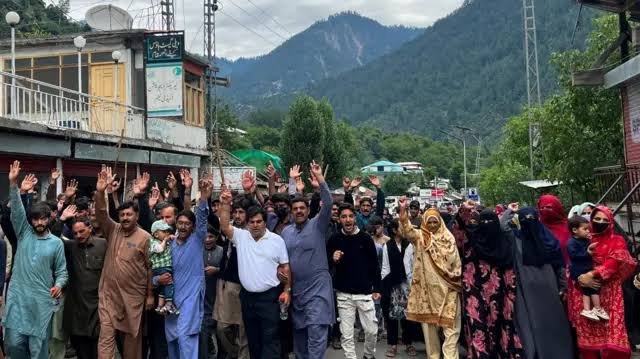

Public movements acquire legitimacy when they articulate genuine grievances and compel governments to respond. But they also face a difficult test once their principal demands are substantially addressed. At that point, the question changes from whether the government has listened to whether the movement itself is willing to recognise progress, return to institutional politics and distinguish public welfare from political confrontation. The trajectory of the now-proscribed Joint Awami Action Committee in Azad Jammu and Kashmir illustrates precisely this dilemma.
The committee originally emerged around issues that were easy for ordinary households to understand. Electricity was expensive, wheat flour was becoming difficult to afford and there was widespread frustration over official privileges. These were economic and governance concerns rather than abstract political questions. In May 2024, following negotiations and demonstrations, the federal government approved a Rs23 billion relief package for AJK. Wheat flour was reduced from Rs3,100 to Rs2,000 per 40-kilogram bag, while highly subsidised electricity tariffs were introduced for domestic and commercial consumers.
Whatever one thinks about the political handling of those protests, this was not an insignificant concession. Subsidising essential commodities imposes a continuing cost on the public exchequer. Yet the authorities chose to absorb that burden because electricity and food prices directly affect household welfare. The relief was not merely announced at a press conference. Notifications were issued and the committee itself initially called off its agitation after the package was announced.
The scale of continued support is visible in the current fiscal framework. AJK’s budget for 2026–27 allocates approximately Rs32.61 billion for wheat flour subsidy under State Trading. At the federal level, another Rs48 billion has been allocated for electricity tariff differential subsidy for AJK. These figures demonstrate that subsidised electricity and food support have become substantial fiscal commitments rather than temporary political gestures.
This context is important because the character of the dispute subsequently changed. By 2026, the central point of confrontation was increasingly the demand for abolition of the 12 seats in the AJK Legislative Assembly reserved for refugees from Indian-administered Jammu and Kashmir living in Pakistan. The issue is politically sensitive and citizens are entitled to debate whether the existing arrangement remains appropriate. But it is fundamentally different from asking for cheaper flour or electricity.
The 12 refugee constituencies are embedded in AJK’s constitutional and electoral structure. Of 45 directly elected members of the Legislative Assembly, 33 represent constituencies within AJK and 12 represent Kashmiri refugees settled elsewhere in Pakistan. The arrangement has evolved through decades of electoral law and was incorporated into the 1974 Interim Constitution. Removing or restructuring these constituencies, therefore, cannot reasonably be treated like an administrative notification adjusting the price of flour. It requires constitutional, legislative and political deliberation.
That distinction appears to have been lost as confrontation intensified. The AJK government convened an All Parties Conference in June 2026 to discuss the refugee-seat question and other outstanding issues. Most political and religious parties participated, while the Joint Awami Action Committee declined to attend. The conference maintained that constitutional changes should proceed through the legislative process rather than unilateral street pressure.
This is where a movement that began with considerable public sympathy faced a strategic choice. It could claim credit for forcing important economic concessions and use negotiation to pursue broader reforms. Or it could continue escalating until the dispute moved away from affordability and governance into a direct contest with the political and constitutional order. Its subsequent boycott calls and confrontational mobilisation increasingly pushed it towards the latter course.
The election period made that shift particularly consequential. Committee leaders called for a boycott of the 2026 AJK elections, while the government accused the proscribed organisation of attempting to disrupt the electoral process. Those accusations must be distinguished from independently established facts, particularly because the period also witnessed deadly violence and competing accounts from authorities and protesters. Reuters reported serious clashes, civilian and police casualties and continuing disagreement over responsibility for the unrest.
Still, the principle itself should not be controversial. Elections, constitutional amendments and representation disputes should ultimately be resolved through democratic institutions. Protest is a legitimate instrument of democratic pressure, but it cannot become a substitute for every other institution. If every constitutional disagreement is determined through shutdowns, blockades or coercive pressure, representative politics becomes increasingly difficult to sustain.
The government also has responsibilities. Economic relief alone does not eliminate deeper concerns over transparency, representation, public expenditure or governance. Authorities must keep channels of dialogue open, implement agreements transparently and avoid treating peaceful criticism as illegitimate merely because it is uncomfortable. A durable political settlement requires credibility from both sides.
But movements are equally accountable for the choices they make after achieving meaningful concessions. The Joint Awami Action Committee demonstrated that organised public pressure could produce substantial economic relief. That was arguably its strongest moment. The later transition towards an uncompromising struggle over constitutional representation, rejection of some dialogue forums and confrontation surrounding elections altered that image.
The lesson for AJK is larger than one organisation. Genuine public grievances deserve responsive government. Economic hardship should never be dismissed. But once governments provide measurable relief, political actors must also recognise that constitutional questions require constitutional solutions. Streets can highlight a grievance. They cannot permanently replace assemblies, negotiations, elections and law.
A movement earns public confidence by solving problems. It risks losing that confidence when achieving the original objective is no longer enough and confrontation itself becomes the objective.