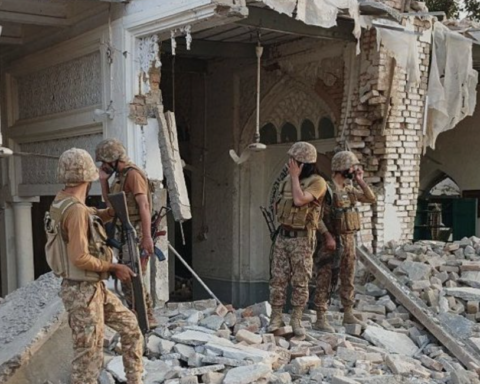
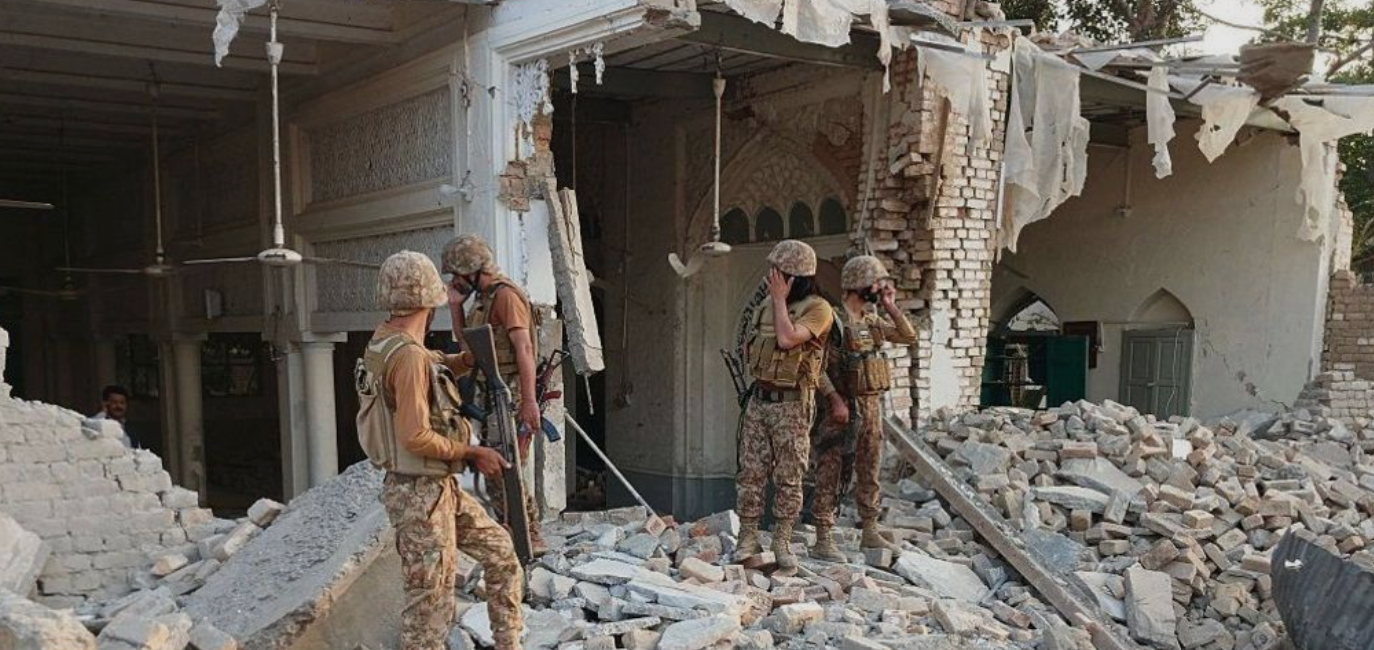

There are moments when governance is measured not through speeches, slogans or political mobilisation, but through presence, judgment and priorities. The terrorist assault on Kohat’s Old Police Lines on September 18 was one such moment. Twenty-one people were killed, including 15 police personnel and six civilians, when an explosives-laden vehicle struck near a mosque during Friday prayers and armed attackers subsequently entered the compound. More than 100 people were injured. Among the dead were SP Traffic Akbar Shinwari and Dr Israel Orakzai, a senior paediatrician serving the district. The attack was therefore not merely an assault on a police installation. It struck policemen, civilians, medical professionals and families gathered around one of the province’s most important security institutions.
Later that evening, funeral prayers were offered for the 15 slain police personnel before their bodies were sent to their native districts. Media coverage reported the presence of senior police and provincial officials. Chief Minister Sohail Afridi, meanwhile, condemned the attack, requested a detailed report from police authorities and instructed officials to ensure treatment for the wounded. These were appropriate administrative steps. Yet an incident of this magnitude inevitably raises a broader question about executive leadership.
At a time when policemen were being buried after an attack on the heart of the provincial security apparatus, what should command the immediate attention of the province’s chief executive?
That question has acquired added significance because the attack came during an intense period of political mobilisation. PTI had announced preparations for a September 27 march towards Islamabad, while Afridi was scheduled to undertake a multi-city tour of Punjab as part of the mobilisation effort. Reports said the original programme covered 13 cities and included stops across Mianwali, Khushab, Sargodha, Faisalabad, Sheikhupura and Lahore, although elements of the itinerary were subsequently altered.
There is nothing unusual in a political leader participating in party affairs. Political organisation, peaceful protest and mobilisation are part of democratic politics. The issue becomes more complicated, however, when the political leader concerned is also the chief executive of a province facing a sustained terrorism challenge. A chief minister does not cease to be a political figure after entering office, but public office imposes an additional responsibility. When a province is confronting repeated attacks on police stations, checkpoints and security personnel, political activity must coexist with the continuous requirements of administration, intelligence coordination, policing and crisis management.
Kohat makes this distinction particularly important. The terrorists did not attack an isolated rural post. They penetrated the Police Lines complex, where sensitive police and Counter-Terrorism Department facilities were located. Police said attackers entered the compound after the initial explosion, forcing security personnel into an extended clearance operation. Such an attack demands more than condemnation.
It requires a security review asking how the attackers approached such a protected facility, whether threat assessments had identified vulnerabilities, whether perimeter security was adequate and whether intelligence was converted into preventive action
These are fundamentally questions of governance. They involve police leadership, the Home Department, CTD, district administration, intelligence coordination and ultimately the provincial executive. The chief minister does not personally guard police installations, but the office bears political responsibility for ensuring that institutions have the resources, policy direction and administrative support required to perform their duties.
The debate over political mobilisation also intersects with a recent Islamabad High Court ruling concerning the use of public resources for political marches. In its detailed judgment regarding the planned September 27 protest, the court held that government resources and officials could not be deployed to facilitate political processions towards Islamabad. It also referred to previous episodes in which provincial resources and police participation had complicated the security situation in the federal capital.
Following the court directions, the Khyber Pakhtunkhwa chief secretary issued instructions barring the use of public funds, government vehicles, machinery, equipment or officials for the march
The principle involved deserves attention beyond party politics. Police personnel are public servants. Their vehicles, weapons, training and deployment are funded to protect citizens and enforce the law. In a province where officers are themselves frequent targets of terrorism, every decision concerning police deployment carries an opportunity cost. Personnel assigned away from core policing responsibilities may not be available elsewhere. Vehicles used for one purpose cannot simultaneously support another. Senior commanders preoccupied with political mobilisation cannot devote the same institutional attention to counterterrorism operations. This is precisely why the separation between partisan politics and state resources matters.
Afridi himself has repeatedly emphasised the scale of Khyber Pakhtunkhwa’s sacrifices. He has said that nearly 80,000 lives have been lost in the struggle against terrorism and described the province as Pakistan’s frontline in that fight. Whatever figure one adopts from different historical datasets, the underlying point is difficult to dispute. KP has endured an extraordinary human and economic burden from militancy over the past two decades.
That history should shape the province’s priorities. A region facing such a persistent threat needs a counterterrorism policy that goes beyond reactions after every attack. Police infrastructure requires continuous protection audits. CTD needs intelligence, technology, training and forensic capacity. Threat information must move quickly between provincial and federal agencies. Vulnerable installations require hardened access control. Families of fallen police personnel need timely compensation and long-term institutional support.
Most importantly, the public deserves measurable answers about what changed after each major attack
The Kohat tragedy should therefore not become another brief cycle of mourning followed by political argument. Nor should legitimate questions about governance be reduced to partisan point-scoring. The central issue is institutional responsibility. Political parties will continue to hold rallies, organise marches and contest power. That is normal in a democracy. But the obligations attached to executive office are different.
When 15 police officers are carried from a funeral ground in coffins, the most urgent political message is already visible. It is the sacrifice of the men expected to hold the front line against terrorism. The province’s leadership must demonstrate, through decisions rather than statements alone, that protecting those officers and the citizens they serve remains at the centre of government attention.