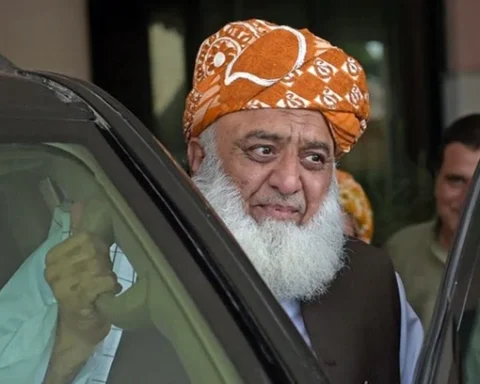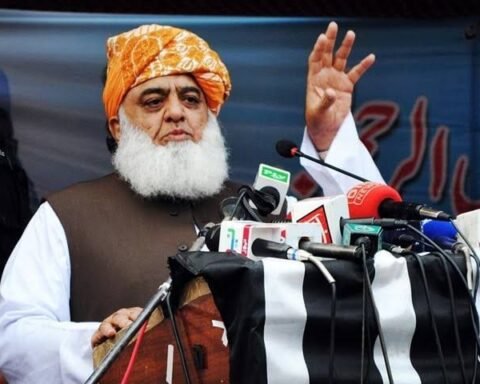
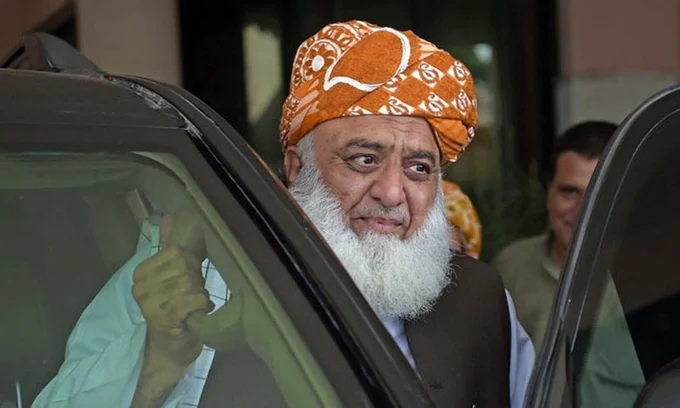

There is an old saying in Pakistani politics: you can tell a lot about a man not by what he says, but by who cheers when he says it. By that standard, Maulana Fazlur Rehman has some serious explaining to do.
Afghan media and hostile platforms have been amplifying Maulana’s anti army remarks with barely concealed enthusiasm. When the TTP and their sympathizers celebrate your statements and share them across their networks, it is no longer purely a matter of domestic political dissent. It becomes a question of national responsibility, one that a seasoned politician of Maulana’s standing cannot simply wave away by claiming his words were “taken out of context.”
Let us be fair. Maulana Fazlur Rehman is not a newcomer to politics. He has decades of experience navigating Pakistan’s complex political landscape, and his party has deep roots among religious communities in Khyber Pakhtunkhwa and Balochistan. He deserves to be heard, and his concerns about governance, about the wellbeing of Pashtun communities, and about the constitutional process deserve a serious response. Defence Minister Khawaja Muhammad Asif himself termed Maulana’s recent statement about military personnel “highly irresponsible” and “an insult to the immense sacrifices of the martyrs” and that reaction reflects how seriously the establishment is taking this moment.
But seriousness cuts both ways. If Maulana wants to be taken seriously as a statesman, he must ask himself an honest question: what is the difference between legitimate political criticism and handing ammunition to those who want to destabilize Pakistan? The answer is not ideological. It is practical. He has argued publicly that military institutions must understand that deal making is the domain of politicians, and that force should only be directed by political leadership. Fine, but political leadership also carries a burden: the burden of knowing that your words travel further than your intention.
The timing and trajectory of Maulana’s recent political turns are difficult to ignore. Just days before KP’s emergency was imposed, Maulana went to meet the Prime Minister, reportedly advising the government against imposing governor’s rule or an emergency, calling it a last resort. He was, in other words, a mediator. Then the emergency happened. And almost overnight, the mediator became the most vocal critic. One has to ask: what changed in those twenty four hours? Was it principled outrage, or was it the realization that there was no share in the new arrangement?
His claim that the emergency in tribal areas is somehow linked to American designs on Pakistan’s mineral wealth is exactly the kind of sweeping allegation that fires up crowds at rallies but cannot survive five minutes of scrutiny. The Pakistan U.S. minerals cooperation framework was established in September 2025. The KP emergency was imposed in October 2026. The Defence Minister has categorically stated that not a single mining contract has been awarded to any American company. If Maulana has evidence to the contrary, a specific lease, a signed document, a government notification, he should present it. If he does not, then invoking “America” in every political season is not analysis; it is theatre.
Then there is the question of his sudden warmth toward PTI. Not long ago, PTI supporters were calling Maulana “Diesel” and a “hypocrite” at their rallies, while the government scrambled to keep the two parties from forming an alliance, recognizing such a combination as politically dangerous. Maulana himself was still calling the parliament “puppets” while hinting at an alliance post Eid. Now the two parties march together. What exactly has changed between PTI and JUI F in terms of principles? Nothing. What has changed in terms of mutual political interest? Everything.
This is not an accusation of treason. Allegations of that severity require evidence and due legal process, not political rhetoric. But it is a legitimate demand for clarity. At a time when Pakistan’s security situation remains gravely serious, with over 82 percent of terrorism related deaths in 2023 attributed to the TTP, its subsidiaries, and the Islamic State Khorasan, careless statements by senior political figures carry real consequences. The Pashtun communities of KPK and the tribal belt are not abstractions in a political speech. They are real people burying real coffins. They deserve a politics that serves them, not one that uses their grief as electoral fuel.
Balochistan Chief Minister Sarfraz Bugti, himself a leader operating in one of the most terrorism scarred provinces in the country, has consistently praised security forces while also reaching out to those willing to lay down arms. His message on national security has been clear: political differences are legitimate, but undermining the institutions fighting terrorism is not. He has warned that such statements strengthen the enemy’s narrative and contradict national unity. Coming from someone who governs a province where soldiers die weekly, this is not political posturing; it is lived reality.
Maulana Fazlur Rehman has the right to oppose. He has the right to criticize policy. He has the right to organize and protest. What he does not have the right to do, morally, if not legally, is to make statements that hostile platforms use as propaganda against Pakistan while pretending the consequences are someone else’s problem.
Leadership means owning the full impact of your words, not just the parts that serve you in the next election cycle.
Pakistan’s security forces are paying in blood every single week.
The least that any politician, of any party, any ideology, owes them is the dignity of not becoming the headline on enemy media.
The Pashtuns of this country have suffered enough. They do not need a political leader who speaks for them only when the cameras are rolling and the opposition alliance needs numbers. They need someone who will stand with them consistently, whether that means confronting the government or confronting the TTP terrorists who are murdering their children. Half measures and shifting alliances have already cost this nation too much. It is long past time for leaders of Maulana’s stature to decide, once and for all, which side of history they want to stand on.