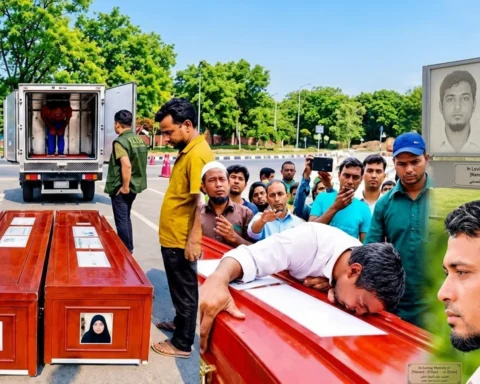
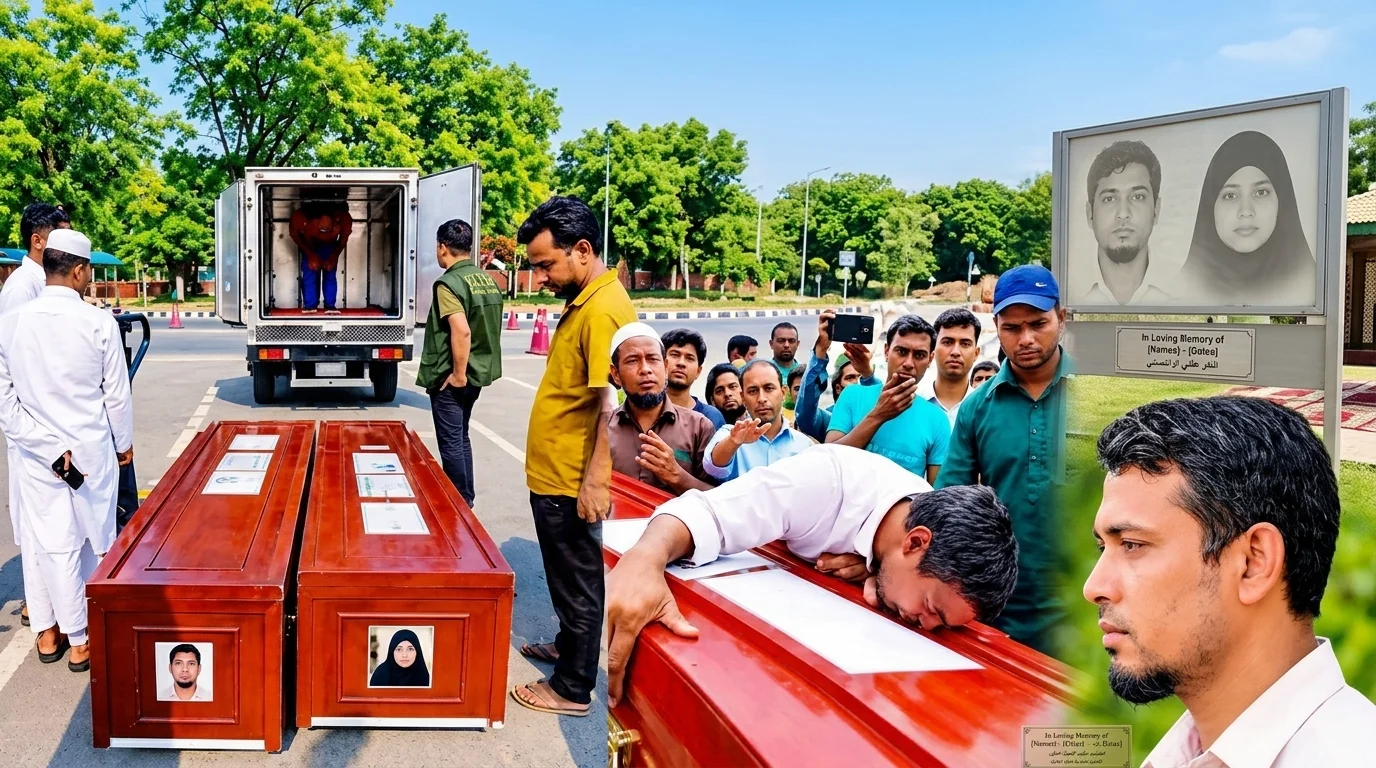

On October 14, 2026, Saudi Arabia executed two Bangladeshi nationals, Nazrul Islam Abdul Basir and Siti Akhtar, in the Mecca region following convictions for committing indecent acts inside a mosque. Saudi Arabia’s Interior Ministry announced the executions and confirmed that the pair were sentenced to death under ta’zir, discretionary punishment in Islamic law. Before the day was over, the world was already living inside a completely different story, one that had almost no connection to what actually happened.
A photo showing a couple at the Masjid al Haram was being widely shared on social media, claiming to show the executed Bangladeshis. The viral caption described the act as Nazrul “kissing his pregnant wife’s belly” inside the mosque. Earlier social media claims suggested that Nazrul and Sweety were married and that the incident involved little more than kissing on the forehead during Umrah. A video of a man and a woman near Al Hajar Al Aswad went viral, attributed to the executions, which the official media account of the Holy Mosques later confirmed was misleading.
None of it was true. And the speed at which fabricated versions of this story circulated tells us something deeply troubling about the information ecosystem we now inhabit.
Let us begin with what is actually confirmed. Nazrul Islam Basir, 25, from Brahmanbaria, was the eldest son of Abdul Basir and Rahima Begum. His family confirmed he had been arrested around eight months after leaving for Saudi Arabia and had remained imprisoned until his execution. Nazrul’s father denied that he was married to Siti Akhtar, he said the family did not even know her. It was never confirmed whether the couple was married to each other. The romantic “newlywed couple punished for a forehead kiss” story, the version that spread across millions of accounts in hours, was directly contradicted by the family of the man himself.
The verdicts became final after being upheld by the relevant judicial authority, and a royal order was issued authorising their implementation. This was not a rushed decree. Nazrul was arrested on August 1 and Sweety the following day, with both remaining in Jeddah prisons from that point until execution. That represents a legal process spanning over three years, hardly the impulsive brutality the viral narrative implied.
The fact checking community worked quickly but was overtaken by the volume of the false content. Research clearly established that a viral video linked to the executions, featuring two other individuals entirely, was fabricated and false. An old photo of an unrelated couple was being falsely linked to the executions, with no explicit mention in the actual Saudi statement of the relationship between the man and woman, or the manner of execution. This is the anatomy of modern disinformation: take a real event, strip it of its specific facts, rebuild it with emotionally manipulative fictions, then flood the network before corrections can reach the same audience.
This pattern is not accidental, and it is not new. Research by Rumor Scanner found at least 155 instances of disinformation about Bangladesh across various Indian media and social platforms in 2025 alone, with social media accounts on X spearheading communal propaganda campaigns. The Mecca executions became a new node in an already well established disinformation network, this time directed not just at Bangladesh but at Saudi Arabia, at Islamic jurisprudence, and by extension at the credibility of Shariah based governance itself.
The legitimate questions in this case deserve honest engagement. Bangladesh’s State Minister for Foreign Affairs raised the question of why Saudi Arabia failed to notify Dhaka prior to carrying out the capital punishment, invoking Articles 36 and 37 of the Vienna Convention on Consular Relations, which mandate host countries to notify foreign consulates when foreign nationals face capital proceedings. Neither the Ministry of Foreign Affairs in Dhaka nor the Bangladesh mission had received advance notification from Saudi authorities. These are real procedural concerns, and they deserve to be addressed through proper bilateral channels.
Bangladesh has sought an explanation from Saudi Arabia, requesting copies of court judgments, details of charges, and clarification about why its diplomatic mission was not notified before the executions took place. This is the right response, measured, institutional, and grounded in actual legal frameworks. Legal experts have noted that the Vienna Convention does not oblige a state to give prior notification of every execution, though notification of detention and death remains an obligation under the Convention. The distinction matters. It creates space for a serious diplomatic conversation rather than performative outrage.
What is deeply irresponsible, however, is allowing fabricated grief to substitute for genuine accountability. The viral misinformation surrounding this case achieved exactly the opposite of justice. It made it harder to ask the real questions, about consular access, about the nature of the evidence considered, about what legal representation was available, because the information space was already saturated with fiction. When a fact checker has to spend their time debunking a fake photograph before they can even discuss the actual case, the disinformation campaign has already won a partial victory.
Saudi Arabia describes the executions as lawful enforcement of its judicial system and the protection of a holy site, while critics counter that opaque proceedings and missing notification undermine that claim. Both positions can be held simultaneously without descending into fabrication. The sanctity of the Haram is a genuine Islamic value. The procedural rights of migrant workers facing capital charges are also a genuine obligation. These are not contradictory concerns, they are complementary ones that serious people can and should debate honestly.
Bangladesh must ensure that when an individual receives a death sentence abroad, the diplomatic mission is promptly alerted so that it can investigate, acquire legal aid, and pursue all available options. The way forward includes seeking a formal notification arrangement, so that prompt notice of arrest, charge, sentence, and execution date becomes standard in any bilateral labour or consular agreement. That is the constructive outcome this case should produce.
What it should not produce is a weaponised information environment where every action by an Islamic judicial system becomes raw material for a pre packaged narrative of barbarism. The people who engineered the fake photographs, the invented family relationships, and the manipulated video clips were not seeking justice for Nazrul Islam or Siti Akhtar. They were seeking to manufacture a story that served a different purpose entirely.
The truth of this case is complicated enough to demand serious attention. The lies told about it were simple enough to travel at the speed of a share button. That gap, between complexity and simplicity, between reality and weaponised fiction, is precisely where modern disinformation lives. Closing it requires more than fact checks after the fact. It requires audiences, institutions, and media ecosystems committed to the harder work of waiting for what is actually true before deciding what to feel.