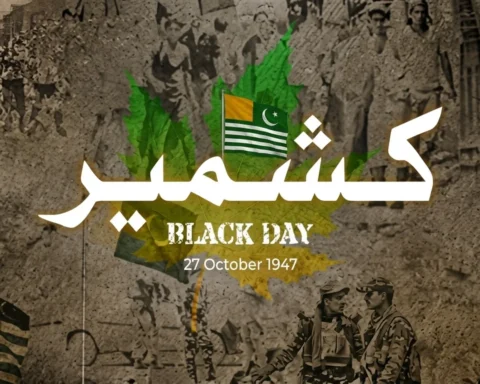
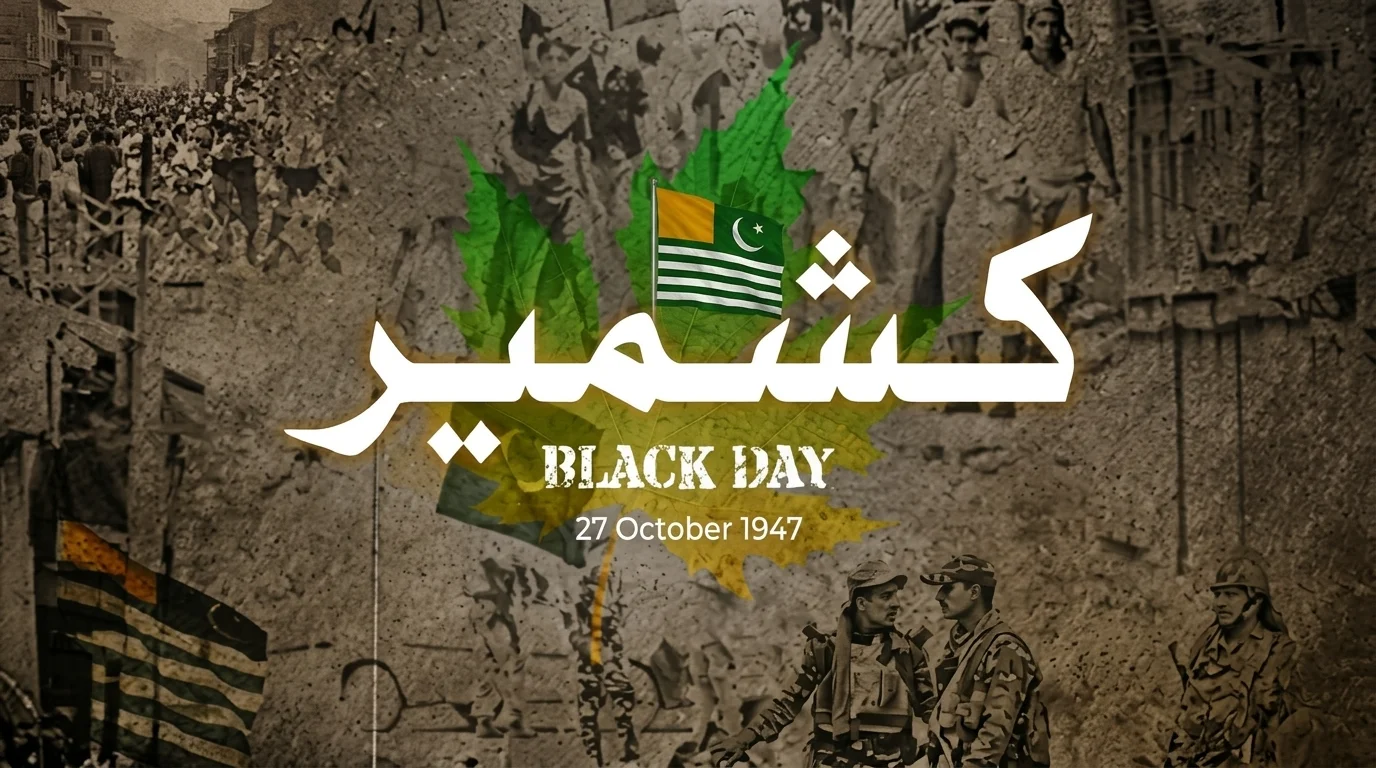

Every year on October 27, something quiet but deeply felt happens across Pakistan, across Azad Jammu and Kashmir, and in Kashmiri communities scattered around the world. Black flags go up. Rallies are held. Speeches are delivered. But perhaps most powerfully, people simply pause and remember.
This year marks 79 years since Indian forces landed in Srinagar. Seventy nine years. Nearly eight decades of a dispute that the United Nations itself promised to resolve through a free and impartial plebiscite, a promise that, to this day, remains unfulfilled.
Pakistan’s Prime Minister Shehbaz Sharif, speaking on the occasion, described October 27, 1947 as the beginning of a “tragic chapter” in the history of Jammu and Kashmir, one that continues to cast a long shadow over the entire region. That shadow is not metaphorical. It falls on real people: Kashmiri political leaders and activists held in prolonged incarceration, ordinary men and women living under what human rights organisations and UN bodies themselves have documented as heightened militarisation and suppression of fundamental freedoms.
The question worth asking today, seriously and honestly, is not whether this dispute exists. It does. It is recognised in international law, in UN Security Council resolutions, and in the lived experience of millions. The real question is: why does the world keep looking away?
A Day Etched in Blood and Betrayal
To understand why October 27 carries so much weight, you have to go back to the chaos of Partition. In October 1947, as the subcontinent was being cleaved into two nations, the princely state of Jammu and Kashmir remained undecided. Its ruler, Maharaja Hari Singh, had signed a Standstill Agreement with Pakistan but was vacillating on accession. Then, on October 27, Indian military forces arrived in Srinagar, an arrival that Kashmiris across both sides of the Line of Control and their supporters worldwide remember not as a rescue, but as the start of an occupation.
India’s Governor General at the time, Lord Mountbatten, had conditionally accepted the Maharaja’s instrument of accession with a clear commitment: once order was restored, the question of accession would be settled by a referendum in which the will of the Kashmiri people would be ascertained. That referendum, a promise enshrined in the very foundation of the dispute, was never held.
The United Nations Security Council passed multiple resolutions demanding that a plebiscite be held. Experts and legal scholars across both sides of the conflict acknowledge that those resolutions were never implemented. As experts and lawmakers reaffirmed this year, the UN has a standing, unfulfilled commitment to the people of Jammu and Kashmir, and that obligation does not expire with the passing of decades.
October 27 is not observed as Black Day out of mere sentiment. It is a legal, moral and political protest against a broken promise that continues to define the lives of millions.
August 5, 2019 When the Ground Shifted Again
If October 27, 1947 was the wound, then August 5, 2019 was salt rubbed into it. On that day, the Indian government unilaterally revoked Article 370 of its constitution, the provision that had granted Jammu and Kashmir a degree of special autonomous status. In a single parliamentary manoeuvre, occupied Kashmir’s legislative protections were stripped away, and the territory was bifurcated into two union territories under direct central government control.
Deputy Prime Minister and Foreign Minister Ishaq Dar, in his statement on Kashmir Black Day 2026, was unambiguous: India’s unilateral measures of August 5, 2019 had aggravated the situation in the disputed territory, intensified the suffering of its people and could not alter the region’s disputed status under international law. Pakistan’s National Assembly, in a unanimous resolution passed on October 27, 2026, also firmly rejected those actions as illegal attempts to change the demographic character of occupied Kashmir.
The concerns are not merely political. President Asif Ali Zardari this year pointed to continuing restrictions on fundamental freedoms, heightened militarisation, arbitrary arrests, and reports of human rights violations as ongoing realities that demand sustained international attention. These are not allegations made in isolation. The United Nations Office of the High Commissioner for Human Rights documented systematic violations in detailed reports, corroborated by independent human rights organisations operating in the region.
Kashmiri political leaders remain incarcerated. Journalists face restrictions. The ordinary rhythm of life for millions of people continues to be disrupted by the weight of an unresolved conflict that the world’s most powerful institutions have repeatedly recognised, but failed to resolve.
Pakistan’s Voice and the Plebiscite That Must Happen
Pakistan’s position on Kashmir, as Prime Minister Shehbaz Sharif reiterated this year, is clear, consistent and principled: lasting peace and stability in South Asia cannot be achieved without a just resolution of the dispute in accordance with relevant UN Security Council resolutions and the freely expressed wishes of the Kashmiri people.
This is not a new position. It has been Pakistan’s diplomatic cornerstone for nearly eight decades. But what sets the 2026 observance apart is the breadth and urgency with which that position was expressed, not just by the executive branch, but by the National Assembly in a unanimous resolution, by PPP Chairman Bilawal Bhutto Zardari who questioned when the international community would finally act on its own recognised obligations, and by Pakistan’s diplomatic missions from Beijing to Ottawa and beyond.
India has countered by pointing to elections held in occupied Kashmir, but Pakistan’s ambassador in Beijing was direct in rejecting those polls as a substitute for the UN supervised plebiscite that international law requires. And that distinction matters enormously. An election held under occupation, with fundamental freedoms curtailed and political leaders imprisoned, cannot credibly represent the will of a people. A genuine plebiscite, free, fair, internationally supervised, is an entirely different proposition.
Dar’s message also carried a clear call to the international community: fulfil your responsibilities, take sustained notice of the human rights situation in IIOJK, and press for an end to violations and an exercise of the right to self determination. Letters were sent to the UN General Assembly President, the UN Security Council President, the Secretary General, the UN High Commissioner for Human Rights, and the OIC Secretary General. This is not rhetoric, it is a structured diplomatic effort that deserves to be taken seriously.
The dispute cannot be resolved through unilateral actions or force. That point, reiterated across every statement issued by Pakistan’s leadership today, is not only a political position, it is a principle enshrined in the UN Charter itself.
The World Cannot Keep Waiting
There is something deeply uncomfortable about the ease with which the international community has learned to live with the Kashmir dispute. Generation after generation of Kashmiris has grown up under its shadow, and generation after generation of world leaders has delivered statements of concern while the underlying reality barely shifts.
Bilawal Bhutto Zardari put it with quiet force: Kashmir’s children deserve a future of freedom, peace and a life free from fear, not another prolonged wait to decide their own future. That is not a political slogan. It is a human reality.
Neither time, nor repression, nor unilateral action can extinguish the legitimate aspirations of the Kashmiri people. The National Assembly’s resolution this year stated it plainly, and it echoes what Kashmiris themselves have maintained across seven decades of resistance: the question will not disappear by being ignored.
The path forward, as Pakistan has consistently argued, runs through dialogue, through international engagement, and ultimately through a free plebiscite in which the Kashmiri people themselves choose their future. No amount of demographic engineering, administrative restructuring or electoral exercises under occupation can substitute for that fundamental act of self determination that the world promised and then quietly forgot.
On October 27, 2026, as Pakistan and Kashmiris worldwide mark Black Day for the seventy ninth time, the message remains unchanged and undiminished: the promise made to Kashmir must be kept. Not as a favour. Not as a concession. But as a matter of international law, human dignity and basic justice.