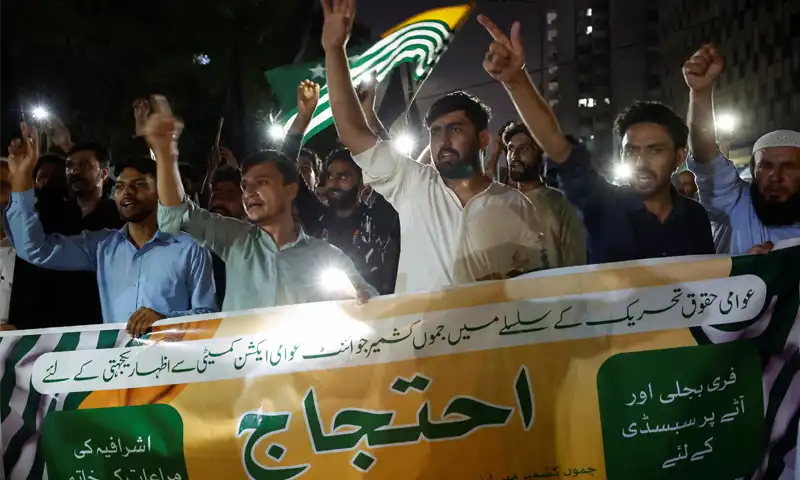

In Azad Jammu and Kashmir, public concerns over inflation, electricity bills, administrative reforms and basic facilities were real, serious and worthy of urgent attention. No responsible government can dismiss public frustration when ordinary citizens face rising costs, weak services and institutional inefficiency. That is precisely why the agreement between the government and the Joint Awami Action Committee was important. Its purpose was to move public demands from street pressure into a legal, administrative and phased process of implementation. Once that process began, the responsible path should have been monitoring, dialogue and accountability. Instead, the strike call for June 9, 2026, raises a difficult but necessary question: is this still a movement for public rights, or has it become a platform for personal politics?
The record presented by the government shows that several major demands have already moved beyond promises. According to official claims, 177 FIRs have been withdrawn, while compensation of more than Rs. 118 million has been paid to the heirs of those who lost their lives and to the injured. Relief has also been extended in the electricity sector through the implementation of the 5KW tariff adjustment, the removal of surcharges, and the division of outstanding electricity dues into 36 instalments. Electricity arrears linked to the Mangla Dam project have reportedly been waived, while the health card facility has been extended to the people of Kashmir.
These are not symbolic gestures; they are administrative and financial measures with direct public impact
Administrative reforms have also been initiated. The number of departments has been restricted to 22, the cabinet size has been reduced to 20 ministers, and an open merit policy has been introduced for admissions and employment. In the development sector, projects worth billions of rupees have entered practical stages, including MRI and CT scan projects worth Rs. 5.5 billion, a hospital upgradation programme of Rs. 2.8 billion, power system improvement projects worth Rs. 10 billion, feasibility studies for Neelum Valley and Kahuta–Azad Pattan roads, and multiple water supply schemes. Such projects cannot be completed overnight. Feasibility studies, PC-I preparation, CDWP approvals, tendering and implementation are technical steps that require time, documentation, scrutiny and funding channels.
This is where the conduct of the JAAC leadership becomes questionable. If demands are being implemented, relief has been given, and major projects are moving through formal stages, then why push the region back toward shutdowns and confrontation? Leaders such as Shaukat Nawaz, Sardar Umar and Amanullah have every right to question the government, but they also carry a public responsibility not to mislead people by presenting every technical delay as deliberate failure.
A political movement that refuses to acknowledge progress risks becoming less about public welfare and more about preserving its own relevance
Every strike has a cost, and that cost is rarely paid by those who announce it. The daily-wage labourer loses income. The shopkeeper loses sales. Students lose class time. Patients suffer because transport, pharmacies and health services are disrupted. Public transport workers, small traders, schoolchildren, hospital visitors and ordinary families carry the burden. Meanwhile, protest leaders gain visibility, media attention and political leverage. That imbalance must be questioned. A movement cannot claim to defend the public while repeatedly asking the same public to absorb the damage.
The most troubling feature of this politics is the attempt to keep anger alive even when solutions have begun. There is a difference between demanding implementation and manufacturing permanent crisis. If every administrative step is dismissed as deception, every project timeline is called failure, and every reform is ignored, then the objective no longer appears to be resolution. It begins to look like a strategy of agitation for agitation’s sake. Some leaders may fear that once issues are resolved, their political space will shrink.
In that case, public grievances become not a cause to be solved, but fuel to keep a political shop open
Even more dangerous is the reported shift of the Action Committee toward constitutional matters and the nature of Kashmir’s relationship with Pakistan. This goes far beyond electricity bills, flour prices, taxes or service delivery. When a movement that began with economic and administrative demands begins entering sensitive constitutional territory, citizens have the right to ask what its real destination is. Public rights must not be used as a cover for instability, confusion or narratives that weaken Kashmir’s larger political position.
The people of Azad Kashmir deserve relief, transparency and accountability. They also deserve peace, open markets, functioning schools, active hospitals and development projects that reach completion. They should ask whether another shutdown will accelerate road projects, hospital upgrades, water schemes or electricity reforms, or whether it will delay them further.
They should ask whether JAAC leaders are telling the full truth about feasibility, PC-I, CDWP and tendering processes, or simplifying technical realities to inflame public emotion
The central question is simple: when progress has been made on 32 points, when FIRs have been withdrawn, compensation paid, tariff relief granted, surcharges removed, arrears rescheduled, health cards extended, open merit introduced and development schemes pushed into formal stages, why insist on another strike? If the answer is public welfare, then the strategy should be constructive monitoring, not shutdown. If the answer is political pressure before elections, then the public should recognize it for what it is.
A common Kashmiri must now decide whether his future lies with peace, work, education, healthcare and development, or with repeated calls for closure that damage his livelihood. A strike in which the public suffers and others benefit cannot automatically be called a people’s movement. Kashmir needs leadership that solves problems, not leadership that survives by keeping problems alive.