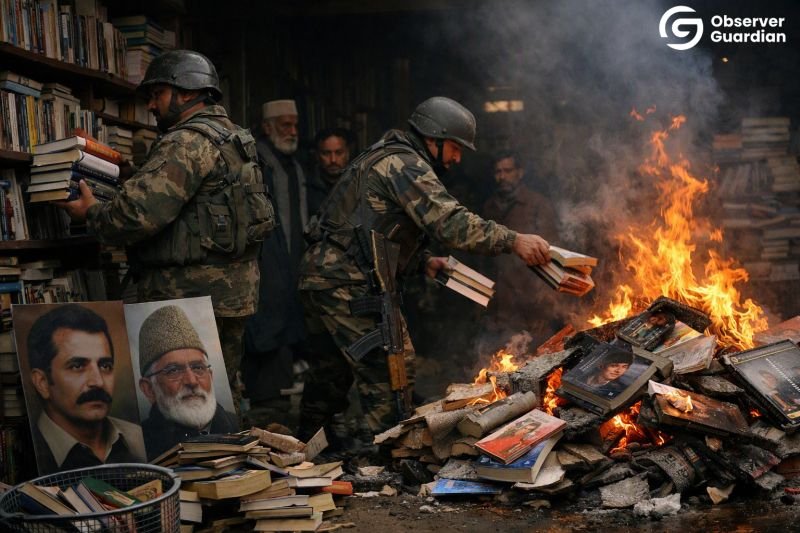
Indian forces have begun an intellectual robbery in IIOJK, removing books referencing Kashmiri Muslim identity, Maqbool Bhat, and Syed Ali Shah Geelani. The Modi regime, acting as a modern Lord Macaulay, seeks to rewrite history. Kashmiri scholars, civil society, and Mirwaiz Umar Farooq condemn this assault on academic freedom and cultural identity.
Throughout history, empires seeking total dominance over a populace have recognized that physical occupation alone is never enough. To truly subdue a nation, one must conquer its mind, rewrite its historical archives, and erase the literary footings of its collective consciousness.
What is currently unfolding in Indian Illegally Occupied Jammu and Kashmir (IIOJK) represents a calculated, aggressive campaign of intellectual robbery.
Under the guise of maintaining administrative control and state security, occupation forces have initiated a systematic crackdown on books, libraries, and academic discourse, attempting to purge Kashmir’s rich, multi layered identity from the public record.
Modern Macaulayism: Engineering Historical Amnesia
The Modi administration’s approach to IIOJK increasingly mirrors the colonial strategies of the 19th century. Much like Thomas Babington Macaulay sought to replace indigenous Indian knowledge systems with an imperial curriculum designed to produce submissive subjects, today’s policy directives in Kashmir aim to redefine what Kashmiris are permitted to read, remember, or research.
By policing ideas and removing literature from bookstores, school curricula, and public libraries, New Delhi is attempting to manufacture a political narrative rooted in Hindutva ideology. Historical figures who articulated Kashmir’s socio political aspirations such as Maqbool Bhat and Syed Ali Shah Geelani along with reference works documenting the distinct Muslim heritage of the valley, are being systematically scrubbed from official repositories. Authors, historians, and academics who detail the living realities of the region find their works criminalized, transforming library shelves into battlegrounds of memory versus erasure.
Escalation of Literary Surveillance
This intellectual blockade is not an isolated policy, it is an accelerating mechanism of state sponsored censorship. Recent developments demonstrate the scope and severity of this campaign:
- Mass Proscription of Academic Works: Statutory measures such as Statutory Order 203 issued by the administration have placed blanket bans on dozens of seminal books by prominent global scholars, historians, and journalists. Works by international scholars like Sumantra Bose, Christopher Snedden, and Hafsa Kanjwal, alongside internationally recognized authors such as Booker Prize winner Arundhati Roy, have been outlawed under sweeping security statutes.
- Raids and Seizures: Armed police raids on private bookstores and commercial publishers across Srinagar and other districts have led to the confiscation of hundreds of titles containing historical analyses of the Kashmir dispute.
- Institutional Purges: In school library networks operating under programs like Samagra Shiksha, administrative crackdowns have targeted titles as foundational as Personalities and Legends of J&K. Government officials have been suspended, authors blacklisted, and entire press lines barred merely for presenting nuanced biographical entries on prominent Kashmiri figures or employing established historical nomenclature.
┌─────────────────────────────────────────────────────────────┐
│               MECHANISMS OF CENSORSHIP IN IIOJK             │
├──────────────────────────────┬──────────────────────────────┤
│ Institutional Vetting        │ Blacklisting of authors and  │
│                              │ purges of school libraries   │
├──────────────────────────────┼──────────────────────────────┤
│ Legal Proscription           │ Banning academic books via   │
│                              │ security statutes (e.g. BNSS)│
├──────────────────────────────┼──────────────────────────────┤
│ Physical Enforcement         │ Bookstore raids and police   │
│                              │ confiscation of literature   │
└──────────────────────────────┴──────────────────────────────┘
The Collective Response of Kashmiri Civil Society
This assault on academic freedom and cultural heritage has met resolute opposition from every corner of Kashmiri civil society. Religious scholars, university faculty, legal practitioners, and community leaders have spoken out against the forcible removal of their literary heritage.
Mirwaiz Umar Farooq and prominent civil society representatives have rightly characterized these bans as an existential assault on the cultural identity of the Kashmiri nation. For a people whose history spans centuries of rich literary, philosophical, and spiritual tradition, depriving the younger generation of access to their own history is viewed not merely as regulatory censorship, but as an attempt to delegitimize their very existence.
When a state criminalizes the possession of historical texts and memoirs, it signals a deep vulnerability an admission that its political stance cannot withstand open intellectual inquiry or historical scrutiny.
Why Historical Memory Cannot Be Banned
The fundamental flaw in the Hindutva project’s attempt to erase Kashmiri history lies in its misunderstanding of how collective memory functions. Literature and historical consciousness do not exist solely on physical paper, they are embedded in oral traditions, family histories, digital archives, and the lived experiences of millions.
History has repeatedly shown that banning books rarely achieves the intended submission. Instead, state enforced censorship heightens public awareness, drives critical reading underground, and reinforces the determination of an occupied people to preserve their identity. State apparatuses can suspend librarians, raid shopfronts, and purge public catalogs, but they cannot purge the deeply rooted consciousness of a nation.
The ongoing intellectual crackdown in IIOJK must be recognized for what it is an authoritarian attempt to impose cultural hegemony and silence legitimate historical narrative.
Protecting academic freedom and ensuring Kashmiris retain the right to read, write, and remember their own history remains essential to preserving the truth against ideological rewrite. Books, ultimately, outlast the governments that fear them. The ideas within those 650 seized volumes, those 25 formally banned titles, those audited theses and digital archives they will not disappear. They will be passed from hand to hand, whispered across generations, and eventually read openly again. History is patient. And the truth, however inconvenient to those in power, does not require official approval to survive.
Disclaimer: The views and opinions expressed in this article are exclusively those of the author and do not reflect the official stance, policies, or perspectives of the Platform.