
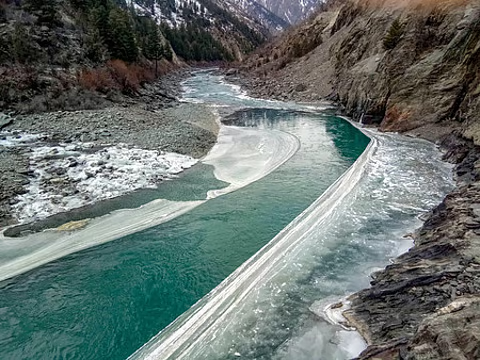

The Chenab River has long stood at the heart of Pakistan’s water security, agricultural survival, and national food system. For decades, the Indus Waters Treaty provided a legal and diplomatic framework to manage this shared river system between Pakistan and India. Yet today, that framework is under extraordinary strain. India’s decision to move ahead with major hydrological infrastructure on the Chenab basin, while holding the treaty in abeyance and withholding critical hydrological data, reflects a dangerous shift in South Asia’s water politics. What was once treated as a shared ecological responsibility is increasingly being transformed into an instrument of strategic pressure.
India’s planned investment of Rs 2,352 crores in the Chenab-Beas Link Tunnel Project in Himachal Pradesh’s Lahaul-Spiti region is particularly alarming. The proposal reportedly involves the construction of an 8.7-kilometre tunnel to divert water from the Chenab basin into the Beas river system. This is not a minor engineering intervention. It is an inter-basin diversion project on a river system whose waters are central to Pakistan’s irrigation economy under the Indus Waters Treaty. When viewed alongside India’s parallel effort to restore sediment management capability at Salal Dam, with both projects collectively valued at nearly Rs 2,600 crores, the pattern becomes difficult to ignore.
These are not isolated technical works; they represent an expanding hydraulic footprint over a river that sustains millions downstream
The most serious concern is not merely the construction of infrastructure, but the political context in which it is being pursued. India’s unilateral suspension of treaty obligations and continued refusal to share hydrological data with Pakistan strike at the heart of cooperative riparian governance. In transboundary river systems, data is not a courtesy; it is a necessity. Timely information on river flows, flood patterns, reservoir operations, and hydrological changes allows downstream communities to plan irrigation, manage crops, prepare for floods, and avoid humanitarian crises. Denying such information in a climate-stressed region is not only irresponsible, it is destabilizing.
For Pakistan, the implications are severe. The Chenab feeds one of the world’s largest irrigation networks and supports vast agricultural zones that produce wheat, rice, cotton, and other essential crops. Any alteration in flow timing, seasonal availability, or sediment behavior can affect sowing cycles, canal operations, groundwater recharge, and rural livelihoods. Pakistan’s food security is already vulnerable to climate change, erratic monsoons, glacial melt, and population pressure.
Under these conditions, unilateral upstream control over western rivers does not remain a technical matter; it becomes a direct threat to economic resilience and human security
India may present these projects as development initiatives, engineering upgrades, or water management measures. However, the absence of transparency makes such explanations difficult to accept at face value. When a state expands its capacity to regulate, divert, or manipulate downstream flows while refusing to engage fully under an existing treaty mechanism, suspicion is inevitable. The Chenab-Beas Link Tunnel and the Salal Dam works together suggest a strategic effort to enhance India’s control over the Chenab system. This undermines the legal spirit of the Indus Waters Treaty and erodes confidence in rules-based water cooperation.
The broader danger is the normalization of unilateral hydro-political behavior. If India can suspend treaty cooperation and simultaneously advance projects affecting rivers allocated to Pakistan, the precedent is deeply troubling. It weakens one of the most durable water-sharing arrangements in modern history and signals to other upstream states that treaties can be treated as optional during political disputes.
In a region as sensitive as South Asia, where two nuclear-armed states already face recurring tensions, the weaponization of water is an especially reckless path
Climate change makes the situation even more urgent. Himalayan glaciers are retreating, rainfall patterns are becoming more unpredictable, and extreme floods and droughts are increasing in frequency. These realities demand more cooperation, not less. Shared rivers require shared monitoring, joint risk assessment, early-warning systems, and institutional trust. India’s current approach moves in the opposite direction. It converts environmental vulnerability into geopolitical leverage and leaves downstream populations exposed to uncertainty.
The international community must not remain silent. The Indus Waters Treaty is not merely a bilateral document; it is a global example of how hostile neighbours can manage shared resources through law and institutional discipline. If that framework is allowed to weaken without consequence, the message to the world will be dangerous: powerful upstream states can disregard treaty obligations when politically convenient.
Such a precedent would have implications far beyond South Asia, affecting river basins in Africa, the Middle East, Central Asia, and elsewhere
Pakistan must respond with diplomatic clarity, technical preparedness, and international legal engagement. It should document the hydrological, agricultural, and ecological risks of these projects, mobilize treaty mechanisms, engage neutral experts where necessary, and raise the matter in relevant international forums. At the same time, Pakistan must strengthen its own water governance through better storage, efficient irrigation, flood planning, and climate adaptation. Defending treaty rights abroad must be matched by reform and resilience at home.
The Chenab is more than a river. It is a lifeline for Pakistan’s farms, communities, and food supply. India’s expansion of diversion and flow-control infrastructure amid treaty suspension is a serious warning sign. Water must not be turned into a weapon of coercive diplomacy. In a region already burdened by history, conflict, and climate stress, the path forward lies in transparency, treaty compliance, and responsible stewardship. Anything less risks deepening mistrust and pushing South Asia toward a dangerous new era of water insecurity.