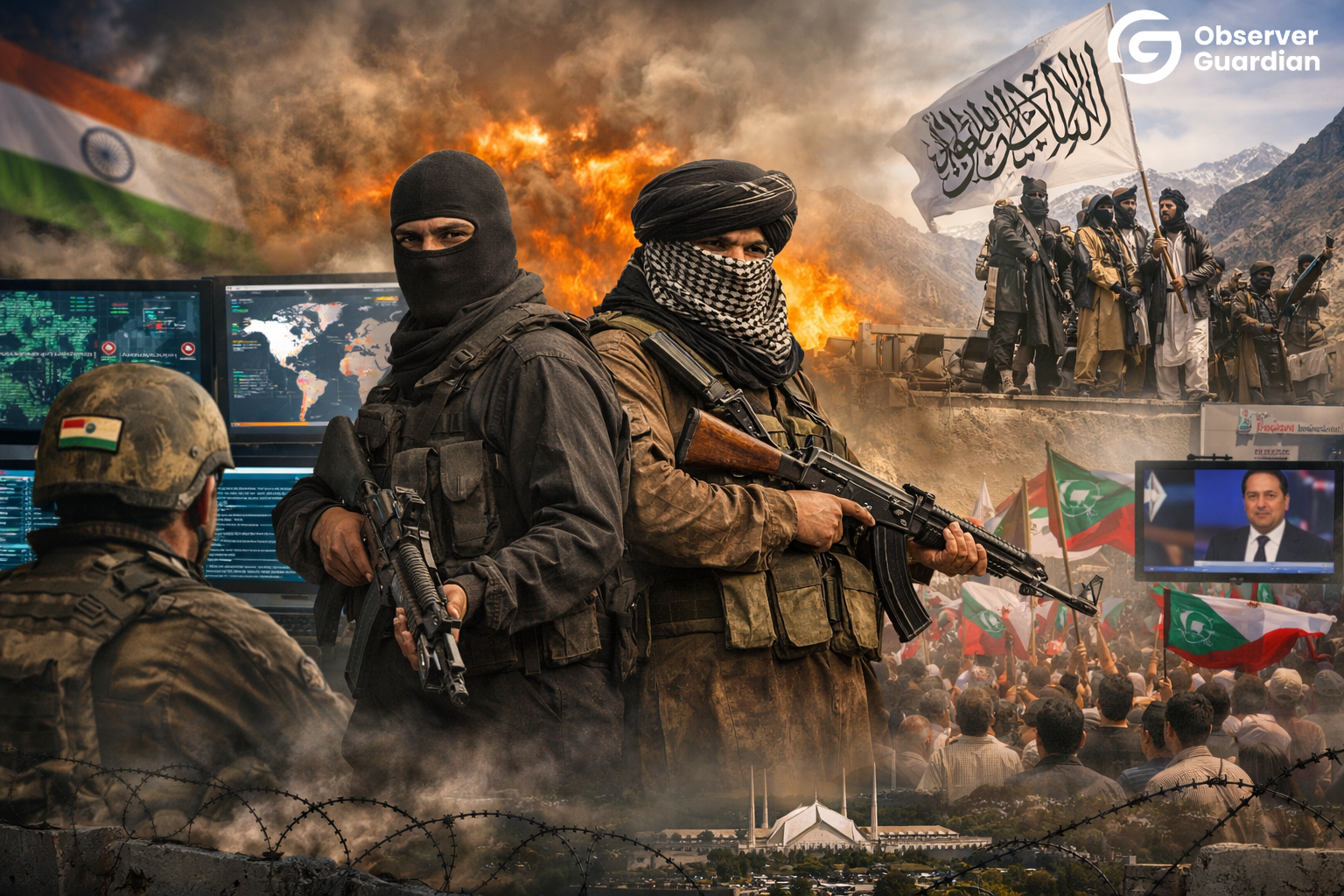

Pakistan’s soldiers are winning almost every firefight in Khyber Pakhtunkhwa and Balochistan. Yet the country keeps losing ground in a war most citizens cannot see.
This is the paradox of Fifth Generation Warfare (5GW): a conflict fought not on hilltops but inside timelines, group chats, and news feeds, where the objective is not territory but belief. A recent piece in a leading national daily, “The Field Left Open,” makes this case with unusual clarity and the data emerging from the last fourteen months only sharpens the argument.
The Numbers Behind the Narrative
Statistics from the current wave of violence tell a grim story. Between late April 2025 and early April 2026, terrorist outfits collectively designated as Khawarij carried out over four hundred drone strikes across Khyber Pakhtunkhwa alone, killing hundreds of people, security personnel, police, and ordinary civilians alike. The pattern is not random. Casualties among noncombatants have risen sharply since early 2025, with districts like Bannu, Tank, Bajaur, and Dera Ismail Khan bearing the brunt as Khawarij networks increasingly target soft, civilian locations rather than fortified military positions. This is a deliberate strategy: maximise psychological shock, minimise the cost of the attack.
In Balochistan, the picture is equally alarming. Analysts now estimate that the Baloch Liberation Army (BLA) has grown from a few hundred fighters five years ago to a force of roughly three thousand, with allied groups pushing the total insurgent strength in the province into the thousands. Early 2026 saw coordinated, multidistrict offensives, so called “Operation Herof” phases, that combined suicide bombings, hostage taking, and infrastructure sabotage across more than a dozen locations simultaneously. These are not the actions of a scattered separatist fringe; they are the actions of a networked, funded, and mediasavvy insurgency.
Security forces continue to respond with precision operations. Intelligence based raids in North Waziristan, Bannu, and Orakzai have eliminated scores of Khawarij fighters and destroyed training camps, ammunition caches, and command facilities in recent months. The state’s kinetic response remains firm and largely effective at the tactical level. But the numbers above reveal something the battlefield reports do not: this fight is expanding, not contracting, and its centre of gravity has shifted from terrain to perception.
The Cognitive Battlefield
This is where the recent analysis on 5GW deserves close attention. Its central insight is simple but underappreciated: Khawarij and BLA propaganda do not win because their arguments are strong. They win because they are the only voice speaking directly to aggrieved communities in the language of politics rather than the language of bureaucracy. The BLA’s foreign facing media wing produces polished, English language briefings aimed at parliamentarians, journalists, and diaspora audiences who have no independent way of verifying claims about Balochistan. The Khawarij media apparatus, meanwhile, produces slick video content and adapts its messaging to breaking news almost as fast as mainstream outlets.
The four part mechanism described in the original analysis is worth restating plainly, because it explains why these campaigns are so durable. First, audiences are primed emotionally. Resentment and suspicion of the state are cultivated before any specific claim is made. Second, real governance failures and administrative neglect, which exist in every province, are reframed as proof of deliberate state malice rather than ordinary shortcomings. Third, the information space is saturated so thoroughly that a counter narrative struggles to even be found. Fourth, the claims are fused with identity itself, so that questioning them feels like a personal betrayal rather than a policy disagreement.
Against this machinery, Pakistan’s mainstream political discourse offers remarkably little. Ruling parties recite infrastructure statistics and development milestones. Opposition parties recite grievances about stolen mandates and institutional interference. Both registers talk past the actual battlefield of ideas. Neither offers an elected leader standing in front of a Baloch or Pakhtun audience and directly, persuasively dismantling separatist and terrorist propaganda in their own language, on their own terms.
Why Politicians Stay Silent
The reluctance is understandable, even if it is costly. A political leader who names the BLA risks being branded, online, as merely echoing the security establishment. A leader in Khyber Pakhtunkhwa who condemns the Khawarij by name risks real electoral backlash in constituencies where the state’s presence is already contested. Short term political survival counsels silence. But silence has a price: when no elected voice enters the room, hostile narratives are not defeated in argument. They simply go unchallenged, and unchallenged narratives calcify into accepted truth for an entire generation of young people scrolling through their phones.
There are exceptions worth learning from. Balochistan’s Chief Minister has, at points, been willing to name substate actors directly and push back against diaspora driven narratives in front of Baloch audiences, without the political ceiling collapsing on him. That such an approach is possible and survivable should matter enormously to a political class that has largely opted out of this fight.
Occupying the Field
None of this diminishes the sacrifices of Pakistan’s security forces, who continue to absorb the human cost of this conflict in the mountains of Waziristan and the plains of Balochistan.
But a war fought only with drones, raids, and press releases from military spokespeople cannot, by itself, close a narrative vacuum that exists in the space of democratic politics.
Institutional communication has a role, but it is not a substitute for elected leaders with genuine public mandates standing up and contesting the story of Pakistan directly with the citizens hostile narratives are trying to recruit.
The field is still open. It will not stay empty forever. Someone will fill it. The only question is whether it will be Pakistan’s own democratic voices, or the propagandists who have, so far, faced no serious competition at all.
Disclaimer: The views and opinions expressed in this article are exclusively those of the author and do not reflect the official stance, policies, or perspectives of the Platform.