Five years have passed since Kabul fell. The images are still vivid crowds storming the airport tarmac, desperate hands gripping the wheels of departing aircraft, a nation swallowed in disbelief. Yet today, in August 2026, the more pressing question is not how the Taliban seized power, but why after half a decade the international community is still debating whether to extend them the dignity of diplomatic recognition.
The answer, articulated clearly by Australia and Canada in recent days, is as straightforward as it is sobering: there is nothing to normalize.
A Regime That Has Only Doubled Down
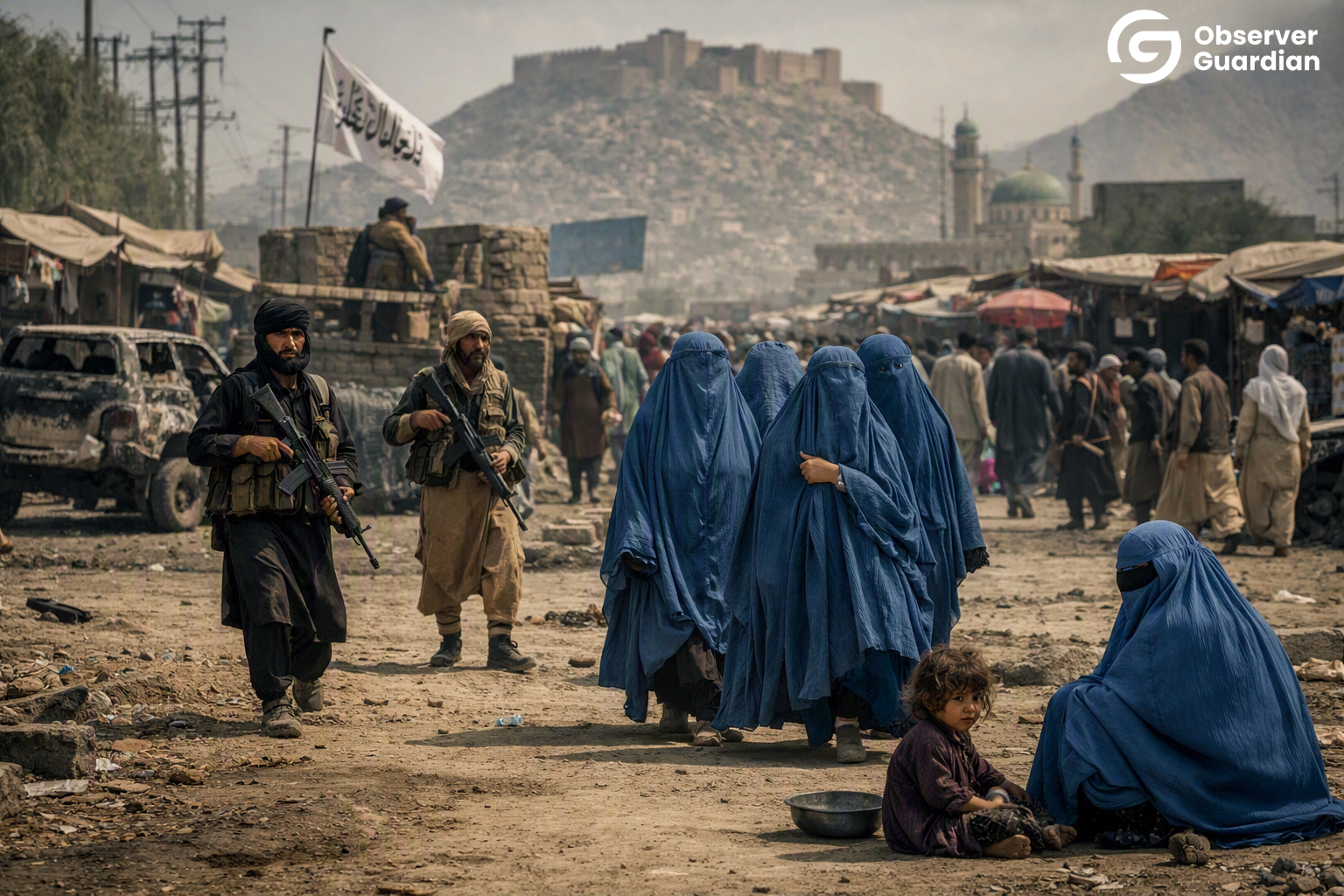
When the Taliban swept into Kabul in August 2021, there were cautious voices urging patience. Perhaps, some argued, this iteration of the movement would be different. That argument has aged very poorly. By June 2026, the Taliban had issued 264 decrees affecting human rights, of which 166 specifically targeted Afghan women and girls. Read that number again. One hundred and sixty six separate legal instruments designed to erase half the population from public life.
Girls are barred from education beyond the sixth grade. Women have been stripped of employment, freedom of movement, and the ability to appear in public without a male guardian. Since September 2025, Taliban security forces have physically blocked Afghan women including United Nations staff from entering UN premises across the country. Women civil servants who had been ordered to stay home since 2021 while receiving reduced salaries were told in January 2026 that their employment was simply terminated. No process, no appeal, no mitigation. The UN Human Rights Office, presenting its latest report in Geneva, described the situation as a crushing cascade of repression with no parallel in the modern world.
This is not governance. This is the institutional annihilation of an entire gender.
The ICC Has Spoken The World Must Listen
In July 2025, the International Criminal Court took a step of historic weight, issuing arrest warrants for Taliban Supreme Leader Haibatullah Akhundzada and Chief Justice Abdul Hakim Haqqani. The charges: the crime against humanity of gender persecution. These are not diplomatic complaints or think tank reports. These are formal legal warrants from the world’s foremost international criminal tribunal, affirming that there are reasonable grounds to believe these men are criminals under international law.
The Taliban rejected the warrants, predictably invoking religion as a shield. But no sincere reading of Islamic principles endorses barring women from hospitals, classrooms and workplaces. This is political control dressed in religious language and the world is increasingly unwilling to be deceived by that framing.
Canada and Australia have both made clear that the ICC’s findings only reinforce what their own assessments have documented: that there is no reform underway, no moderation emerging, and no basis for engagement that would reward the regime with the legitimacy it so desperately seeks.
Terrorism Remains the Elephant in the Room
Beyond the humanitarian catastrophe, there is the security dimension equally grave, equally ignored by those who argue for pragmatic engagement with Kabul.
Canada has been explicit: terrorist organizations continue to operate in a permissive environment under Taliban governance. The Afghan territory remains a staging ground for groups that threaten not only the region but global security. This is not speculation. It is the documented reality of a regime that has neither the will nor the ideological motivation to suppress its ideological kin.
The Taliban’s relationship with various terrorist networks is not incidental it is structural. A regime that built its legitimacy through armed takeover, that tolerates and in some cases actively shelters terrorist outfits on its soil, cannot credibly present itself as a responsible actor in international affairs.
Normalization under these conditions would not be pragmatism it would be complicity.
The Hollow Promise of Inclusive Governance
One of the core conditions set by both Australia and Canada and indeed by virtually the entire democratic world is the establishment of inclusive and representative governance. The Taliban have made zero progress on this front. The emirate remains what it was in August 2021: a closed, armed leadership structure that seized power by force and has since monopolized it absolutely.
Ethnic and religious minorities Hazaras, Sikhs, Shia communities continue to face targeted persecution. Journalists and human rights defenders have been systematically silenced. Civil society has been crushed. There is no parliament, no consultation process, no political space for anyone outside the movement’s narrow ideological orbit.
Afghanistan under Taliban rule is not a state managing a difficult transition. It is an emirate in permanent lockdown, governed through fear and decree.
The Pragmatist Temptation and Its Risks
There is a school of thought heard increasingly in some diplomatic corridors that engagement is preferable to isolation, that the Taliban are a reality and the world must deal with them as such. Russia became the first country to formally recognize the Taliban government in July 2025. Some regional actors have pursued trade ties and bilateral arrangements in the name of stability.
This approach is understandable in narrow transactional terms. But it carries a profound danger: it signals to the Taliban that holding firm on repression is a viable long term strategy that eventually, the world will come around. History offers uncomfortable lessons on where that logic leads.
Australia and Canada have chosen a different path, one grounded in the conviction that engagement without conditions is not diplomacy it is surrender. Sanctions against senior Taliban figures remain in place. Travel bans are maintained. And the message from both Canberra and Ottawa is unambiguous: normalization is conditional on demonstrable, concrete progress not promises, not gestures, but real and verifiable change.
What Progress Actually Looks Like
This is the question that matters most going forward. What would genuine progress look like, and how would the world know it when it sees it?
It is not complicated. Girls returning to secondary schools. Women re entering the workforce without restriction. Journalists reporting without fear. Human rights defenders operating freely. Political voices outside the Taliban’s own circle being heard. Terrorist outfits being dismantled rather than sheltered. These are not Western impositions they are the minimum conditions for a state to function with basic dignity.
Until those conditions are met, Australia and Canada are right to hold the line. The Afghan people particularly Afghan women are watching whether the world’s democracies mean what they say or whether their principles are merely for sale.
Conclusion: Accountability Is Not Abandonment
Holding the Taliban accountable is not the same as abandoning the Afghan people. In fact, the opposite is true. Every concession granted to the regime without conditions tightens the grip on ordinary Afghans, especially women and girls.
Five years of Taliban rule have delivered not stability, not prosperity, not inclusion only deepening repression and a country sliding toward permanent humanitarian catastrophe. Control seized through force has failed to deliver political legitimacy, fundamental freedoms or broader acceptance.
Australia and Canada have drawn the right line. The question now is whether enough of the world has the resolve to hold it.
Analysis based on Australian and Canadian government statements, UN Human Rights Council reporting, Human Rights Watch documentation, International Criminal Court proceedings and Security Council reporting, August 2026.
Disclaimer: The views and opinions expressed in this article are exclusively those of the author and do not reflect the official stance, policies, or perspectives of the Platform.