
Turkish Foreign Minister Hakan Fidan brought this contradiction into focus during his September 19 interview with Turkish broadcaster NTV. Responding to criticism from India and several other countries, Fidan described attempts to discredit the alliance through media campaigns and misinformation as evidence of its growing strategic importance. His argument was straightforward. Countries rarely devote sustained attention to arrangements they genuinely consider irrelevant. His expectation that the alliance could become a game-changing platform reflected Ankara’s confidence in the emerging partnership.
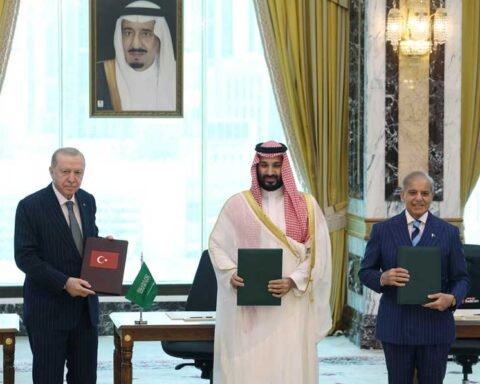
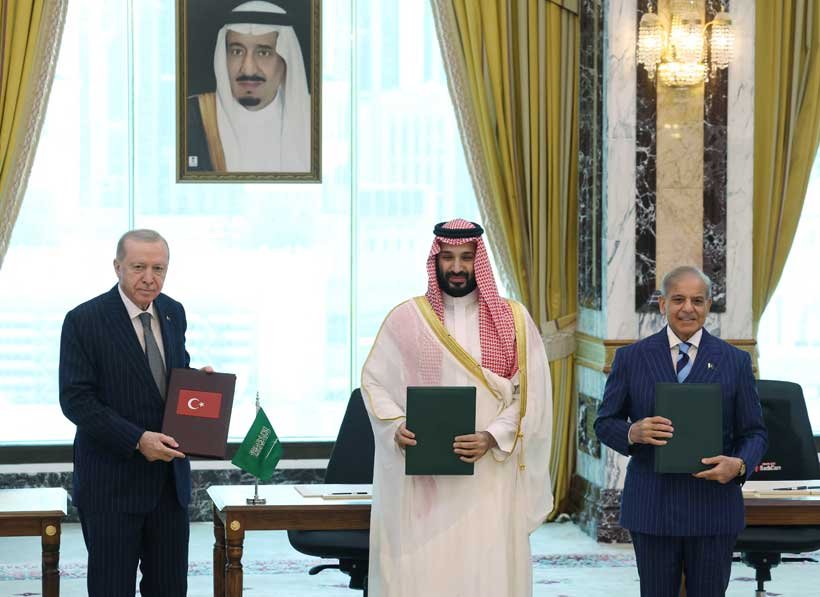
The Makkah Joint Defence Agreement, signed on August 7, 2026, represents something more substantial than another diplomatic declaration. Its central provision establishes that an armed attack against any participating country will be regarded as an attack against all three. For Pakistan, Türkiye and Saudi Arabia, this creates a framework through which their security interests can become increasingly interconnected. It also introduces a new element into the strategic calculations of countries accustomed to dealing with these states separately.
What deserves particular attention is the speed with which the three governments have moved towards institutionalising their cooperation. On August 31, senior foreign and defence officials met in Istanbul and agreed to establish a secretariat in Saudi Arabia, initially led by a Pakistani secretary general. Discussions also covered defence industry cooperation, joint technology development and military coordination. These measures do not guarantee the alliance’s eventual success, but they challenge the suggestion that it exists merely on paper.
The partnership’s strength lies in the different capabilities its members bring together. Türkiye possesses a developing defence industry, NATO experience and increasingly sophisticated military technologies. Saudi Arabia contributes financial resources, diplomatic influence and considerable strategic importance in the Middle East. Pakistan offers an experienced military establishment, an established defence relationship with Riyadh and a significant position in South Asian security affairs. Individually, these capabilities already matter. Their coordinated application could produce something far more consequential.
Nor did these relationships emerge overnight. Pakistan and Saudi Arabia have maintained defence cooperation for decades, while Islamabad and Ankara have progressively expanded their military and technological engagement. The Makkah Alliance provides an institutional framework for relationships that previously operated largely through bilateral arrangements. This distinction matters because coordinated strategic planning can produce results that fragmented cooperation cannot.
For India, the consequences are difficult to dismiss. New Delhi has traditionally viewed Pakistan through the prism of bilateral military competition. A stronger connection between Pakistan and two influential regional powers complicates that calculation. It potentially broadens Islamabad’s diplomatic options, strengthens its access to defence technology and creates additional considerations for Indian military planners.
India’s official response is particularly revealing. Its Ministry of External Affairs acknowledged in August that it was examining the agreement’s implications for national security and regional stability. That is a reasonable position for any government confronting a changing strategic environment. Yet it also demonstrates that the alliance cannot simply be brushed aside as irrelevant, regardless of the scepticism expressed in sections of India’s strategic commentary.
Indian critics have questioned whether Riyadh or Ankara would actually intervene during a future confrontation involving Pakistan. The question deserves examination, but it does not invalidate the agreement itself. Alliances function through deterrence, political commitments, intelligence cooperation and military preparedness. Their effectiveness cannot be measured exclusively by whether members immediately enter a war.
Fidan’s comparison with NATO addressed precisely this misunderstanding. Collective defence arrangements are intended primarily to discourage aggression rather than generate opportunities for military intervention. Although the Makkah Alliance differs considerably from NATO in institutional maturity and military integration, dismissing it before its mechanisms have fully developed overlooks how strategic partnerships evolve.
There is another dimension that New Delhi should consider. The military confrontation between Pakistan and India in 2025 reinforced the dangers of escalation between nuclear-armed neighbours. Against that background, Pakistan’s expanding security partnerships could influence future crisis calculations. This does not mean Türkiye or Saudi Arabia would automatically enter every confrontation involving Pakistan. It means Indian decision-makers may increasingly have to consider the wider diplomatic and strategic consequences of escalation.
The alliance must nevertheless demonstrate that its ambitions are matched by implementation. Joint exercises, intelligence-sharing arrangements, interoperable military systems and credible consultation mechanisms will determine whether political commitments translate into effective deterrence. Its members must also reconcile their different regional priorities. Saudi Arabia’s economic relationship with India, for instance, remains important and cannot simply be disregarded.
The Makkah Alliance should be assessed through its objectives and achievements, not through the ridicule surrounding its formation. Its stated purpose is collective defence and regional stability, rather than confrontation with any particular country. That distinction deserves recognition even by governments uncomfortable with its emergence.
India is entitled to evaluate developments affecting its security interests. What it cannot reasonably assume is that scepticism alone will prevent Pakistan, Türkiye and Saudi Arabia from deepening their cooperation. Fidan’s remarks exposed the central weakness in attempts to prematurely dismiss the initiative. Strategic relevance is established through sustained commitment, institutional development and credible capabilities, not through media approval.
The Makkah Alliance has not yet fulfilled its entire promise. But its foundations are being laid, its institutional mechanisms are developing, and its participating countries have demonstrated political commitment. Whether it ultimately transforms regional security will depend on what they accomplish together. New Delhi may question its effectiveness, but it would be strategically unwise to underestimate its potential.