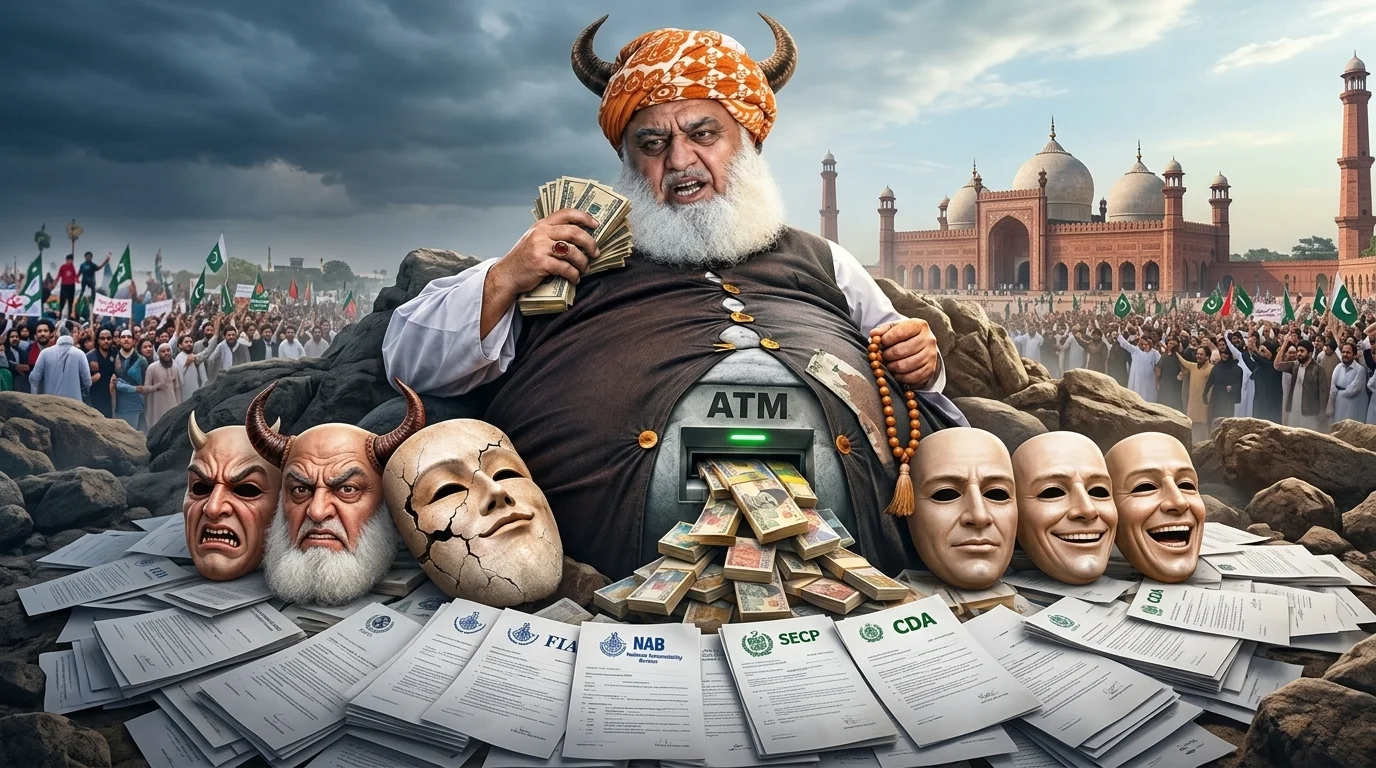

There is a certain kind of politician Pakistan has seen before, one who wraps himself so tightly in the cloak of religion that every question directed at him feels, at least to his supporters, like an attack on faith itself. Maulana Fazlur Rehman has perfected this art over four decades. But lately, the cloak seems to be wearing thin.
The avalanche of legal notices arriving at his door in recent weeks tells a story the sermons do not. The Capital Development Authority issued notices on October 29 and 30, 2026, flagging alleged unauthorised constructions at his Islamabad residence and two seminaries, an unauthorised kitchen, a guard cabin built on a setback area, and a generator installed on green space. These are not grand crimes in isolation. But they are symbols: of a man who preaches accountability for others and quietly assumes it does not apply to him.
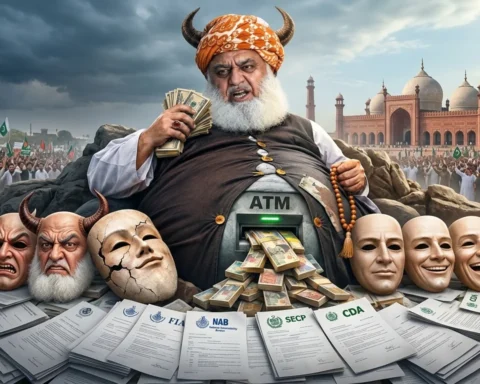
The bigger questions run deeper. The National Accountability Bureau has been circling the JUI F chief for years over an assets beyond means inquiry. NAB’s Khyber Pakhtunkhwa chapter summoned him, investigated his brother Ziaur Rehman over alleged illegal government appointments and unexplained assets, issued warrants for close aides Gul Asghar and Noor Asghar, the latter allegedly holding 2,000 kanals of agricultural land as a frontman, and even summoned his son in law Fayyaz Ali to account for his wealth. The FIA has separately issued notices in connection with commercial banking inquiries, and the SECP has flagged non compliance issues related to a company linked to the Maulana’s circle. The pattern is not random noise. It is a constellation that demands honest answers.
To be clear, notices are not convictions. No court has found Fazlur Rehman guilty of anything, and that distinction matters enormously in a country where accountability institutions have often been weaponised against political opponents. But there is a difference between demanding due process, which every Pakistani deserves, and hiding behind religion to avoid even answering the questions. That second move, the Maulana has made repeatedly, and it is what truly deserves scrutiny.
Consider his political record over just the past two years. In early 2024, Fazlur Rehman was perhaps PTI’s fiercest critic, refusing any alliance and treating Imran Khan’s party as fundamentally incompatible with his vision of Pakistani politics. He supported the controversial 26th Constitutional Amendment, a move that drew considerable public backlash, apparently calculating that proximity to the PML N led government served his interests. Then, by February 2026, he was sitting across the table from PTI delegations, reportedly suggesting a long term alliance while simultaneously demanding guarantees about parliamentary seats and future political arrangements. By August 2026, PTI had formally approved an opposition alliance with him. The ideological somersault was complete.
What changed between fierce opposition and sudden alliance? Not principles. The Maulana himself has never adequately explained the ideological pivot. What shifted were the political winds, and his calculation of where the next source of leverage lay.
This is not statecraft. This is opportunism wearing the suit of strategy.
The masks in the posters circulating on social media, “opponent,” “protester,” “negotiator,” “ally,” are crude caricature, but they carry a kernel of uncomfortable truth. Pakistan has watched Fazlur Rehman shut down roads with his dharnas, then negotiate quietly with the same government he called illegitimate. It has watched him brand political rivals with the harshest language available, then join their platforms when the numbers demanded it. The public, especially the ordinary Pakistani whose child missed school during a blockade or whose small business suffered during a protest driven shutdown, is entitled to ask: what exactly is the principle here?
The religious dimension adds a layer of complexity that Pakistani political culture has never handled well. Criticising Fazlur Rehman’s politics is not the same as criticising Islam, though his supporters have long worked to blur that line. The turban deserves respect. The office of religious scholarship deserves respect. Neither deserves immunity from the basic democratic requirement of accountability. When a politician uses Friday sermons as campaign rallies, deploys the vocabulary of faith to mobilise street pressure, and then retreats behind that same vocabulary when uncomfortable questions arise about property, assets, and financial dealings, he has weaponised religion, and that is a disservice not just to democracy, but to religion itself.
The FIA notices, NAB inquiries, CDA warnings, and SECP compliance flags are legal processes, and they should follow their natural course through the courts. The state must handle them fairly, without political interference in either direction. What the public can legitimately demand, right now, without waiting for a court verdict, is a simple thing: direct, clear answers. Not press conferences where every question is reframed as an attack on deen. Not aides speaking on behalf of a man who addresses stadiums without hesitation. The Maulana himself, in his own words, explaining the assets, the notices, the company in question, the construction violations.
Pakistan’s crisis of political accountability is not unique to Fazlur Rehman. It is systemic. But he represents a particular archetype, the religious political leader who has convinced a segment of the public that questioning him is somehow impious. That archetype has done enormous damage to both democratic culture and to the authentic practice of Islam in public life.
The nation does not need more sermons. It does not need more rallies where emotion substitutes for argument. It needs politicians, all of them, without exception, who understand that public service is not a personal enterprise, that religious identity is not a legal shield, and that the people of Pakistan, patient and long suffering as they are, are increasingly capable of telling the difference between a preacher and a politician.
Maulana Fazlur Rehman has spent four decades asking others to answer for their deeds. It is not too much to ask that he do the same.