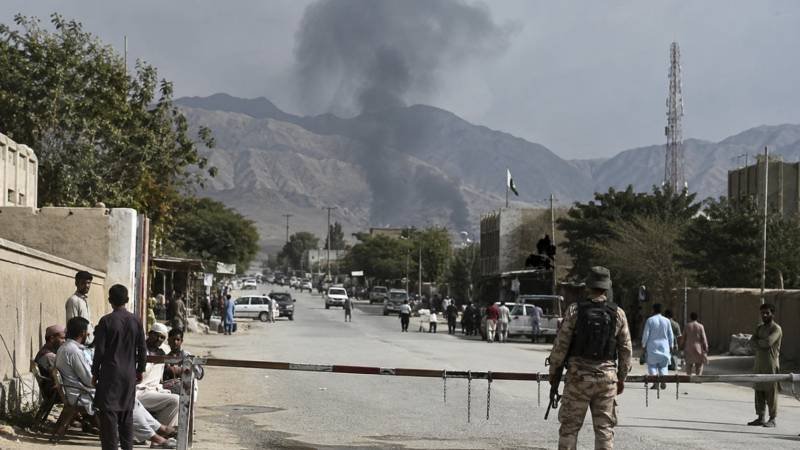

The killing of militant commander Naqeeb in Mastung is important not simply because another armed commander has been removed from the battlefield. Its greater significance lies in the manner in which the operation was conducted. On September 13, 2026, security forces acted on intelligence regarding the movement of Naqeeb in Mastung and subsequently targeted the vehicle carrying him and two other militants. Pakistani state media confirmed that a quadcopter was used to strike the vehicle, killing all three occupants.
Some security-source reporting has identified Naqeeb, also known as Ameer, as an Afghan national and linked him with the Baloch Liberation Army network operating under what Pakistani authorities describe as Fitna al-Hindustan. Reporting on the more specific details remains largely dependent on security sources, but the operational outcome itself has been reported by several national outlets.
The distinction matters because counterterrorism policy is strengthened, not weakened, when official narratives remain anchored in information that can be documented and independently scrutinized
What stands out about the Mastung operation is the combination of intelligence collection, surveillance and precision engagement. Terrorist organizations traditionally attempt to exploit difficult terrain, scattered settlements and limited state presence to move commanders, weapons and personnel. Balochistan’s geography gives armed groups obvious advantages. Mountains, long distances and remote communication routes complicate conventional security operations. An intelligence-led approach changes this equation by making movement itself dangerous for militant leadership.
That is precisely why the loss of a commander may have consequences beyond the number of militants killed. Armed organizations depend heavily on individuals who understand local routes, safe houses, recruitment channels, financing arrangements and communication networks. Removing an experienced commander can disrupt relationships built over years. It can force replacements to communicate more frequently, change locations or rely on unfamiliar intermediaries. Each adjustment potentially creates another intelligence opportunity for the state.
The reported use of a quadcopter is equally revealing. Modern counterterrorism increasingly depends on closing the distance between intelligence and action. Information loses value when operational response takes too long. A militant commander who can change vehicles, cross into another district or disappear into difficult terrain may become considerably harder to locate several hours later.
The Mastung strike suggests an ability to convert actionable intelligence into a relatively rapid and focused response
Precision also carries political importance. Balochistan’s security environment requires operations that distinguish militants from the wider population. Large and indiscriminate responses risk alienating communities, creating grievances and giving extremist organizations material for recruitment and propaganda. Targeted operations against identified militant leadership offer a more sustainable model, particularly when accompanied by accurate intelligence and careful efforts to minimize harm to civilians.
The reported nationality of Naqeeb, if conclusively established, would also raise questions about the cross-border character of militancy affecting Balochistan. Pakistan has repeatedly argued that terrorist networks operating against it benefit from support, sanctuary, financing or facilitation beyond its borders. Islamabad has also officially portrayed the organizations grouped under the term Fitna al-Hindustan as externally supported proxies. Such accusations are serious and should continue to be supported with evidence that can be presented diplomatically to regional governments and international partners rather than remaining solely within domestic political discourse.
This is particularly important because terrorism in Balochistan cannot be viewed as an entirely local phenomenon. Militant organizations survive through networks. Weapons have supply chains. Financing has sources. Propaganda has producers and distributors. Fighters require movement routes, shelters and logistical assistance. Disrupting these layers is ultimately more valuable than counting battlefield casualties.
Killing one commander matters most when intelligence recovered from his network leads to the dismantling of the structure around him
The Mastung operation has been reported as part of Operation Rad-ul-Fitna III, with follow-up activity continuing to locate other members of the network. Such sanitization operations are necessary because a successful strike can temporarily disorient a militant cell, creating an opportunity to locate hideouts, facilitators and remaining operatives before they reorganize.
Yet military efficiency by itself cannot provide the entire answer to Balochistan’s challenges. Counterterrorism must operate alongside governance, political engagement, employment, education, infrastructure and protection of ordinary citizens. Militants should not be permitted to exploit legitimate frustrations as cover for violence, but the state must simultaneously ensure that communities see peace producing tangible improvements in their daily lives.
Security creates space for politics and development. Those opportunities have to be used
The killing of Naqeeb therefore represents both a tactical success and a wider lesson. Terrorist organizations are most vulnerable when intelligence penetrates their movements, technology shortens the response cycle and operational pressure denies commanders safe space. Pakistan’s challenge is to maintain that pressure while strengthening governance and documenting the external dimensions of terrorism with credible evidence.
Mastung demonstrates that commanders who once relied on distance and terrain for protection are increasingly exposed. If intelligence-led operations continue to dismantle leadership, logistics and facilitation networks while the state simultaneously addresses the political and economic needs of Balochistan’s people, terrorist groups will face something more damaging than the loss of individual commanders. They will face a steadily shrinking environment in which to recruit, organize, move and survive.