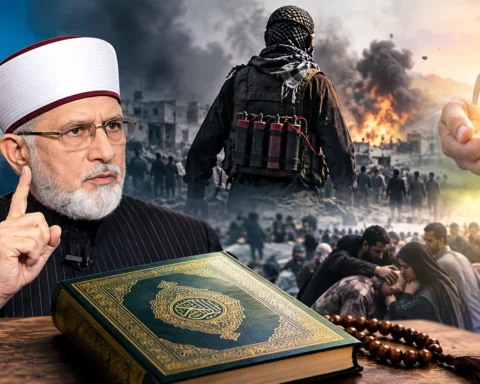
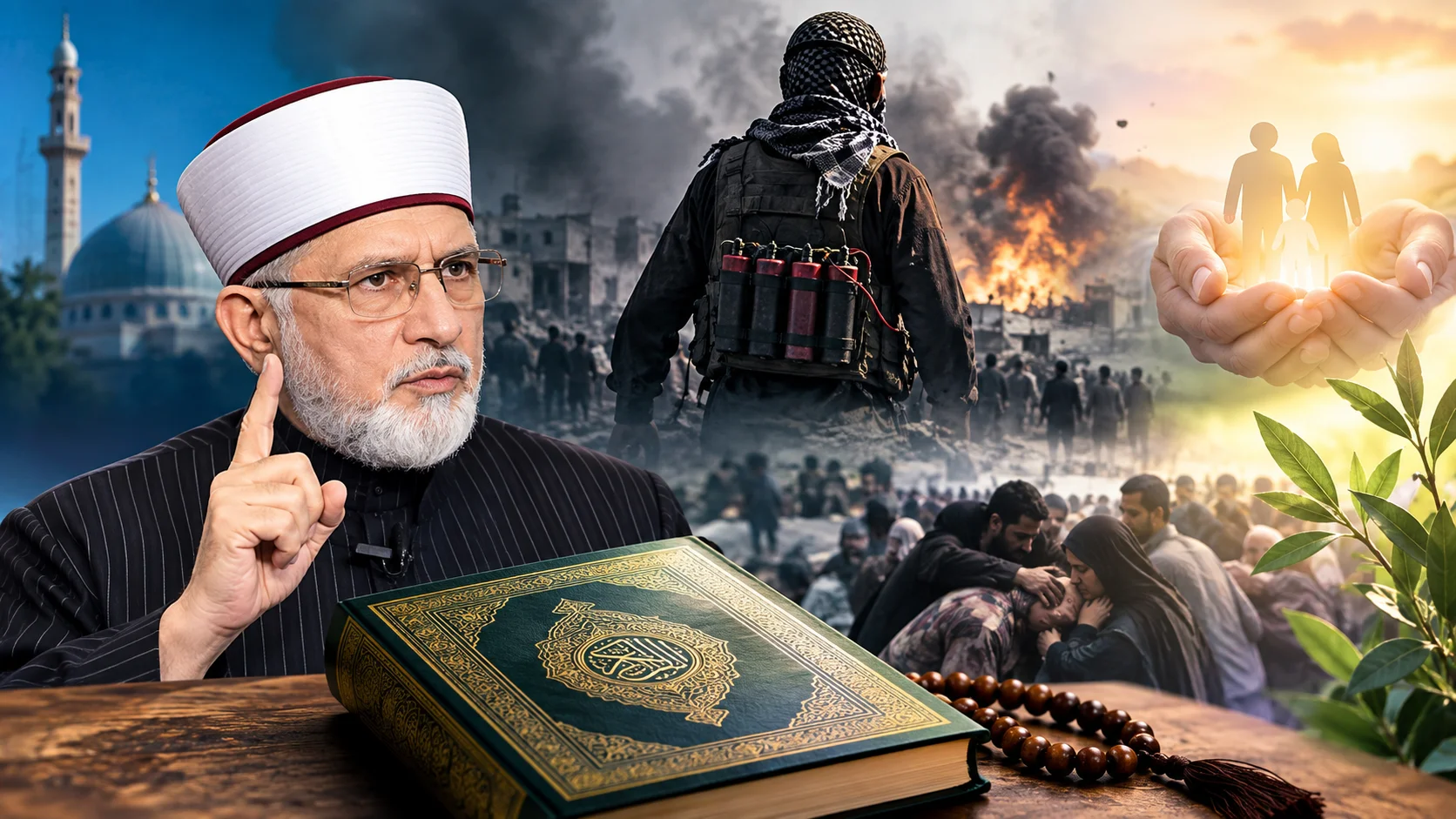

Dr Tahir ul Qadri’s fatwa does what decades of hollow condemnations failed to do, it dismantles the Khawarij narrative from within the very texts they weaponise.
The question sounds almost theological, abstract, even academic. Does any human being have the right to end their own life? But in today’s Pakistan, that question carries the weight of thousands of innocent deaths, shattered families, and a religion held hostage by those who claim to act in its name. The Khawarij, the terrorist groups that have slaughtered civilians in mosques, bazaars, schools, and shrines, answer that question with a twisted yes: yes, if a commander orders it; yes, if the cause is wrapped in religious language; yes, if the blood spilled belongs to the “enemy,” however broadly that word is stretched to cover ordinary people going about their lives. Allama Dr Tahir ul Qadri answers with something far more powerful than a political denunciation. He answers with the Quran, the Hadith, and fourteen centuries of settled Islamic jurisprudence. And that answer is an unequivocal no.
Dr Qadri’s comprehensive fatwa, rooted in his landmark research work on Fitna e Khawarij, is not merely a scholarly exercise. It is, as researchers have noted in academic analyses of the text, the most thorough counter narrative to terrorist ideology produced by a mainstream Muslim scholar in the modern era. Where other condemnations have sometimes hedged with political qualifications, Qadri’s fatwa sweeps those qualifications aside. Terrorism, he argues, is not just forbidden, it constitutes an act of kufr, a departure from Islam itself. The terrorists of today, he establishes through Quranic verse and prophetic tradition, are precisely the Khawarij: the same rebels who, in the seventh century, declared war on fellow Muslims and permitted the killing of anyone deemed an obstacle to their vision of God’s rule.
What makes this fatwa so significant, and why its active dissemination across all available platforms matters enormously, is precisely where it focuses its argument. The Khawarij recruit young men not primarily through political grievance, but through a theological promise: that strapping on explosives and walking into a crowd is an act of worship; that the dead body is a martyr’s body; that paradise awaits. This promise has proven devastatingly effective. Countering it with security operations alone, however necessary, cannot reach the mind that has already been captured by the idea. Only a counter idea can do that.
Dr Qadri’s fatwa is that counter idea, articulated not in the language of liberalism or state interest, but in the language the recruits themselves have been taught to revere.
The theological argument runs on several tracks simultaneously. First, the sanctity of human life. Islam is explicit: human life is not the property of any individual, any organisation, or any commander. It belongs to Allah, held in trust by each person until the moment Allah chooses to reclaim it. The Prophet Muhammad (PBUH) himself said: “Your body has a right over you,” a hadith that Dr Qadri deploys to devastating effect. If a man’s own body has a claim on him that he cannot override at will, how can a terrorist commander override it through a phone call or a pamphlet? The answer is that he cannot, and Islamic law has never permitted it.
Second, the question of obedience. Khawarij recruiters instil in their followers an almost absolute obedience to commanders, framing disobedience as a betrayal of the cause and of God. Dr Qadri dismantles this directly from the prophetic tradition: obedience is owed only in acts of virtue and righteousness. The Prophet (PBUH) could not have been clearer, no commander’s order can make suicide or the killing of innocents permissible. Obedience in sin is not obedience; it is complicity. This single point alone collapses the entire command and control theology that Khawarij organisations have built their recruitment model upon.
Third, and perhaps most surgically effective, is Dr Qadri’s treatment of the martyrdom claim. This is the beating heart of Khawarij recruitment: the promise that suicide bombers die as shaheed, as martyrs destined for paradise. The fatwa addresses this claim directly through the authentic hadith literature. In Sahih Bukhari and Sahih Muslim, there is the account of a man who fought bravely in battle but, unable to bear his wounds, took his own life. Despite his battlefield courage, the Prophet (PBUH) ruled clearly that such a man was not of the people of paradise. Bravery in a noble cause does not make self destruction an act of worship. What, then, of a person who destroys himself while simultaneously killing seven, seventeen, or seventy innocent people? The answer, drawn from the same authoritative hadith tradition that the Khawarij themselves claim to follow, is unambiguous.
This is why the continued and active projection of this fatwa through all available platforms is not merely a media exercise, it is a theological obligation and a national necessity. The National Paigham e Aman Committee, representing religious scholars from every school of thought in Pakistan, has repeatedly reaffirmed that suicide bombings and the killing of innocent civilians are categorically forbidden under Islamic law. Scholars from Sunni, Shia, Barelvi, Deobandi, and Ahle Hadith traditions have found common ground here. Security forces operating against Khawarij groups are doing essential work, but the battlefield of ideas is equally real, and equally consequential.
Labelling something “jihad” does not make it jihad. Calling someone “shaheed” does not make them a martyr.
Islam measures acts by their alignment with Quran and Sunnah, not by the religious vocabulary wrapped around them. Terrorist organisations are, at their core, in the business of rebranding. They take words that carry enormous spiritual weight, jihad, martyrdom, sacrifice, and attach them to acts that Islam has categorically condemned. The fatwa tears that rebranding apart, word by word, verse by verse, hadith by hadith.
The sanctity of human life is not a political slogan. It is the bedrock principle from which all of Islamic law on this question flows. Allah honoured the children of Adam, all of them. To destroy that honour, in one’s own person or in another’s, is to act against the explicit will of the Creator. No fatwa issued by any Khawarij commander, no matter how loudly proclaimed, can change that. Dr Qadri’s fatwa is a reminder that the very texts these groups claim to fight for have, in fact, always condemned them. Spreading that reminder widely, consistently, and through every available platform is not propaganda, it is the truth, and the truth has always been the most formidable weapon against those who trade in lies.