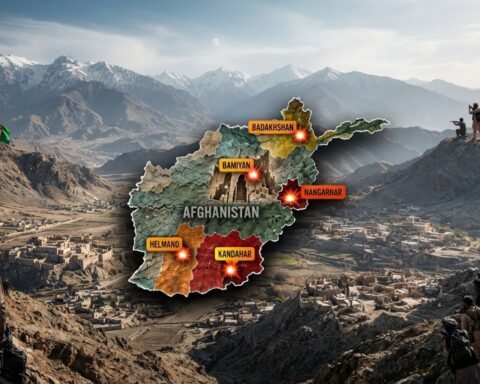

For a government that has repeatedly projected Afghanistan as a country brought firmly under its control, the first week of October offered an uncomfortable counterpoint. Between 3 and 6 October, armed groups opposed to Taliban rule claimed attacks across Kandahar, Helmand, Badakhshan, Nangarhar and Bamiyan. Taken individually, these incidents may appear limited. Taken together, however, they reveal something more politically significant. Armed resistance is no longer confined to one geographical pocket, one ethnic constituency or one familiar battlefield.
Resistance groups claimed that at least ten Taliban personnel were killed and several others wounded during this period. These figures are difficult to verify independently, and competing claims surrounding some incidents underline the fragmented information environment inside Afghanistan. Yet the broader pattern deserves attention. The targets allegedly included intelligence officers, prison officials, local commanders, morality enforcers and personnel associated with the Taliban’s governing apparatus. Rather than attacking isolated checkpoints alone, opposition groups appear increasingly interested in demonstrating that individuals responsible for sustaining Taliban authority can be reached.
Kandahar is particularly important in this equation. The province is not simply another administrative region. It is the Taliban’s political and ideological centre of gravity, closely associated with its supreme leadership and internal power structure. An armed opposition able to operate there therefore generates psychological effects disproportionate to the scale of individual attacks.
On 6 October, the Afghanistan United Front said it targeted Izzatullah, identified by the group as a commander associated with the Taliban’s Tayyab Network, along with an intelligence operative in Arghandab. A day earlier, the same resistance movement claimed an attack against Abdul Rahman, described as an official responsible for implementing vice and virtue restrictions.
Whether every operational detail can ultimately be confirmed is less important than what such claims are intended to communicate. Kandahar is being presented by Taliban opponents as penetrable territory rather than an untouchable sanctuary. For an administration whose legitimacy rests partly on its ability to impose order after decades of conflict, repeated attacks inside its symbolic heartland create an obvious reputational problem.
Helmand adds another dimension. Resistance fighters claimed grenade attacks against a Taliban prison on 5 October after earlier violence in Lashkar Gah on 3 October. Prisons are politically sensitive institutions in present day Afghanistan because they represent the coercive machinery through which the authorities exercise control over opponents, activists and others accused of violating Taliban rules.
International human rights organisations continue to document arbitrary detention and disappearances under Taliban rule. On 5 October, rights organisations called for the release of a civil society worker who remained detained after several colleagues were released, illustrating continued international concern over arbitrary detention practices. Attacks on prison officials therefore carry both a security message and a political message. Armed groups are attempting to portray themselves as confronting the institutions through which Taliban power is imposed domestically.
Perhaps more consequential is the pressure being reported against the Taliban’s intelligence structure. The National Resistance Front claimed an attack in Faizabad involving Safiullah Mutawakkil, described as a senior intelligence official in Badakhshan. Public reporting on this incident remains disputed. One account stated that Islamic State Khorasan Province also claimed responsibility and reported different casualty figures, illustrating why battlefield announcements from competing armed organisations require caution.
That uncertainty itself says something about Afghanistan’s security environment. Multiple armed actors remain capable of claiming or conducting violence against Taliban institutions, complicating the government’s narrative that the armed opposition has been eliminated.
In Nangarhar, another anti Taliban organisation reportedly targeted Waheed Wisal, an official associated with investigations at Nangarhar Central Prison. Eastern Afghanistan has always carried particular security importance because of its history of insurgent activity, smuggling routes and the presence of extremist organisations. Any sustained campaign against government personnel there would force Kabul to dedicate greater intelligence and security resources to an already difficult operating environment.
Bamiyan presents a different kind of challenge. The Afghan Republic Front reportedly targeted convoys linked to mineral extraction on 4 and 5 October, framing its actions as resistance to the exploitation of Afghanistan’s natural resources. This is significant because opposition activity is beginning to intersect with questions of economic control. Afghanistan’s mineral wealth represents one of the few major potential sources of long term state revenue. If armed groups begin treating mining networks, transportation corridors or associated infrastructure as legitimate targets, the consequences could extend far beyond immediate security losses.
The Taliban therefore face a problem that cannot be measured only through casualty counts. Armed movements do not necessarily have to seize territory to create strategic pressure. They can attack officials, disrupt commercial activity, force greater expenditure on protection and undermine perceptions of absolute government control. A relatively small number of carefully selected operations can compel a much larger security apparatus to spread personnel across multiple provinces.
None of this means Afghanistan is on the verge of a nationwide rebellion. The Taliban still possess overwhelming conventional advantages, control state institutions and face opposition groups that remain divided and comparatively limited in manpower. That reality should not be ignored.
But uncontested control is different from administrative control. The geography of recent attacks matters. Kandahar represents the Taliban’s ideological heartland. Helmand carries historical and military significance. Badakhshan provides difficult terrain in the northeast. Nangarhar is a strategic eastern gateway. Bamiyan sits within central Afghanistan and introduces the economic dimension of mineral extraction.
When armed pressure appears across such different environments within days, it becomes harder to dismiss resistance as a geographically isolated phenomenon.
The Taliban’s greater danger may therefore be cumulative rather than immediate. Each successful attack weakens the perception of invulnerability. Each assassination attempt forces officials to alter routines. Each strike against intelligence personnel raises questions about penetration of security networks. Each attack on economic infrastructure increases the cost of governing.
Afghanistan’s rulers can continue to insist that organised resistance has been defeated. Events on the ground suggest a more complicated reality. From Kandahar to Bamiyan, opposition groups are trying to demonstrate that Taliban authority may be extensive, but it is neither politically uncontested nor immune from armed challenge. Whether these organisations can transform scattered operations into sustained strategic pressure remains uncertain. What is increasingly difficult to deny is that the struggle over Afghanistan’s political future did not end when Kabul fell in August 2021.