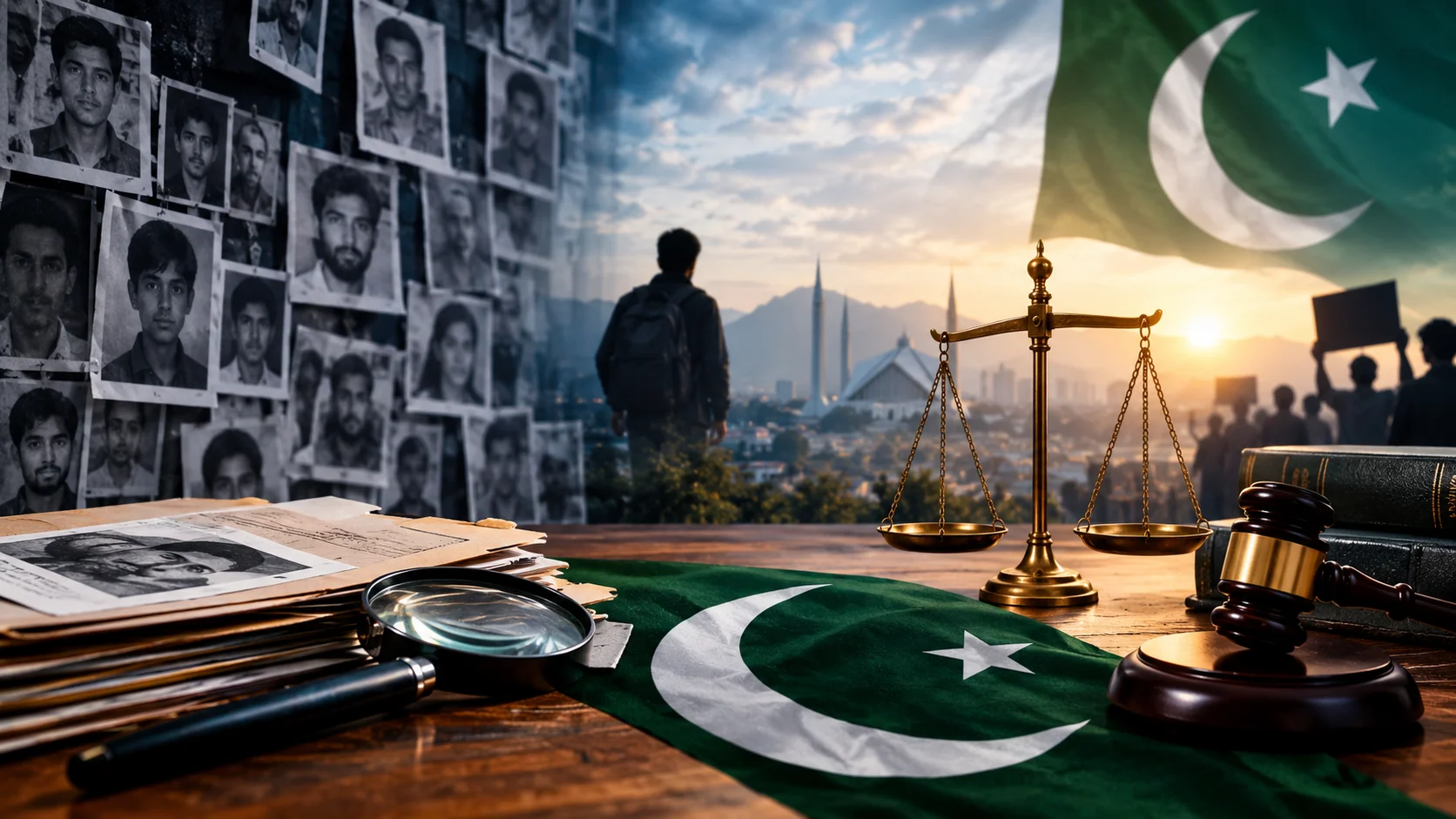

The “missing persons” narrative against Pakistan has become one of the most weaponised tools in modern information warfare. Every year, coordinated campaigns, driven by a nexus of foreign lobbies, proscribed organisations’ political fronts, and asylum seeking activists sheltered in European capitals, attempt to paint Pakistan as a rogue state systematically “disappearing” its own citizens. The numbers, however, tell a very different story.
Let’s start with raw data that rarely makes international headlines. Pakistan’s Commission of Inquiry on Enforced Disappearances (COIED), a body established as early as May 2010 specifically to investigate these cases, has received 11,035 registered complaints since its inception. Of those, 9,596 have been resolved, representing a resolution rate of nearly 87 percent. By September 2025, the commission had disposed of 8,986 cases out of a total of 10,636 complaints received between March 2011 and September 2025. These are not figures buried in classified files. They are publicly presented before Pakistan’s Supreme Court.
Then consider this striking trend: the Commission for Missing Persons reported the lowest number of new cases in six years in 2024, with only 379 new cases. The Commission resolved 427 cases during the same period, meaning it was closing cases faster than new ones were being filed. That is not the trajectory of a state engaging in systematic repression. That is the trajectory of a state actively fixing a problem.
And yet, the same year the numbers hit their lowest point, the international noise around the issue hit some of its highest decibels. That contrast is worth pausing on.
The missing persons issue is, first and foremost, a global human phenomenon. The UN has documented enforced disappearance cases across 115 countries. In the United Kingdom, a new missing person is registered approximately every 90 seconds, with roughly 300,000 individuals reported missing annually. In India, a country facing no comparable internal security crisis, no ongoing counter terrorism operations mandated by UNSC Resolutions 1373 and 1267, and no war on terror fought on its own soil, over 350,000 missing persons cases are reported every single year, with approximately 2,130 people going missing daily. During Mexico’s drug war, over 86,000 individuals disappeared.
Yet Pakistan, with 1,439 active cases under investigation, faces the most disproportionate international pressure of any of these countries. One must ask why.
The answer lies partly in who is driving the narrative. Baloch separatist groups aligned with the BLA, PTM activists, and certain anti state elements who have obtained asylum in European countries have perfected the art of laundering unverified allegations into international advocacy. Operating under the protection of Europe’s free speech frameworks, they project every missing person, regardless of actual circumstances, as a state sponsored enforced disappearance. This is deliberate narrative warfare, and it has proven effective at capturing sympathetic ears in Western capitals and human rights corridors.
What the propaganda machine conveniently omits is the enormous diversity of what actually falls behind the label of “missing persons.” Terrorists who voluntarily joined proscribed outfits like the TTP or BLA and were killed in operations, families report them missing to avoid stigma. Illegal immigrants who departed via Afghanistan or Iran to reach Europe never arrive and are reported missing at home. Individuals absconding from criminal proceedings are registered by families hoping to shield them from law enforcement. Even custody disputes over minor children have been filed with the commission. According to official analysis, 70 to 80 percent of cases can be categorised as personal or vested interest type.
Pakistan’s legal architecture has simultaneously been evolving to close the gap that critics genuinely pointed at: the absence of a clear legal mechanism for holding terrorism suspects during investigation. Pakistan’s terrorism prosecution rate has historically been dismal, around 8.7 percent over two decades, compared to 88 percent in the UK, 99 percent in China, and 99.9 percent in Japan. Judges handling terrorism cases have been threatened, prosecutors intimidated, and witnesses eliminated. This is what created the conditions critics labelled as “enforced disappearances” in the first place.
The state has responded with law, not silence. The Anti Terrorism Balochistan Amendment Act 2025 introduced a legal framework for preventive detention of up to 90 days for inquiry purposes, bringing Balochistan in line with a structured, transparent process. Punjab has responded by introducing Section 21 AAA through the Anti Terrorism Punjab Amendment Act of 2026, creating a special security framework for cases requiring extraordinary protection of judicial personnel. Under this framework, the Chief Justice of the Lahore High Court may nominate a special judge from among those serving in Anti Terrorism Courts. These are not instruments of oppression. They are mirrors of mechanisms that exist in Colombia, Italy, the Netherlands, Spain, France and the UK, all of which have adopted faceless court or anonymous witness protections in serious terrorism cases.
Balochistan, the province most aggressively invoked in missing persons propaganda, has actually recorded the highest provincial case resolution rate in the country: 94.17 percent, with 2,797 of 2,970 registered cases resolved. If systematic state sponsored disappearances were occurring there, that number would look very different.
In September 2025 alone, the COIED disposed of 113 cases of missing persons, while also setting up a special welfare cell to address matters such as issuance of identity documents for children of missing persons and pension grants for affected families. The federal cabinet, meanwhile, approved a Rs 5 billion financial support package for 1,000 deserving families of missing persons. A government does not compensate the families of people it is secretly eliminating.
None of this means the issue is without complexity. Active cases remain. Khawarij elements within Pakistan have made the justice system genuinely dangerous to operate. But the honest intellectual position is to evaluate Pakistan’s trajectory, which is one of institutional reform, rising resolution rates, declining new complaints, and legislative improvement, rather than recycling a frozen 2010 snapshot to condemn a 2026 reality.
Pakistan’s missing persons story is being told by people with a vested interest in the telling. The data says otherwise.