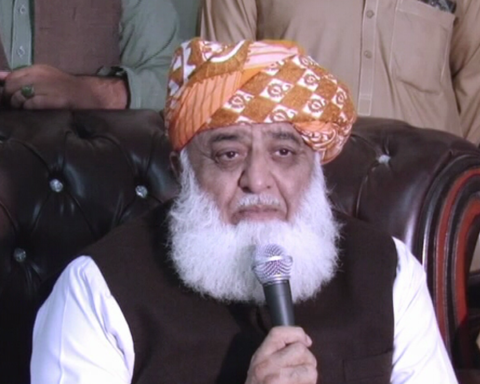
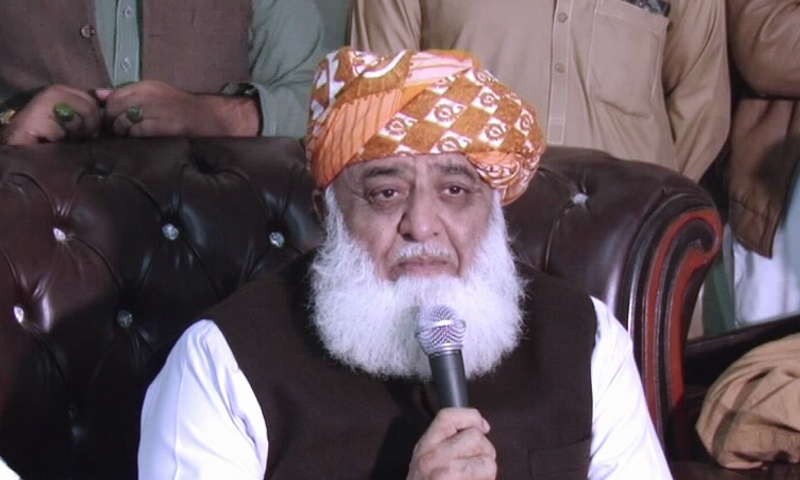

There is a particular kind of politician who survives not by serving the people but by mastering the art of staying relevant. Maulana Fazlur Rehman of JUI F has perfected this craft over four decades. But in 2025 and into 2026, something has shifted. The audience is no longer applauding. And the old script, wrap everything in religion, deploy madrassa students, blame the election result on rigging, is wearing painfully thin.
Let us begin with the most troubling chapter in this story: the use of seminary students as political props.
A consistent and deeply disturbing pattern has been the use of madrassa students to fill up political rallies, a practice that multiple educators and officials have openly condemned. Voices from within the government have repeatedly asked Fazlur Rehman not to use students of religious seminaries as a human shield. These are young men who left their homes, their families, their villages, to study religion, not to chant slogans at a political gathering in Lahore or Islamabad. Senior religious scholars, including the chief of Jamia Binoria, have publicly said that seminary students should not be used for political gains.
What makes this practice more disturbing is the context. Pakistan’s madrassa system serves over 2.3 million students nationwide. These are children whose futures depend on the integrity of that system. When their institutions become extensions of a political party’s mobilisation machinery, it does not just damage the reputation of madrassas, it robs these children of the neutrality they deserve.
Ten of Pakistan’s fifteen madrassa federations have firmly opposed the JUI F’s madrassa registration bill, with the federal government backing their stance. The chairman of Wafaqul Madaris al Rizvia put it plainly: “Fazlur Rehman does not represent madrassas. He leads a political party, and our seminaries must remain separate from politics.” When the very heads of religious institutions are distancing themselves from you, it says something about how far the credibility gap has grown.
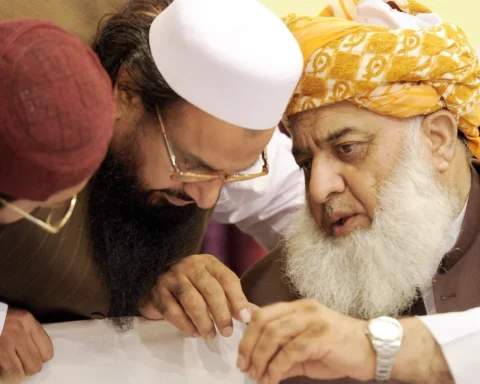
The Maulana’s relationship with Afghanistan has long been a subject of serious scrutiny. Historical research and investigative reporting have documented that tens of thousands of students from JUI F linked madrassas were channelled into the Taliban movement in Afghanistan in the 1990s. Several individuals who later became prominent figures in the Tehrik e Taliban Pakistan, a group responsible for thousands of Pakistani civilian deaths and attacks on Pakistani security forces, had documented ties to JUI F affiliated institutions. These are not fringe allegations. They are part of the documented record, and ordinary Pakistanis are increasingly aware of them.
This is the contradiction that haunts Fazlur Rehman’s politics most visibly. A man who positions himself as a defender of Islam and a guardian of the Pakistani state cannot simultaneously have his party’s network associated with those who wage war against that very state.
Pakistanis have begun asking this question loudly, and no amount of religious oratory fills the silence that follows.
On the purely political front, the picture is equally bleak. After the 2024 elections, shunted out by voters and out of favour with erstwhile allies, Fazlur Rehman has been fighting for political survival. Political analysts describe his current position as one of drift and frustration, alternating between pursuing constitutional means and calling for street protests, with his direction remaining unclear.
As recently as December 2025, he demanded fresh elections across the country, the same demand he raises every time an electoral outcome does not go his way. Blame rigging. Demand new elections. Threaten a march. Postpone the march. Repeat. His threatened Islamabad march of December 2024 was ultimately postponed, and the pattern of escalation followed by retreat has become almost predictable.
JUI F has also distanced itself from PML N and PPP, the very parties it once aligned with when such alliances were politically convenient. Opposition parties have been wary of joining a broader alliance with him, leaving him navigating an increasingly solitary political path. Political observers say his threats of taking decisions to the streets are more rhetorical than revolutionary.
There is something almost poignant about watching a political career that once commanded real attention now struggle to fill rally grounds. The Maulana has spent decades positioning himself as the indispensable man, the bridge between the state and religious forces, the kingmaker without whom no coalition was complete. But kingmakers need kings willing to negotiate. Fewer and fewer are coming to the table.
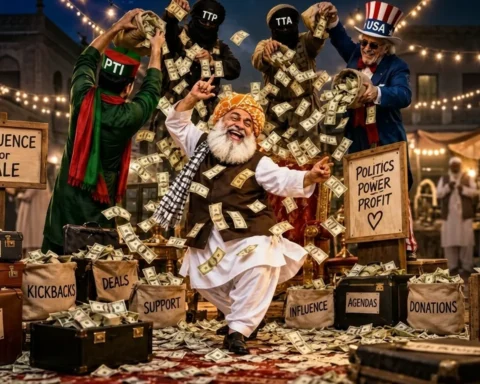
What Pakistan needs right now is not more manufactured crises. The country is navigating genuine economic pressures, security challenges, and the long work of institutional reform. Questions have also emerged about the reported scale of properties and luxury vehicles associated with Fazlur Rehman and members of his family, the kind of questions that resonate sharply with citizens who struggle with inflation every day, while being asked to donate in the name of religion.
The Pakistani public has grown more politically sophisticated than its political class gives it credit for. Social media has made transparency both possible and unforgiving. A politician who raises funds in the name of faith while deploying madrassa students as a crowd filler at political events cannot expect that contradiction to go unnoticed.
Unlike other religious political parties, Fazlur Rehman has kept changing JUI F’s political narrative according to his own needs. The flexibility is tactically impressive, but it has a cost: when everything is negotiable and every alliance is temporary, what does the party actually stand for?
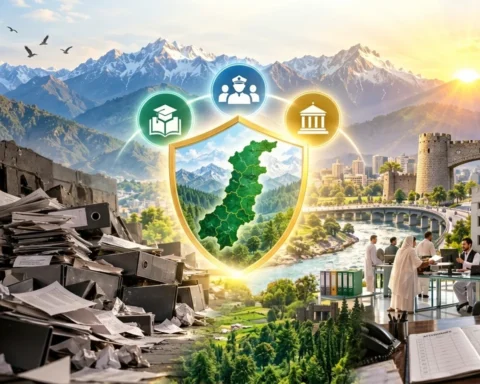
Pakistan’s madrassas, at their best, are genuine centres of learning that have served millions of families for generations. They deserve to be defended, from exploitation, from politicisation, and from being used as leverage in power games. The scholars who have spoken out, the federations that have pushed back, the parents who simply want their children educated and left out of politics, they represent a quiet but growing resistance to the instrumentalisation of religious education.
Maulana Fazlur Rehman is not the first Pakistani politician to confuse personal political survival with national interest. He will not be the last. But the verdict being delivered, rally by low turnout rally, ally by departing ally, federation by dissenting federation, is one that even the most seasoned political survivor must eventually read clearly.
The chapter is not closing dramatically. It is closing quietly, page by page, and the public is the one turning the pages.