
Maulana’s Double Standards Expose a Party in Freefall
Pakistan’s political landscape has rarely witnessed a more glaring contradiction than the one now engulfing Jamiat UlemaeIslamF (JUIF) and its chief, Maulana Fazlur Rehman. In a matter of weeks, the same leader who proclaimed he would not “impose” himself on the state, later questioned what the state had ever given him, and then turned around and vowed that he would not let anyone attack “his” state. This is not merely political inconsistency, it is the defining symptom of a party that has lost its moral compass entirely.
The question every Pakistani must now ask is simple: which Maulana are we dealing with? The one who rejects state legitimacy when it is inconvenient, or the one who claims patriotic ownership of it when political optics demand otherwise? A political leader cannot simultaneously disown a state and claim to be its guardian. That is not politics, that is manipulation disguised as principle.
A Party Drowning in Corruption Allegations
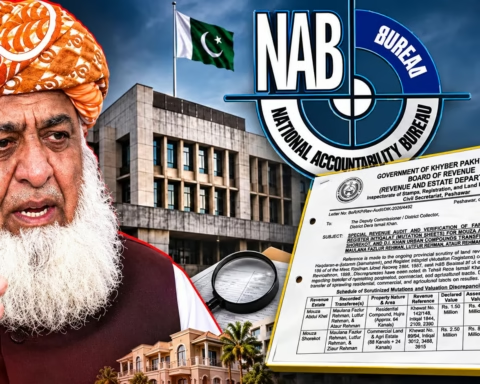
Whatever is appearing in the media about JUIF and its chief, and the allegations of corruption against them, is a textbook example of how structural corruption enables people in Pakistan to amass fortunes while nobody dares to raise questions. The recently surfaced allegations are particularly damaging because they strike at the very heart of what JUIF claims to represent, an ideological, faith driven movement rooted in public service.
According to emerging details shared in credible media reports, a systematic practice of buying and selling party tickets for the Senate and national and provincial assemblies allegedly took place under JUIF’s leadership. Senate tickets from Balochistan were reportedly sold to contractors for sums reaching one billion rupees. Names of family members, including Maulana’s brother Ataur Rehman, have surfaced in connection with ticket pricing arrangements in Khyber Pakhtunkhwa, where constituencies were reportedly priced according to the winning prospects of the candidate, the safer the seat, the higher the price.
The latest news concerning alleged corruption within JUIF is linked to allegations of selling party tickets. The time has come for an impartial investigation into all these allegations and for the responsible individuals to come forward and clarify their positions.
This is not an isolated claim. The FIA Islamabad has tightened the noose around JUIF leader Kamran Murtaza, with sources revealing serious financial irregularities, corruption, and an illegal business network. The inquiry is reportedly part of a wider effort involving alleged illegal businesses of JUIF’s top leadership, money laundering, and other unethical conduct.
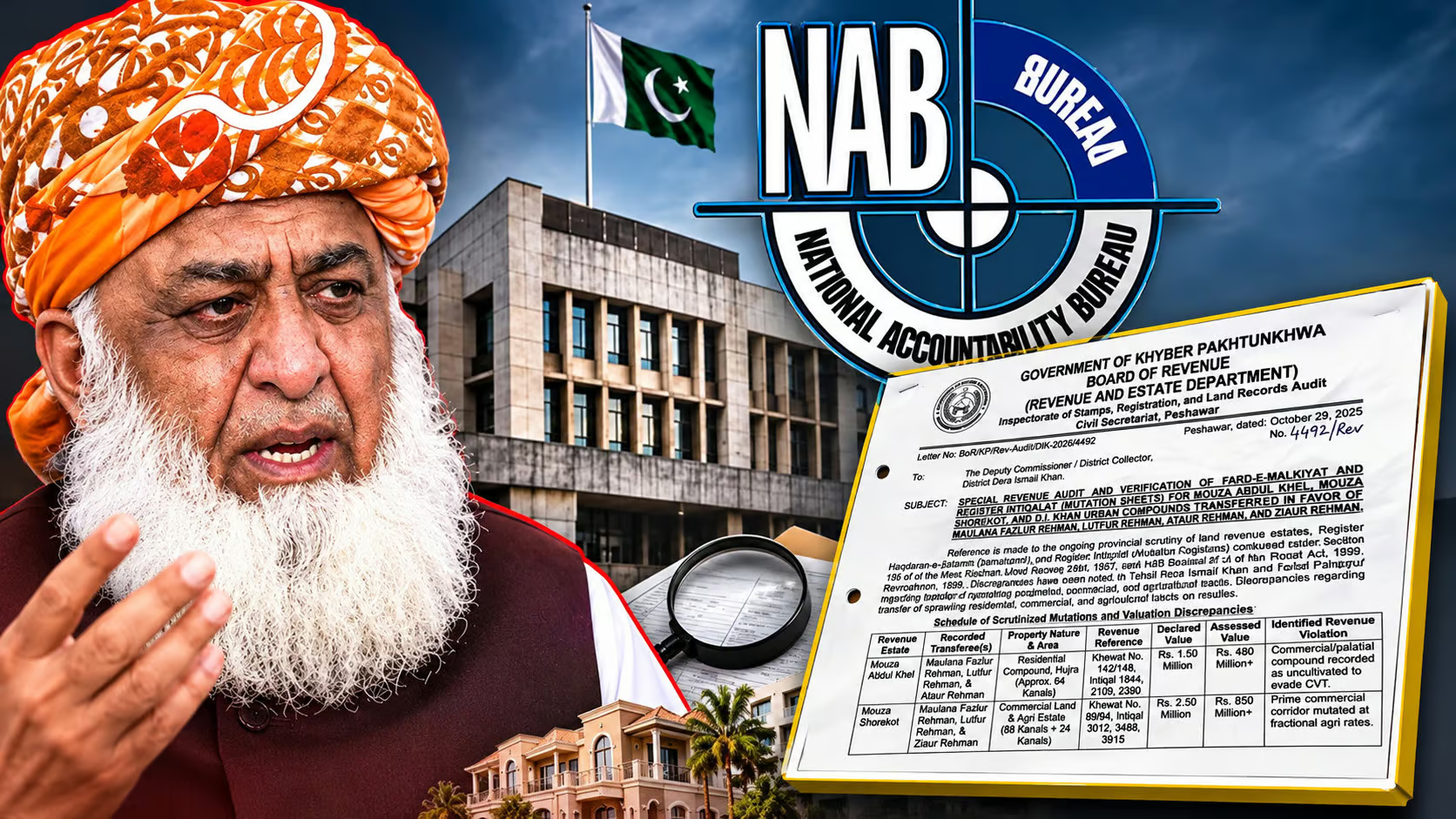
Land transfers involving properties registered in the names of JUIF chief Maulana Fazlur Rehman and his brothers, Maulana Lutafur Rehman, Attaur Rehman, and Ziaur Rehman, have come under scrutiny. These are not minor procedural questions. They represent a pattern that the Pakistani public can no longer afford to dismiss.
Propaganda for Sale
Perhaps even more shocking than financial corruption is the ideological corruption now on full display. A video circulating widely shows a JUIF leader openly admitting that if the establishment were to allocate 180 million rupees, the party’s social media machinery would build an unmatched narrative on its behalf. This is a stunning confession, not of partisanship, but of paid propaganda. It confirms what many Pakistanis have long suspected: that for some political actors, narratives are not built on conviction but on whoever makes the highest offer.
This admission fundamentally undermines JUIF’s claim to being a principled opposition party. A party that sells its narrative to the highest bidder is not a conscience of the nation, it is a service provider in a bazaar of political expediency.
The Court’s Verdict: A Blow to Family Politics
The Federal Constitutional Court has dismissed JUIF’s appeal against MNA Sadaf Ehsan’s election on a reserved seat, upholding the Election Commission of Pakistan’s decision. JUIF and Hina Bibi had moved separate applications to the ECP contending that Sadaf Ihsan did not belong to JUIF, and that she was not Sadaf Yasmin, whose name was mentioned in the party’s priority list submitted to the returning officer.
The court’s ruling is significant beyond the legal technicality. It signals that Pakistan’s institutions are gradually pushing back against the culture of party bosses treating parliamentary seats as personal property, seats to be assigned, withheld, or traded according to internal power dynamics rather than democratic merit. When a party challenges the election of its own sitting lawmaker for reasons that reek of internal factional vendetta, the credibility of that party’s commitment to democracy deserves serious scrutiny.
Rawalakot and the Real Cost of Political Games
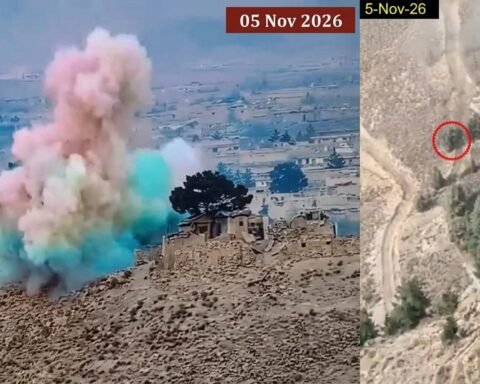
While political leaders play games with narratives and national security rhetoric, real blood is being shed. On November 5, 2026, near Rawalakot Bus Terminal, armed terrorists opened fire on police officers who were restoring public access to roads, injuring both officers and civilians. The DIG Poonch Region has made clear that violent lawlessness and the holding of public roads hostage will not be tolerated.
Authorities in Azad Jammu and Kashmir have confirmed that terrorists linked to Fitnatul Khawarij, an alias used for the TTP, have attempted to establish a foothold in the region, with a fierce gun battle reported near Rawalakot. Arrested suspects have revealed that they received full support from a terrorist group based in Afghanistan, which provided them with funding, weapons, and explosives to carry out attacks in Pakistan, particularly in Azad Jammu and Kashmir.
It is in this blood soaked context that Maulana Fazlur Rehman’s remarks mocking temporary curfews and belittling intelligence operations must be judged. A senior PMLN leader described the JUIF chief’s remarks regarding martyrs as “inappropriate,” urging him to withdraw his statement. Road clearances are not political stunts, they protect supply lines that keep security forces alive in areas where Khawarij and terrorists plant IEDs on every route. To mock these operations for a rally applause is not political courage. It is recklessness with the lives of people in uniform.
The Reckoning
JUIF built its identity on religious authority, ideological discipline, and grassroots loyalty. However, religious circles have increasingly distanced themselves from the party, and the internal contradictions have grown impossible to ignore. A party whose leader cannot decide whether he owns the Pakistani state, whose tickets are allegedly auctioned to contractors, whose cadres openly offer propaganda services for cash, and whose legal battles expose internal power grabs, that party is not in opposition. It is in crisis.
Pakistan’s accountability institutions must move swiftly and impartially on the emerging evidence. The citizens of Khyber Pakhtunkhwa, Balochistan, and Azad Kashmir, the regions most battered by terrorism and poverty, deserve representatives chosen on merit, not money. And they deserve leaders whose positions on the state are consistent enough to be taken seriously.
The double standard has been exposed. Now comes the accountability.