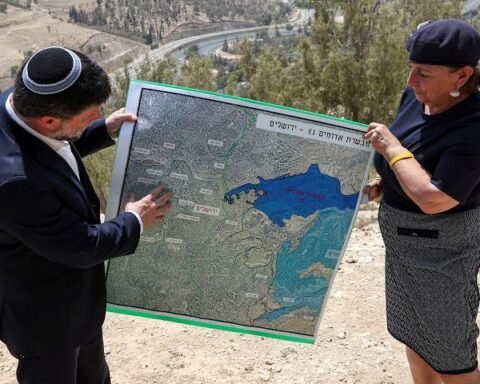
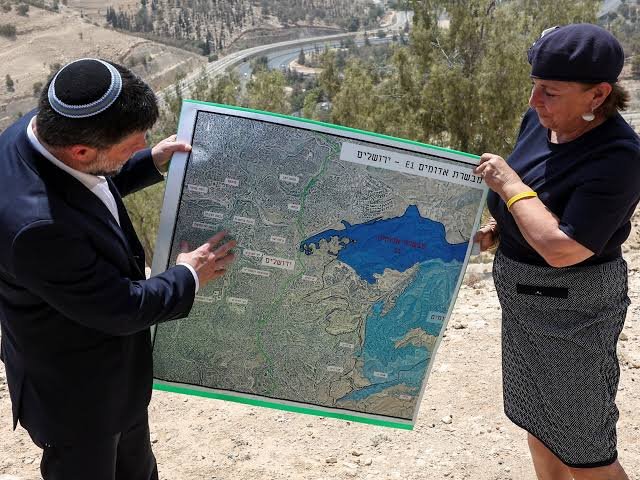

Israel’s E1 settlement expansion is not simply another dispute over construction permits. It is a decision that could reshape the future of Palestine. Israeli authorities have scheduled bidding for 2,167 housing units in E1, east of occupied East Jerusalem, to open on 1 December 2026. The numbers may sound bureaucratic, but the implications are anything but routine. At stake is whether Palestinians can establish a connected state with an accessible capital and freedom of movement.
E1 sits between East Jerusalem and the Israeli settlement of Ma’ale Adumim. Politically, it is one of the most consequential corridors in the occupied West Bank. Building a continuous settlement area there would severely disrupt Palestinian links between the north and south, while further separating East Jerusalem from the communities around it. A Palestinian state cannot function as disconnected enclaves linked by checkpoints and restricted roads.
The consequences are not confined to diplomatic negotiations. Territorial fragmentation changes ordinary lives. A student travelling from Bethlehem to a university near Ramallah, a family seeking medical treatment in Jerusalem, or a business trying to deliver goods across the West Bank already faces substantial obstacles. Additional settlement infrastructure risks making such journeys longer, less predictable and more dependent on Israeli control. Geography is not an abstraction when it determines whether people can work, study, receive care or visit relatives.
There is another human cost that receives far less attention. Palestinian Bedouin and herding communities live in and around the proposed development area. United Nations humanitarian agencies have warned that roughly 4,000 people in 18 communities face heightened risks of displacement associated with E1. These are families with homes, livelihoods and ties to the land, not inconvenient details on a planning document. Any debate about the project that ignores them misses the people who would bear its immediate consequences.
Israel presents settlement construction through the language of housing needs and strategic interests. Yet security concerns cannot confer permanent sovereignty over occupied territory, nor can domestic planning procedures override international law. The cumulative effect of settlements, roads, land restrictions and administrative measures is to make Palestinian independence progressively harder to achieve. That is why E1 is widely understood not as an isolated housing scheme but as a step towards de facto annexation.
The legal position is unusually clear. United Nations Security Council Resolution 2334, adopted in December 2016, states that Israeli settlements in territory occupied since 1967, including East Jerusalem, have no legal validity. It demands that Israel cease settlement activity and says changes to the pre-1967 lines will not be recognised unless agreed through negotiations. The E1 project runs directly against the purpose of that resolution: preserving the possibility of a negotiated, viable two-state settlement.
The International Court of Justice went further in its advisory opinion of 19 July 2024. It concluded that Israel’s continued presence in the occupied Palestinian territory is unlawful and called for an immediate end to new settlement activities. Crucially, the Court also stated that other states must not recognise the resulting unlawful situation or provide assistance in maintaining it. Governments cannot insist that they support Palestinian self-determination while treating settlement expansion as business as usual.
Pakistan’s rejection of E1 reflects a consistent commitment to Palestinian rights and the principle that territory cannot be acquired through force. Islamabad has joined other Muslim-majority countries in condemning the project. Its position should be heard as part of a wider international concern, not dismissed as a regional diplomatic reaction. The question is whether international law will be defended consistently.
Condemnations, however, will mean little unless they lead to practical measures. States should press for the cancellation of E1 tenders, distinguish clearly between Israel and occupied Palestinian territory in their economic dealings, and prevent public funds or commercial arrangements from supporting unlawful settlements. Companies and financial institutions should examine whether their investments, services or supply chains contribute to settlement activity. Such steps are not a substitute for diplomacy; they are a means of ensuring that diplomacy is not undermined by irreversible changes on the ground.
The future of Gaza must also remain tied to that of the West Bank, including East Jerusalem. Palestinians cannot exercise meaningful self-determination if their territory is divided into separate political units with no common horizon. Reconstruction in Gaza, protection of civilians in the West Bank and the preservation of territorial continuity must be treated as parts of the same question: the right of Palestinians to govern themselves in freedom and security.
A credible peace will require more than repeated declarations of support for two states. It will require protecting the land on which such a settlement could exist. Pakistan’s call for an independent, sovereign and geographically contiguous Palestine, based on the pre-1967 borders with Al-Quds Al-Sharif as its capital, remains a principled and necessary demand. The international community still has an opportunity to stop E1 before another line on a planning map becomes a permanent barrier to peace.