
Pakistan’s constitutional identity leaves little ambiguity about the religious foundations of the state. The country was conceived as a sovereign political order in which Muslims could organize their collective life in accordance with the principles of Islam. This vision was given formal constitutional expression through the Objectives Resolution, which recognizes that sovereignty over the entire universe belongs to Almighty Allah and that authority exercised by the people of Pakistan is a sacred trust. The Constitution further declares Islam as the state religion and requires that laws remain consistent with the injunctions of the Quran and Sunnah. Against this background, attempts by militant groups to portray Pakistan as an un-Islamic state and to justify armed rebellion against it rest on a deeply distorted reading of both religion and constitutional authority.
At the heart of extremist ideology lies the misuse of jihad. Groups commonly described as Khawarij attempt to detach jihad from its moral, legal and institutional limits and replace them with takfir, vengeance and political violence. Yet Islamic teachings place extraordinary value on the sanctity of human life. The Quran states in Surah Al-Ma’idah that unjustly taking a single life is comparable to killing all humanity. A doctrine that produces indiscriminate killings, bombings, assassinations and fear among ordinary people therefore cannot credibly present itself as a defence of Islam. Jihad is not lawless violence conducted according to the wishes of an armed faction.
It is governed by principles of justice, legitimate authority, proportionality and protection of innocent life
The shifting justifications offered by extremist organizations further expose the weakness of their narrative. For years, Pakistan’s cooperation with the United States following the events of 2001 was used by militant organizations as a central argument for violence against the Pakistani state. Yet American forces withdrew from Afghanistan in 2021. If foreign military presence had genuinely been the principal reason for their campaign, the justification for continued bloodshed should have disappeared with that withdrawal. Instead, violence continued. This contradiction suggests that theological slogans frequently operate as convenient tools for sustaining a predetermined militant agenda rather than as consistent applications of Islamic jurisprudence.
Equally misleading is the claim that cooperation or peaceful relations with non-Muslim states automatically constitute religious betrayal. Islamic history offers precisely the opposite lesson. The Prophet Muhammad ﷺ entered into agreements with non-Muslims, conducted diplomacy, established political understandings and concluded the Treaty of Hudaybiyyah with the Quraysh. Peaceful engagement, dialogue, trade and treaties are therefore not synonymous with abandoning Islamic principles.
By presenting every political relationship with non-Muslims as prohibited muwalat, extremists erase important distinctions within Islamic jurisprudence and deliberately reduce a sophisticated religious tradition to slogans designed to mobilize anger
Pakistan’s Constitution provides an institutional mechanism for maintaining the Islamic character of legislation. It explicitly stipulates that no law should be enacted that is repugnant to the Quran and Sunnah. Religious scholars, constitutional bodies, courts and representative institutions all have legitimate avenues through which questions concerning Islamic law can be discussed. Prominent scholars, including Mufti Taqi Usmani and Mufti Tariq Masoud, have repeatedly emphasized Pakistan’s Islamic constitutional character and rejected the notion that individuals or armed organizations may unilaterally declare rebellion against the state. Disagreement with government policies does not grant private actors religious authority to raise weapons, attack security personnel or endanger civilians.
This principle is also consistent with the objectives of Sharia. Protection of life, religion, property, intellect and social order lies at the heart of the Maqasid al Sharia. Terrorism attacks all of these objectives simultaneously. It destroys lives, damages mosques and schools, spreads fear, disrupts economic activity and undermines social stability. Counterterrorism, viewed from this perspective, is not merely a matter of national security.
It is also connected to the state’s religious responsibility to prevent fasad fil ard, protect the population and preserve public order
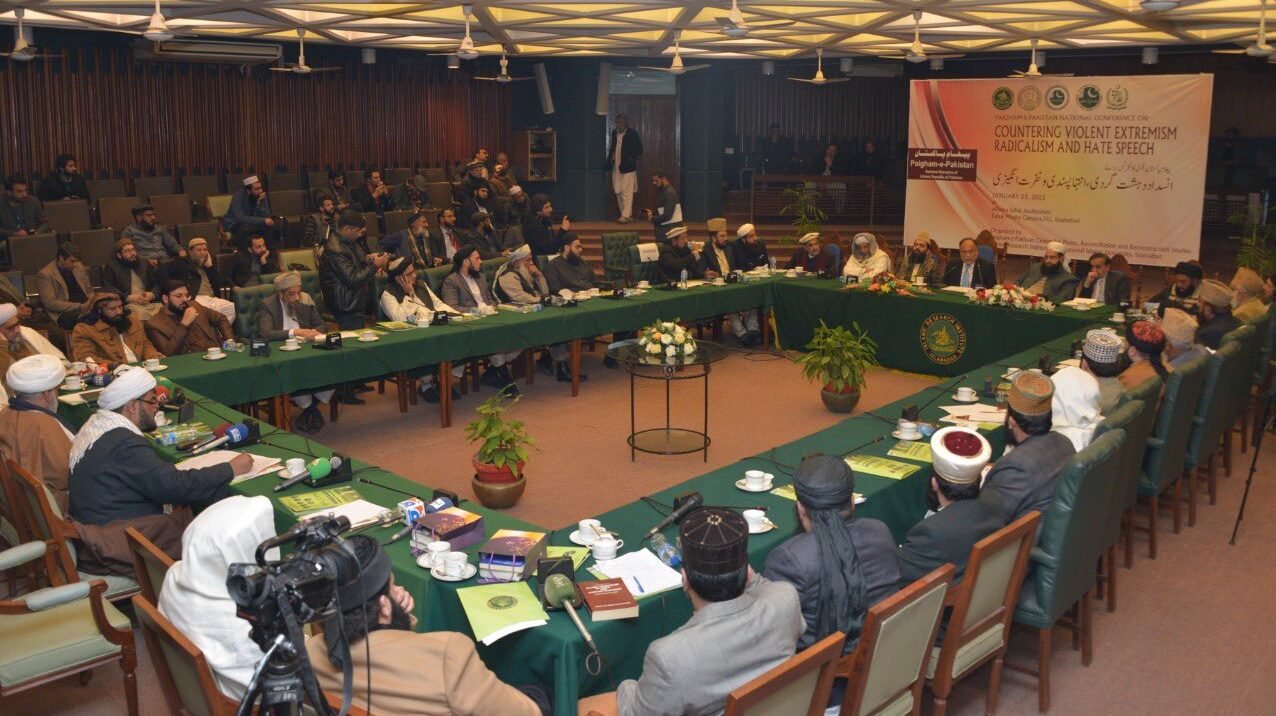
The scholarly consensus emerging from Pakistan has reinforced this position. The Paigham-e-Pakistan initiative, endorsed by more than 1,800 religious scholars, rejected terrorism, suicide attacks and unauthorized armed struggle. Its importance lies in challenging the religious vocabulary through which extremists attempt to legitimize violence. The message is straightforward. Individuals and private organizations cannot appropriate the authority to declare jihad for themselves. Scholars including Mufti Abdur Rahim and Dr Tahir ul Qadri have similarly argued that organized armed jihad falls within the authority of a legitimate state and that civilians cannot be turned into lawful targets through ideological manipulation.
Pakistan’s seminaries have also repeatedly distanced themselves from terrorism. Wifaq ul Madaris and religious scholars from diverse schools of thought have emphasized that madrasas are institutions of religious learning, moral development and social reform rather than recruitment grounds for militancy. Maulana Abdullah Khalil and other scholars have condemned attacks on mosques, madrasas and religious figures. Such attacks expose one of the most glaring contradictions of extremist violence.
A movement claiming to defend Islam while killing worshippers, scholars and students inside sacred spaces damages the very religious life it claims to protect
The Prophet Muhammad ﷺ established clear ethical restraints even during armed conflict. Women, children and other non-combatants were not to be deliberately harmed. Property and places of worship enjoyed protection. Terrorist attacks that deliberately create civilian casualties therefore cannot be transformed into legitimate religious acts merely by attaching the language of jihad to them. As Mufti Tayyab Qureshi and numerous other scholars have stressed, associating Islam with indiscriminate violence misrepresents the religion and provides ammunition to those who portray Islam itself as a source of extremism.
There is also a danger in the way extremist propaganda targets impressionable minds. Simplified fatwas, emotionally charged videos and selective quotations are frequently used to remove religious texts from their historical and jurisprudential context. Young people are encouraged to believe that anger itself creates religious authority.
Islamic scholarship developed elaborate rules precisely to prevent individuals from turning personal grievances into declarations of war
Pakistan’s fight against terrorism must therefore be understood at two levels. It is a defence of territorial sovereignty and public security, but it is also a defence of the integrity of Islamic teachings against ideological manipulation. Armed groups cannot become arbiters of faith simply because they speak in religious language. When violence produces murder, fear and disorder, religious slogans do not cleanse it of its consequences.
The strongest answer to extremist ideology is consequently found in Pakistan’s own constitutional and religious foundations. An Islamic constitutional state possesses institutions for law, scholarship, accountability and reform. Policies can be criticized, governments can change and political disagreements can be contested, but none of these disagreements gives private groups the right to declare war on society. Protecting citizens, preserving national unity and preventing bloodshed are responsibilities shared by both state and society. In that sense, rejecting terrorism is not a retreat from Islam. It is a defence of the justice, restraint and sanctity of human life that Islam itself demands.