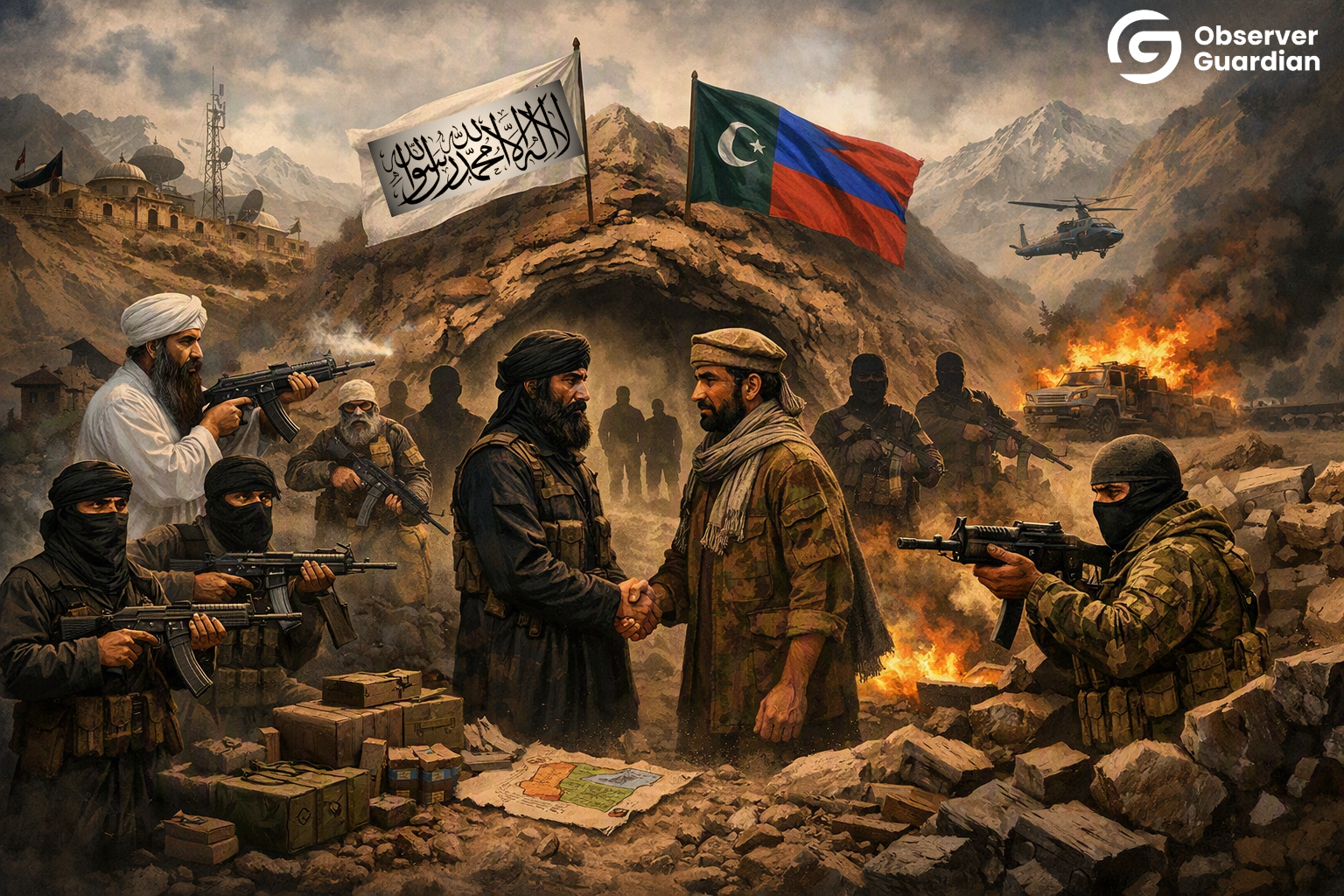

A squad of the Assistant Commissioner Harnai, accompanied by Frontier Corps personnel on routine duty, walked into a meticulously planned ambush. When the gunfire finally stopped, eight brave sons of Pakistan had embraced martyrdom. One lay wounded. Eleven Khawarij terrorists were neutralised by security forces who, true to their tradition, responded with decisive and lethal professionalism. Within hours, the Balochistan Liberation Army (BLA) rushed to claim the attack. To many, this looked like yet another communique from a separatist terrorist group. Look closer, and it exposes something far more dangerous: a unified terror network operating under a common handler, using attribution games as a weapon.
The claim pattern alone tells a story. The Global Terrorism Index 2026, published by the Institute for Economics and Peace, ranked Pakistan as the country most affected by terrorist incidents, with TTP as the deadliest group and BLA following closely. That two groups ranked first and second in Pakistan’s terrorism landscape would coordinate their operational and media strategies is not coincidence. It is doctrine. In the Ziarat Cross attack, TTP carried out the ambush while BLA stepped forward to claim it: shielding TTP from direct attribution and insulating its cross border sanctuaries from a stronger Pakistani response. The Afghan Taliban caretaker regime, known here as TTA, has clear incentives to discourage TTP from openly claiming such strikes: open attribution invites Pakistani military pressure on TTP infrastructure across the border.
The United Nations has now placed formal weight behind what Pakistani security officials and analysts have been saying for years. The 38th report of the UN Analytical Support and Sanctions Monitoring Team, covering December 2025 to June 2026, pointed to growing operational and facilitation linkages among TTP, Al Qaeda, Islamic State Khorasan, and the BLA. But the most damning finding goes deeper than coordination. The report stated that one member state reported BLA terrorists were trained alongside TTP by Al Qaeda trainers inside Afghanistan. That is not two groups borrowing each other’s tactics. That is two organisations sharing the same classroom, the same instructors, and ultimately the same strategic direction. A common handler. A shared mission.
This nexus provides funding, training, weapons, and logistical support: enabling BLA to carry out suicide bombings and attacks on security forces, Chinese workers, schools, and critical economic infrastructure. As of June 2025, security forces recovered 272 US made rifles and 33 night vision devices from BLA terrorists. Reports indicate that terrorists are pairing night vision and thermal equipment with small drones to attack troops with greater precision. These are not the weapons of a provincial separatist group scrounging for resources. This is a well supplied, professionally trained terrorist force with access to sophisticated military equipment: equipment that flowed from Afghanistan’s chaotic post 2021 environment through networks that TTP and Al Qaeda helped engineer.
Despite their sharply different stated ideologies, both BLA and TTP subordinate doctrinal purity to short term operational gains, enabling a transactional alliance centred on a shared adversary, complementary capabilities, and cross border logistical ecosystems. In January and February 2026, BLA conducted synchronized, multi pronged attacks across at least 10 to 12 locations in Balochistan simultaneously, striking Quetta, Gwadar, Mastung, Nushki, Dalbandin, Kharan, Panjgur, and others. The operational sophistication required for such simultaneous, geographically dispersed attacks does not emerge from isolated planning. It emerges from a networked ecosystem: one that the Ziarat Cross ambush further confirms is alive and active.
The international community’s response to this threat has been uneven, and the gaps have consequences. The United States took a meaningful step in early 2026 when it formally designated BLA and its Majeed Brigade as a Foreign Terrorist Organisation: a critical upgrade from its earlier Specially Designated Global Terrorist listing. Australia followed suit in May 2026, sanctioning BLA and three of its leaders for their role in terrorist activities. Yet even as these bilateral designations accumulated, a China Pakistan proposal at the UN Security Council to designate BLA and the Majeed Brigade under the 1267 sanctions regime was blocked, with the US, France, and the United Kingdom all opposing the bid. This contradiction: designating BLA domestically while blocking multilateral accountability: leaves dangerous gaps in the global counter terrorism architecture. It gives BLA operational and financial breathing room that its victims in Balochistan cannot afford.
BLA’s campaign has long since crossed the threshold that defines a terrorist organisation under any serious analytical framework. It has targeted innocent civilian labourers working on development projects, passengers aboard a hijacked train, security personnel protecting communities, and Chinese workers whose only connection to geopolitics is building infrastructure. The nexus between BLA, Al Qaeda, and TTP is aimed explicitly at disrupting the China Pakistan Economic Corridor and other national development projects: a strategic goal that extends beyond Balochistan into the wider architecture of regional connectivity and stability. The attack on Pakistan’s economic future is also an attack on the region’s.
What the Ziarat Cross ambush crystallises is this: the TTP BLA nexus is no longer an intelligence assessment. It is an operational reality, documented by UN monitors, confirmed by recovered weapons, demonstrated through joint training environments in Afghanistan, and evidenced through the choreography of attack and attribution we witnessed on September 3. Pakistan’s security forces have responded with the resolve their oath demands: neutralising the threat on the ground, absorbing unbearable losses, and continuing to hold the line. What they need from the world is not sympathy. They need accountability.
The UN Security Council’s 1267 mechanism exists precisely for this moment. Member states must use it: without veto and without calculation: to designate organisations whose connection to Al Qaeda is no longer a matter of allegation but of UN documented fact. Facilitators operating from Afghan soil must face sanctions. The handlers who coordinate two terrorist organisations under one strategic roof must be named, listed, and isolated. Anything less is not counter terrorism policy. It is appeasement dressed in procedural language.
Pakistan’s security forces paid on September 3 with lives that cannot be replaced. The least the world can do is deny their killers the space, the funding, and the impunity that make the next ambush possible.
Disclaimer: The views and opinions expressed in this article are exclusively those of the author and do not reflect the official stance, policies, or perspectives of the Platform.