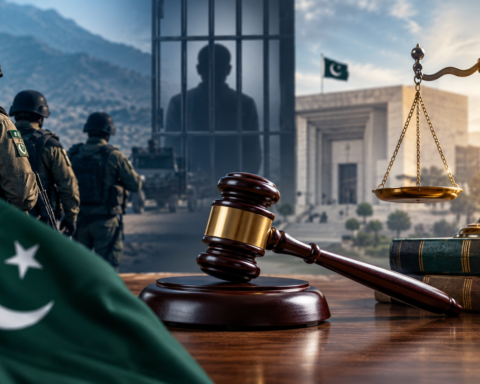
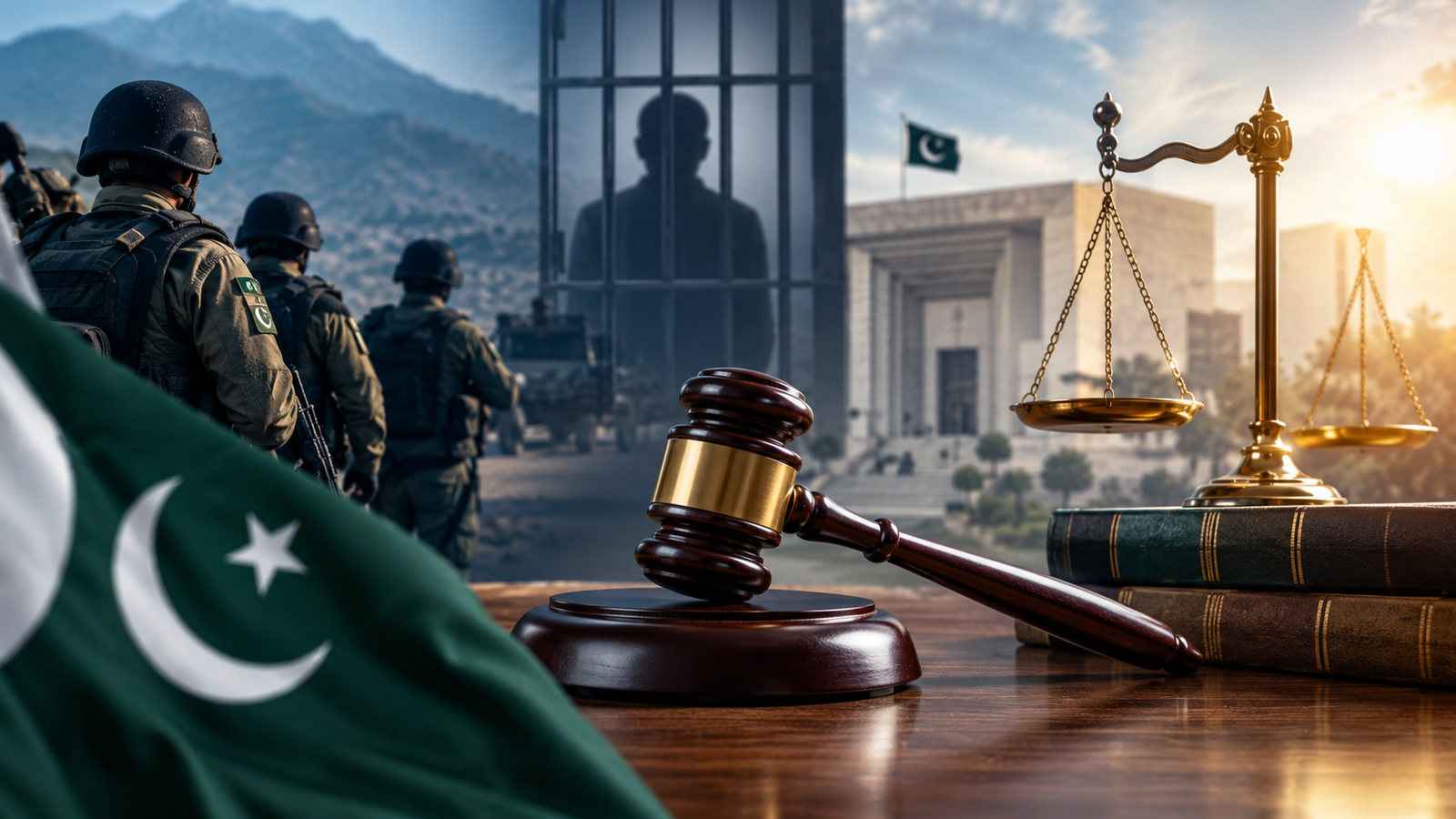

For decades, Pakistan’s war against terrorism played out on two fronts, the battlefield and the courtroom. While the battlefield saw hard won gains, the courtroom repeatedly let the nation down. Terrorists who were apprehended with painstaking effort by law enforcement agencies walked free, not because they were innocent, but because the legal machinery was simply not designed to handle them. That gap between apprehension and justice is precisely where the narrative of enforced disappearances took root and grew. Today, Pakistan is finally moving to close that gap through a coherent, structured legal framework.
The numbers tell a damning story about why change was inevitable. Between 2001 and 2020, Pakistan’s conviction rate in terrorism cases was reportedly as low as 8%, underscoring deep weaknesses in traditional criminal procedures when dealing with complex terrorism cases. Compare that with 88% in the United Kingdom, 99% in China, and 99.9% in Japan, and the scale of the prosecution failure becomes stark. A criminal justice system with such a dismal conviction rate does not just fail the state, it creates a vacuum. And vacuums get filled. When courts cannot deliver justice, pressure mounts on law enforcement agencies to find other means.
That pressure, over time, translates into allegations of enforced disappearances.
The root cause of this failure is structural. Pakistan’s Anti Terrorism Act of 1997 was built on the scaffold of an older criminal code designed to prosecute ordinary criminals, not khawarij affiliated with transnational terror organisations like TTP and BLA. Legal gaps in evidence admissibility, especially evidence gathered through modern surveillance and electronic means, made prosecution nearly impossible. But the more sinister problem was fear. Pakistan has experienced this danger directly. The Anti Terrorism Act of 1997 procedures proved inadequate against organised groups such as TTP and the Balochistan Liberation Army. Judges were targeted. Witnesses disappeared before they could testify. Prosecutors faced death threats. The judicial chain broke down not because the law was entirely absent, but because those meant to enforce it were being systematically silenced.
This reality is not theoretical. Justice Muhammad Noor Meskanzai, former Chief Justice of Balochistan High Court, was assassinated in Kharan in 2022 after surviving a targeted bomb attack years earlier. District and Sessions Judge Abdul Hakeem Kakar was killed in Mastung in July 2026 while Additional Sessions Judge Tariq Lashari was injured in the same attack. Around 50 CTD officials have reportedly been killed in Balochistan alone. When the people responsible for delivering justice face assassination as an occupational hazard, it is no wonder that prosecutions collapse.
Pakistan has now responded with two significant legislative interventions. The Anti Terrorism (Balochistan Amendment) Act 2025 inserted Section 11 EEEE into the ATA 1997, introducing preventive detention for inquiry for up to 90 days. The Anti Terrorism (Punjab Amendment) Act 2026 not only inserted provisions of Section 11 EEEE but also inserted Section 21 AAA, providing a special security framework enabling Faceless Courts and enhanced protection for judges, prosecutors and witnesses. These are not emergency measures conjured in panic, they are deliberately designed institutional responses to a documented crisis.
The 90 day preventive detention framework directly addresses the enforced disappearances narrative. Under it, a suspect must be produced before a judge within 24 hours of apprehension, with family notification and access guaranteed. The detention period allows law enforcement agencies to investigate and build a prosecutable case. If evidence is insufficient, the suspect is released. If evidence is established, the case proceeds to trial. This creates a statutory, time bound, and traceable process where previously there was none, replacing what critics characterised as an unaccounted process with one that has judicial oversight built in. According to official sources, around 90 suspects had been detained under the new Balochistan framework, with around 5 released where allegations could not be established and 40 referred for trial through Faceless Courts.
Faceless Courts address the second dimension of the problem, the safety of those delivering justice. Under the Faceless Court mechanism, the High Court Chief Justice nominates five ATC judges and five prosecutors for terrorism related proceedings, with their identities along with those of witnesses kept confidential through protected documentation, signatures, confidential proceedings and voice masking. This is not unprecedented. Colombia deployed faceless judges during the 1990s in drug trafficking and terrorism cases. Italy’s special protection laws, born from the experience of the Sicilian Mafia’s Maxi Trial, enabled testimony in organised crime cases where witnesses faced lethal reprisals. The United Kingdom’s Coroners and Justice Act 2009 permits Witness Anonymity Orders including voice modification. The Netherlands used similar mechanisms in the MH17 proceedings to protect witnesses facing security risks. Pakistan’s approach sits squarely within an established international tradition.
Critics have raised legitimate questions about due process implications. These deserve engagement rather than dismissal. The framework’s credibility ultimately rests on rigorous judicial oversight of the detention period, meaningful access to legal representation, and consistent application that does not blur the line between genuine terrorism suspects and political opponents. The law’s promise is its structure, the 24 hour production requirement, the 90 day ceiling, the family access provisions. Whether that structure holds in practice is a question that courts, civil society, and parliament must continue to monitor.
What is clear is the alternative. The Commission of Inquiry on Enforced Disappearances has so far received 10,607 cases across Pakistan. That caseload accumulated over two decades of a system that could neither prosecute terrorists effectively nor account transparently for those it detained.
The new framework attempts to break that cycle by bringing terrorism related apprehensions inside the law, not outside it.
Pakistan’s terrorism challenge is among the most severe faced by any state. Pakistan lost approximately 83,000 lives between 2001 and 2022 and suffered economic losses exceeding Rs35 trillion. A nation absorbing losses of that magnitude has both the right and the obligation to build a legal architecture adequate to its reality. What it has done is not abandon the rule of law, it has attempted to extend it into territory where, for too long, it simply did not reach.