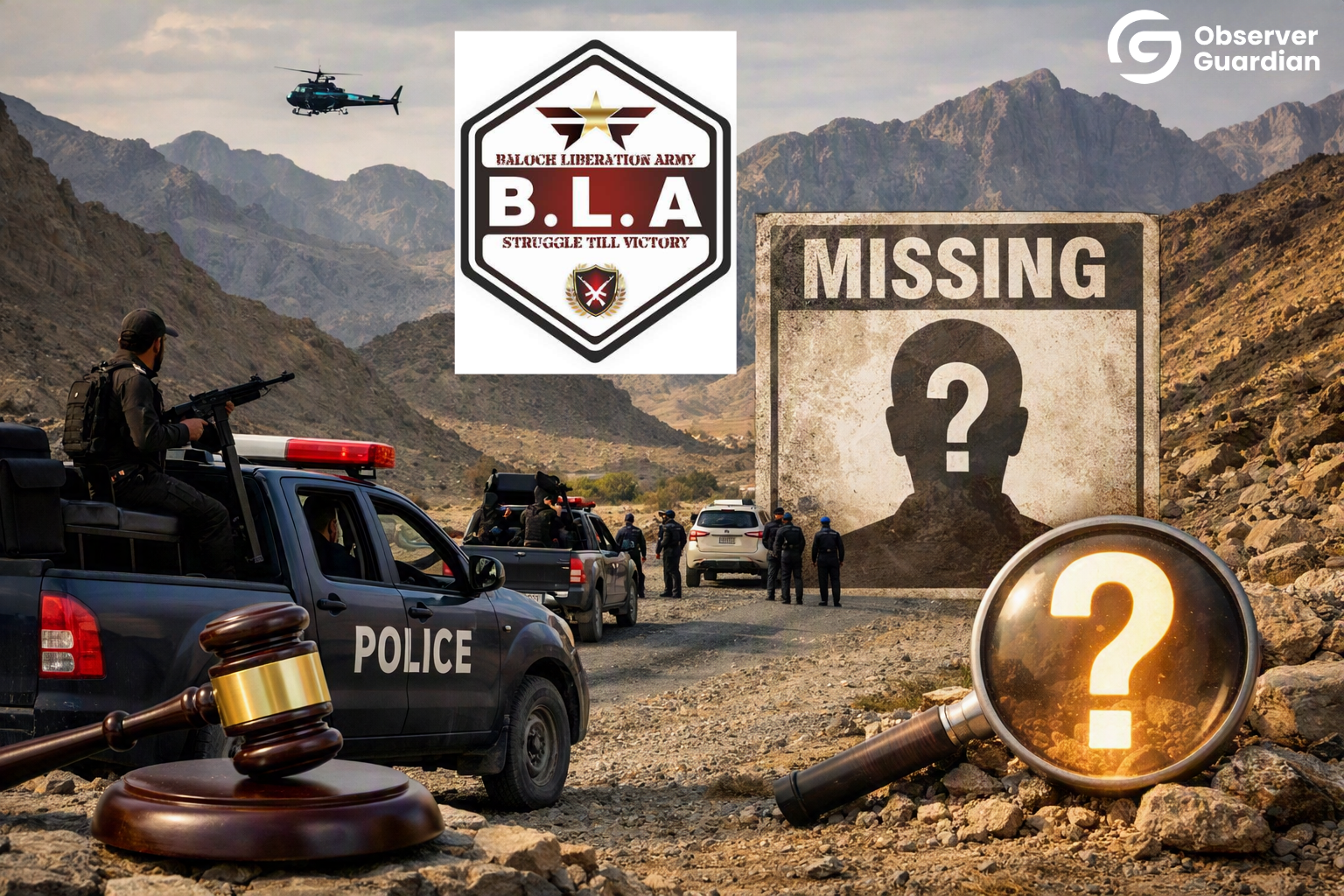
On the evening of September 6, 2026, a Suzuki Cultus bearing registration ALK 507 left the village of Sheesha Dagar in Kalat, heading toward Khuzdar along the N 25 national highway. Behind the wheel was Ali Baig, a Judicial Magistrate posted at Hub Chowki. Somewhere near the Bencha area of Kalat, his phone went silent, and he vanished. His family raised the alarm. Police launched a search operation. As of this writing, his whereabouts remain unknown.
This is not a criminal kidnapping. This is a targeted assault on the judicial system of Pakistan and Balochistan is being used as the testing ground.
The disappearance of Magistrate Ali Baig did not happen in a vacuum. It comes barely six weeks after one of the most chilling attacks on the legal fraternity in recent memory. On July 23, 2026, District and Sessions Judge Abdul Hakeem Kakar was traveling from Quetta to Mastung to hear cases when armed men ambushed his vehicle on the national highway. He and his security guard were killed on the spot, while Additional Sessions Judge Tariq Lashari sustained serious injuries. The Balochistan Bar Council responded by announcing a two day boycott and three days of mourning. Chief Justice of Pakistan Yahya Afridi expressed grief on behalf of the entire judiciary. But beyond condemnations and black armbands, a darker truth demanded attention: this was not a random act of violence. It was a strategy.
The pattern of attacks reflects a calculated shift in strategy to instil widespread fear and destabilise public administration across Balochistan. For months, state law enforcement agencies successfully stood as a wall against anti state elements. In response, these terrorist networks have expanded their scope of violence to soft targets, unarmed citizens, and judicial officers in a desperate bid to create chaos.
This shift did not come from nowhere. It reached a breaking point following the June 22, 2026, sentencing of BYC chief Mahrang Lango by an Anti Terrorism Court in Quetta. Unable to confront law enforcement directly on the ground, the leadership turned its sights on the court system. When you cannot defeat the law in court, you target the people who uphold the law on the road. That is the logic of the Khawarij those who have abandoned all moral and religious boundaries in their war against the state and its institutions.
To target a judicial officer is to attack the very foundation of the legal system.
Any movement that deliberately murders civilians and seeks to paralyse public life forfeits any moral legitimacy. The abduction of Magistrate Ali Baig fits this pattern with surgical precision. He was not a military officer, not a police commander, not a politician. He was a magistrate, a man whose daily work involved hearing complaints, issuing orders, and providing ordinary citizens access to justice. By abducting him, these terrorists send one message above all others: no one in a state uniform is safe, and no institution is beyond their reach.
The BLA’s evolution over the years makes this trajectory entirely predictable. Since August 2024, BLA’s tactics have shown a concerning trend, launching simultaneous attacks on multiple targets and locations, focusing on urban areas, apparently designed to overwhelm and paralyse state security apparatus. The group conducts suicide bombings, ambushes using small arms and explosives, hostage taking operations, and targeted assassinations against local security services, ethnic Punjabis, and Chinese personnel and infrastructure development projects. The international community has taken note. In May 2026, Australia sanctioned the BLA and three of its leaders due to their involvement in terrorist activities, joining other nations including the US and Pakistan in designating the BLA as a terrorist organization.
Yet designations and condemnations alone cannot protect a judge traveling alone on N 25. The disappearance of Magistrate Ali Baig raises serious questions about the security protocols extended to judicial officers in Balochistan’s most volatile districts. Judges and magistrates are the living symbol of state authority at the grassroots level. When they cannot travel safely between their native villages and their courtrooms, the entire civic architecture begins to crack.
Consider what a successful campaign of judicial intimidation would mean for Balochistan. Courts would fall silent. Cases would stall. Citizens with genuine grievances land disputes, criminal complaints, family matters would find no recourse. The vacuum left behind would be filled not by justice but by fear, by informal enforcement, and by the very armed groups who manufactured that vacuum in the first place. This is the goal.
Terrorists do not merely want to kill individuals they want to kill the idea that the state can protect and serve its people.
Balochistan’s people deserve better than this. They deserve a province where a magistrate can drive home to his village without disappearing. They deserve courts that function, judges who are protected, and a legal system that represents the interests of ordinary citizens, not the political agenda of those who thrive in chaos. There can be no ambiguity, and certainly no political equivocation, when confronted with organisations that deliberately murder civilians.
The search operation launched after Ali Baig’s disappearance must be swift and exhaustive. But beyond recovery, there must be a serious reckoning with how judicial officers in Balochistan are protected or left unprotected as they carry out their duties. The state cannot continue to absorb one attack after another on its officers without fundamentally strengthening the security net around those who make the rule of law a daily reality.
Pakistan’s judiciary has buried a judge. It may be searching for a magistrate. It cannot afford to lose the third.
Disclaimer: The views and opinions expressed in this article are exclusively those of the author and do not reflect the official stance, policies, or perspectives of the Platform.