
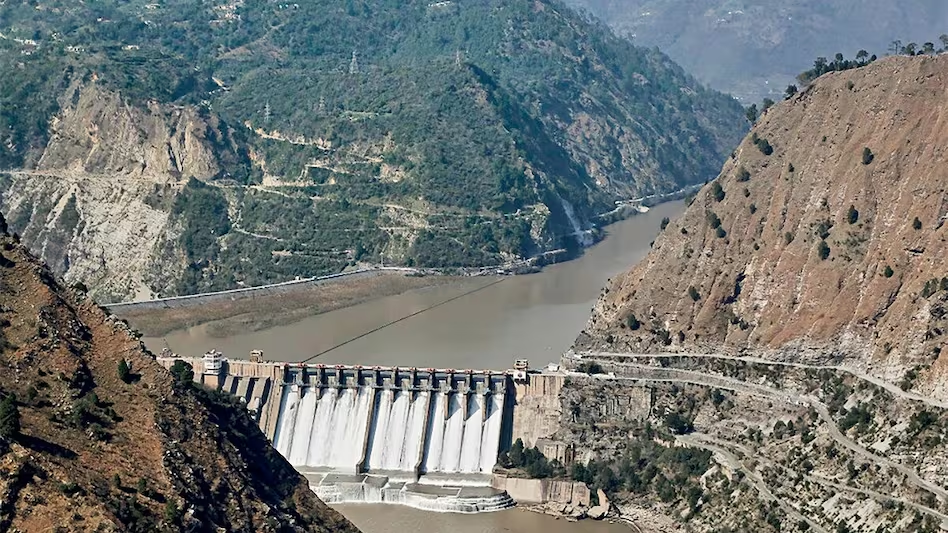

For more than sixty years the Indus Waters Treaty stood as proof that even bitter adversaries could manage a shared lifeline without resorting to coercion. That proof is now being dismantled deliberately and methodically by New Delhi. India’s unilateral decision to hold the 1960 treaty “in abeyance,” paired with increasingly explicit rhetoric about ensuring “not a single drop” reaches Pakistan, and now operationalized through the newly approved Chenab Beas Link Tunnel, represents a dangerous convergence of legal violation, infrastructural aggression, and strategic intimidation against a downstream nation of 240 million people.
From Rhetoric to Engineering
What was once dismissed as political bluster has now acquired physical form. In May 2026 India’s central government formally approved the Chenab Beas Link Tunnel project in Himachal Pradesh, an 8.7 kilometre underground tunnel beneath the Pir Panjal range designed to divert water from the Chandra River the headwaters of the Chenab into the Beas river system. The project carries an estimated cost of ₹2,352 crore and is described as one of the major river linking infrastructure initiatives connected to the Chenab.
Pakistan’s Foreign Office has not minced words. Reacting to the project, Foreign Office spokesperson Tahir Andrabi described India’s plan to tunnel Chenab water into the Beas as a grave violation of the Indus Waters Treaty and broader international law, citing public tender documents indicating an intention to transfer 1.9 million acre feet of water annually from the Chenab into the Beas system. Andrabi went further, framing the inter basin diversion as a breach not only of the IWT but of the Vienna Convention on the Law of Treaties and the principles embedded in the 1997 UN Convention on the Law of the Non Navigational Uses of International Watercourses.
The timing of this project is impossible to separate from the broader context. The tunnel and an accompanying sediment management project at the Salal Dam are being executed against the backdrop of the continuing abeyance of the treaty, placed in suspension by India in April 2025, and India’s categorical rejection of the Court of Arbitration’s May 2026 award limiting reservoir pondage at the Ratle and Kishanganga projects as “illegally constituted.”
Why the Legal Framework Matters
The Indus Waters Treaty was never a vague gesture of goodwill, it was a precise binding division of entire river systems. After nearly a decade of World Bank facilitated negotiations, the treaty allocated the eastern rivers Sutlej, Beas, and Ravi to India for unrestricted use, while the western rivers Indus, Jhelum, and Chenab went to Pakistan.
The Permanent Court of Arbitration has already ruled decisively on the legal status of India’s actions. In June 2025 the court ruled unanimously that India cannot unilaterally suspend the treaty, finding its declaration of abeyance has no legal effect. In August 2025 the court reaffirmed that India’s rights on the western rivers are limited exceptions to a general obligation owed to Pakistan and must be strictly construed.
It is precisely this legal architecture that the Chenab Beas Link Tunnel threatens to override. Unlike a run of river hydroelectric project operating within the Chenab system, the proposed canal is infrastructure explicitly designed to move water from one treaty governed basin into another, the very question the PCA’s rulings were meant to settle. India may describe this as simply harvesting “surplus” monsoon flows, but when a state that has already declared a binding treaty void unilaterally decides what constitutes “surplus” on a river it shares with a downstream nation, the word loses all legal meaning.
A Pattern, Not an Accident
The Chenab Beas project cannot be read in isolation. It follows India’s April 2025 declaration suspending the treaty in the aftermath of the Pahalgam attack, its refusal to participate in arbitration proceedings, its rejection of successive PCA rulings as void, and its withholding of the hydrological data that downstream communities depend on for flood forecasting. Commentators tracking the project describe it as a marker of a fundamentally altered Indian posture. One analysis observed that the diversion project demonstrates New Delhi no longer appears willing to approach the treaty framework with the restraint that characterized earlier decades, and forms part of a broader infrastructure architecture designed to maximize India’s utilization of waters that remained underexploited for decades because of treaty sensitivities and political caution.
Even Indian commentary on the project frames it within an unmistakably adversarial register. One Indian outlet described the initiative outright as a “water strike” on Pakistan, noting it comes months after the treaty was placed in abeyance and is designed to leverage seasonal flows from the Chenab during the summer months when Indian plains face heat and drought. When a project is openly described in militarized language by commentators within the country building it, downstream states are entitled indeed obligated to treat it as a strategic signal, not a benign engineering exercise.
The Stakes Are Civilizational, Not Bureaucratic
Pakistan’s dependence on the Indus system is not a negotiating position, it is a demographic and ecological fact. The Chenab alone sustains agriculture across Punjab, feeding the kharif and rabi cycles that millions of households rely on for income and survival. Even diversions described as “modest” by their proponents represent a permanent precedent, that India can, at will and without consultation, redirect water from a treaty protected basin whenever its domestic calculus changes.
This is the essence of what can only be called hydro aggression not necessarily because every cubic foot diverted today causes immediate catastrophe, but because the act establishes the principle that Pakistan’s water security exists only at the discretion of a neighbor that has already declared the governing treaty meaningless. A nuclear armed state unilaterally rewriting the terms of a sixty five year old water sharing accord, while simultaneously refusing international arbitration, is not managing a domestic infrastructure portfolio, it is redrawing the strategic map of South Asia’s most consequential shared resource.
The World Cannot Look Away
International legal bodies have spoken with unusual consistency. The Permanent Court of Arbitration has repeatedly affirmed that the treaty remains binding and that India’s abeyance has no legal standing. Pakistan’s position that water rights under the IWT are not subject to unilateral political revision rests on this accumulated body of arbitral findings, not on rhetoric.
What is needed now is sustained international attention commensurate with the stakes. A project capable of altering flows into one of the world’s most agriculturally dependent river basins, built by a state that has simultaneously declared the governing treaty void and the arbitration mechanism illegitimate, is not a regional curiosity. It is a test case for whether transboundary water law has any binding force at all when a stronger riparian state decides it is inconvenient. The Chenab does not recognize abeyance. Neither should the international community.
Disclaimer: The views and opinions expressed in this article are exclusively those of the author and do not reflect the official stance, policies, or perspectives of the Platform.