
Few parties in Pakistan’s political history have converted the name of “religion” and “character” into political capital as skillfully as Jamiat Ulema e Islam (Fazlur Rehman). On one hand, this party delivers sermons on Islamic morality, and on the other, its own garment carries stains that are scrubbed at but never washed away.
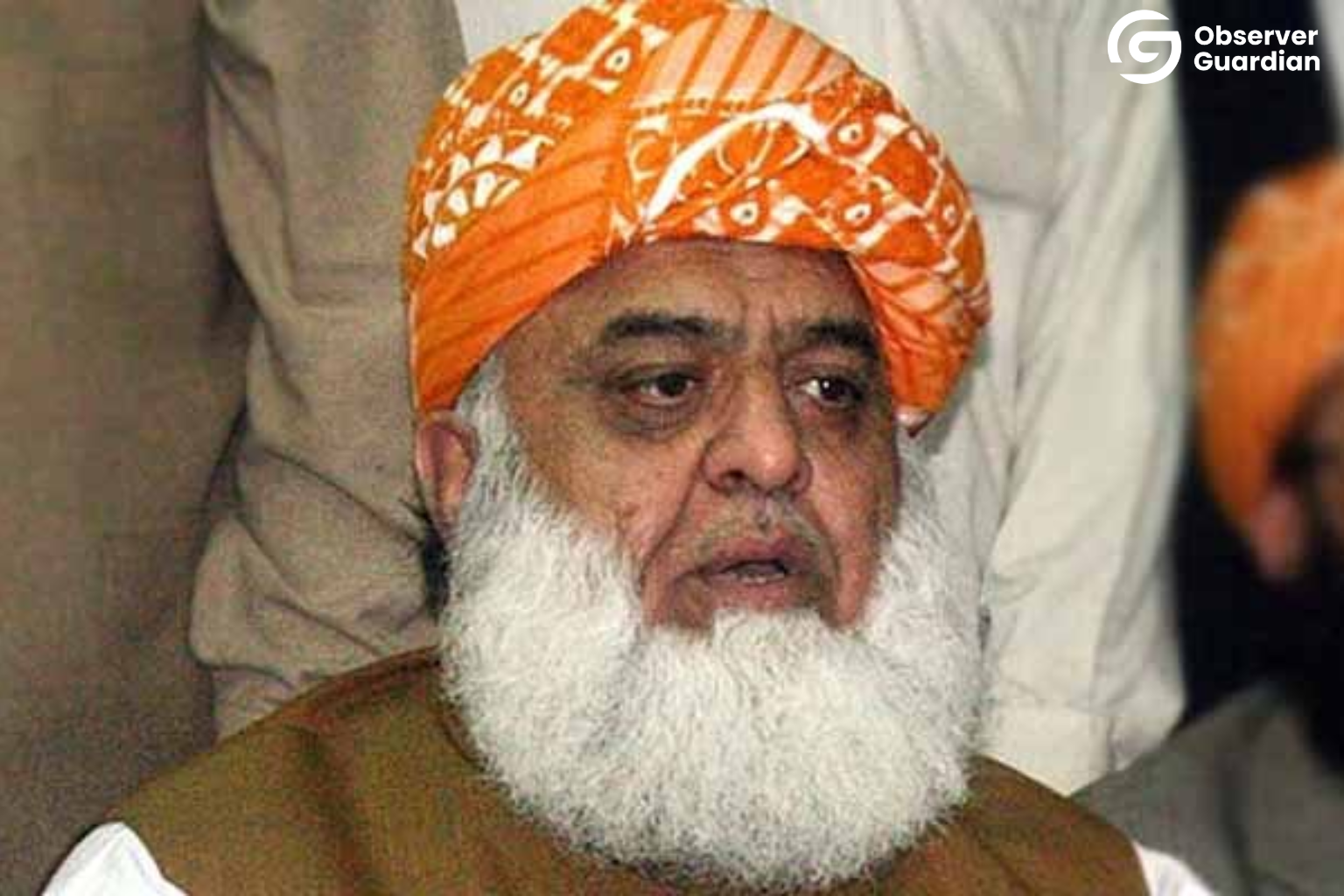
The events of July 2026 once again proved how deeply Maulana Fazlur Rehman’s politics is saturated with contradiction. At a public gathering in Kasur, Maulana Fazlur Rehman made a deeply controversial statement regarding the martyrdom of military personnel, following which a petition was filed against him in a Gujranwala court, and the court summoned him for July 28. This is the same Maulana who calls himself the guardian of “Islamic values.”
Defence Minister Khawaja Asif also remarked on the occasion that Maulana Fazlur Rehman is a seasoned politician and a prominent religious leader, and therefore a greater level of responsibility is expected from him in his choice of words. That this criticism came from his own former allies tells you everything about how Maulana’s politics has eventually unsettled every partner.
But the real question is: what is the state of the party’s own house, when it is the one lecturing others on character? The Mufti Aziz ur Rehman case is already inscribed in history. A local Lahore court handed Mufti Aziz ur Rehman over to police on a three day physical remand on charges of alleged sexual assault against a student. This was a man who headed a madrassa and belonged to circles close to the Jamiat. The question that arises is: why did a party that claims to oversee the religious upbringing of students stay silent about incidents of this nature within its own institutions?
The Muttahida Madaris Council itself declared Maulana Fazlur Rehman’s statements to be the personal and political position of his party, which makes it plain that even the world of madrassas now sees Maulana not as a representative of Islamic education, but as a political operator. For him, madrassas are not centers of learning but instruments of bargaining. When ministries and budgets flow in, the madrassa issue becomes an “internal matter.” When the privileges dry up, those same madrassas become “national assets” and the foundation for protest.
The National Accountability Bureau sent Maulana Fazlur Rehman a questionnaire comprising 26 questions on corruption allegations, demanding a response. These allegations did not rise out of thin air; government institutions put them on record across multiple periods. The alleged sale of Senate tickets, alleged financial benefits in the allotment of government employee housing under the Ministry of Housing these are charges that have never been answered with transparency.
If Maulana Fazlur Rehman’s political record is examined closely, one clear pattern emerges. Critics hold that Maulana Fazlur Rehman’s political style has always been rooted in opportunism, and this impression is not unfounded, because after every entry into government, the scaffolding of the Jamiat’s “principled position” shifts.
When power is granted, the ruling of “expediency” arrives. When it is withheld, the slogan of “revolution” rings out. How he went from electoral defeat in Pishin to being declared a winner the details of that journey live in his own conscience.
The students’ issue is the most painful of all. Thousands of young people study in madrassas, sent there by parents who wanted them to learn the faith. But whenever a political need arises, those very students become part of protests and sit ins. When the “weapon” misfires, responsibility is deposited into the account of “conspiracy.” These young people are treated as components of a vote bank, not as the future of a nation at least in the eyes of the Jamiat leadership.
Pakistan is a democratic country, and political disagreement is the right of every party. The right to criticize belongs to everyone. But when a party raises the banner of character and integrity, it is equally the nation’s right to ask questions of that party.
Using “religion” as a shield and then trading in interests behind that same shield is neither service to the faith nor to the nation.
If the politics of principles is truly the goal, then the gaze must first turn inward. Accountability begins at home, because those who live in glass houses must not throw stones.
Disclaimer: The views and opinions expressed in this article are exclusively those of the author and do not reflect the official stance, policies, or perspectives of the Platform.