
There is something deeply telling about what happened last week in Quetta. Scholars from every school of thought, Sunni, Shia, Deobandi, Barelvi, and others, sat together at Jamia Salafia under one roof and signed a single declaration. They didn’t argue about jurisprudence. They argued about daughters. That alone tells you how serious the situation has become.
The declaration was issued at a joint meeting of the National Paigham e Aman Committee and the Balochistan Paigham e Aman Committee, where participants expressed full support for Pakistan’s security institutions against both Fitna al Khawarij and Fitna al Hindustan, reaffirming that suicide attacks are forbidden in Islam and that terrorism runs contrary to its fundamental teachings. But buried within the broader statement was a warning that deserves far more attention than it has received: terrorist networks are now systematically targeting, blackmailing, and weaponizing women.
This is not rumour. This is documented, confessed, and accelerating.
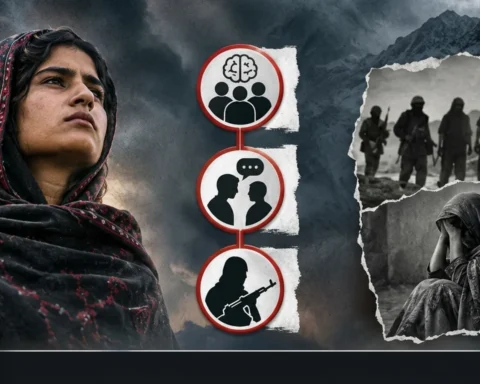
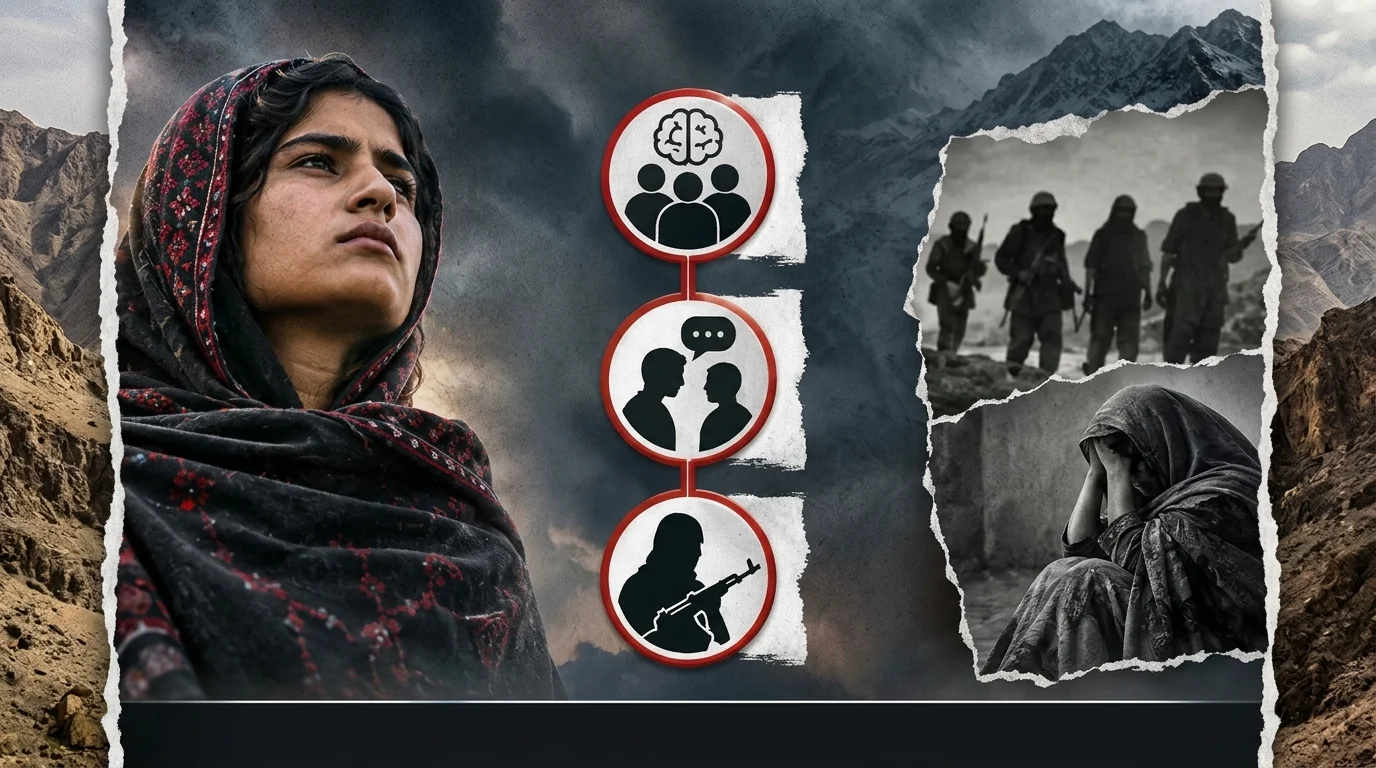
What was once a campaign marked by sporadic guerrilla strikes has evolved into a calculated exploitation of women, drawn or compelled into the ranks of terrorism as instruments of violence. By early 2026, the trend had accelerated dramatically, with many women, when apprehended before completing their missions, offering confessions that paint a picture of exploitation rather than voluntary zeal.
The mechanics of this exploitation follow a chilling pattern. Recruitment does not begin with ideology. It begins with a fake social media account, weeks of grooming, and the creation of explicit material. Adeela Baloch, a nurse and WHO worker, revealed at a press conference that terrorists seduce Baloch women through blackmail, and she was an eyewitness. When ideological manipulation fails, the group resorts to cyber blackmail, trapping young women by acquiring personal digital media to force compliance under the threat of family dishonour.
In an honour based tribal society, that threat is not an embarrassment. It is an existential one. Where explicit material, emotional grooming, or threats to family honour are used to compel women into terrorism, the matter is no longer simply terrorism. It is gendered violence.
Open source intelligence indicates a more structured integration of women in what the BLA called “Operation Herof 2.0” in 2026, with women deployed in synchronised attacks across multiple districts. Operatives were central to high value strikes on security installations, reflecting a systematic use of women in recruitment, planning, and high risk operations. The Global Terrorism Index 2026 ranked Pakistan among the countries most severely impacted by terrorism, and this particular trend is part of what drives that ranking.
Now ask a simple question: What does bombing a road in Balochistan accomplish for the people of Balochistan?
The BLA has escalated its terrorist campaign against critical infrastructure, highways, supply vehicles, and transport grids in Balochistan. When trains are attacked, highways are repeatedly targeted, freight vehicles are stopped, and critical infrastructure is bombed, the economic cost falls entirely on the people of Balochistan themselves. The United States designated the BLA a terrorist organisation in August 2025. Australia followed in May 2026, and the United Kingdom in July 2026. The international community is no longer ambivalent about what this group is.
The scholars in Quetta were right to question the logic of groups who claim to love Balochistan yet blow up the bridges, roads, colleges, and hospitals that connect Balochistan to the rest of the world. It is not liberation. It is manufactured deprivation, designed to keep a province poor, isolated, and angry enough to produce the next recruit.
There is compelling evidence of a nexus involving external hostile forces providing financial support, training, and advanced weaponry to these terrorist groups, working jointly to promote terrorism in Pakistan and weaken it economically and strategically. Security sources documented that India linked social media accounts amplified support for these attacks during coordinated violence, which they described as part of a hostile information campaign. The hashtag #FitnaAlHindustan exists precisely because this threat is understood to be hybrid in nature: kinetic operations on the ground, propaganda warfare online, and the exploitation of genuine local grievances as fuel.
This is where the ulema’s call for dialogue becomes critically important, and also where it must be understood correctly. The scholars did not call for dialogue with those who detonate bombs in school buses or blackmail girls into suicide vests. Senior security officials themselves stressed that the problem cannot be solved through bullets alone and that winning the peace requires winning over ordinary Baloch people. That is the dialogue being urged: with the communities, the families, the youth in universities, the people who have real grievances and deserve real answers through constitutional, political channels. Not with those who knife at the very foundations they claim to be building.
The Quran is unambiguous on this point. Whoever kills one soul without just cause is as if they have killed all of humanity. The scholars quoted it. It was not a political statement. It was a moral boundary, one that applies equally regardless of whether the victim is Muslim, non Muslim, Baloch, or Punjabi. Life is the variable. Taking it without right is the crime.
Parents in Balochistan and Khyber Pakhtunkhwa need to hear this message clearly: terrorist groups operating in Balochistan are increasingly exploiting women through psychological manipulation, coercion, and organised recruitment mechanisms, and radicalisation of vulnerable youth is often carried out through ideological messaging and narrative influence before operational deployment follows. Monitor your children’s digital lives. Ask difficult questions. The enemy is not always at the gate. Sometimes it is in a phone, behind a fake profile, speaking the language of justice while preparing the next trap.
Pakistan’s security forces are doing their part. Security forces have intensified operations in Balochistan, neutralising hundreds of terrorists and foiling several major plots, including a planned attack on Islamabad involving a female operative who was arrested before she could act. Operations are succeeding. But a military operation cannot mend a family. It cannot counsel a girl who was groomed for months and has nowhere to turn. That work belongs to communities, scholars, parents, and the institutions that serve them.
The women of Balochistan are not symbols of resistance. They are targets of a cowardly campaign by people who have run out of men willing to die for them. Naming that truth clearly, from the pulpit, in the home, on the university campus, is itself a form of national defence.