There is a particular kind of institutional failure that doesn’t announce itself loudly. It creeps in through cracks left by urgent necessity, a crisis here, a security vacuum there, and before anyone quite notices, what was once a temporary fix has become a parallel system of power, with its own loyalties, its own rules, and its own immunity from accountability. That is precisely what unfolded in Bannu and Lakki Marwat, where so called Police Peace Committees gradually shed their stated purpose and morphed into something far more dangerous: armed networks operating in the shadows of the state, exploiting local trust, and as evidence now shows, maintaining ties with the very terrorist elements they were meant to resist.
The Khyber Pakhtunkhwa government’s decisive move to dismantle these unauthorized structures deserves more than routine acknowledgment. It deserves serious analysis, because it speaks to a broader challenge Pakistan’s security architecture must honestly confront.
The Original Sin: Accountability Free Auxiliary Forces
Peace committees were never a bad idea in principle. Southern KP, particularly Bannu and Lakki Marwat, has been a frontline for years. The districts absorbed the consequences of regional instability, hosting operations against Khawarij and terrorist networks while the civilian population bore the daily costs. When formal law enforcement was stretched thin, community based auxiliary structures seemed like a pragmatic bridge, local knowledge, local presence, local accountability.
But pragmatism without institutional architecture is a gamble. These committees were never formally codified under the Police Act. They operated on ad hoc administrative mandates, without rigorous vetting, without statutory oversight, and without clear mechanisms of removal. And when you build a structure without an exit door, you should not be surprised when those who occupy it refuse to leave.
The Lakki Marwat crisis that erupted in mid 2026 exposed the full cost of this gamble. A military raid on the home of a peace committee member in May uncovered a wanted terrorist being sheltered under the committee’s protection. The fallout was swift and damning, a committee president’s threatening voice note allegedly leaked, accusations flew, and the fiction that these groups were aligned with state objectives finally collapsed in plain sight.
Wolves in Khaki Clothing
What is particularly troubling about the Bannu and Lakki Marwat situation is not just that criminal elements infiltrated the peace committees. It is who those elements were. A significant portion comprised individuals previously dismissed from the KP police force under former IGP Akhtar Hayat Khan, terminated for corruption, misconduct, and documented links to terrorist networks. These were not naive civilians drawn into crime. These were people with institutional knowledge, police training, weapons familiarity, and a grudge.
Once embedded in the committees, they operated with alarming brazenness. Illegal checkpoints became extortion points. Sophisticated prohibited weapons were carried openly. And most disturbingly, some functioned as informers feeding intelligence to hostile elements, compromising legitimate operations, and putting both police personnel and civilians at risk. Former Constable Waheedullah’s brutal murder of a sixth grade child, and the violent targeting of Constable Dawar Khan simply for dissenting online, were not aberrations. They were demonstrations of a culture of impunity that had been allowed to fester.
This is not a community policing problem gone wrong. This is an organized criminal and ideological subversion of state institutions, wrapped in a flag of legitimacy it had long since forfeited.
The State Strikes Back And Does It Right
What makes the government’s response worth examining is not simply that it acted, but how it acted. The KP government and security institutions chose a synchronized, multi layered approach rather than a blunt crackdown that risks civilian alienation in already sensitive districts.
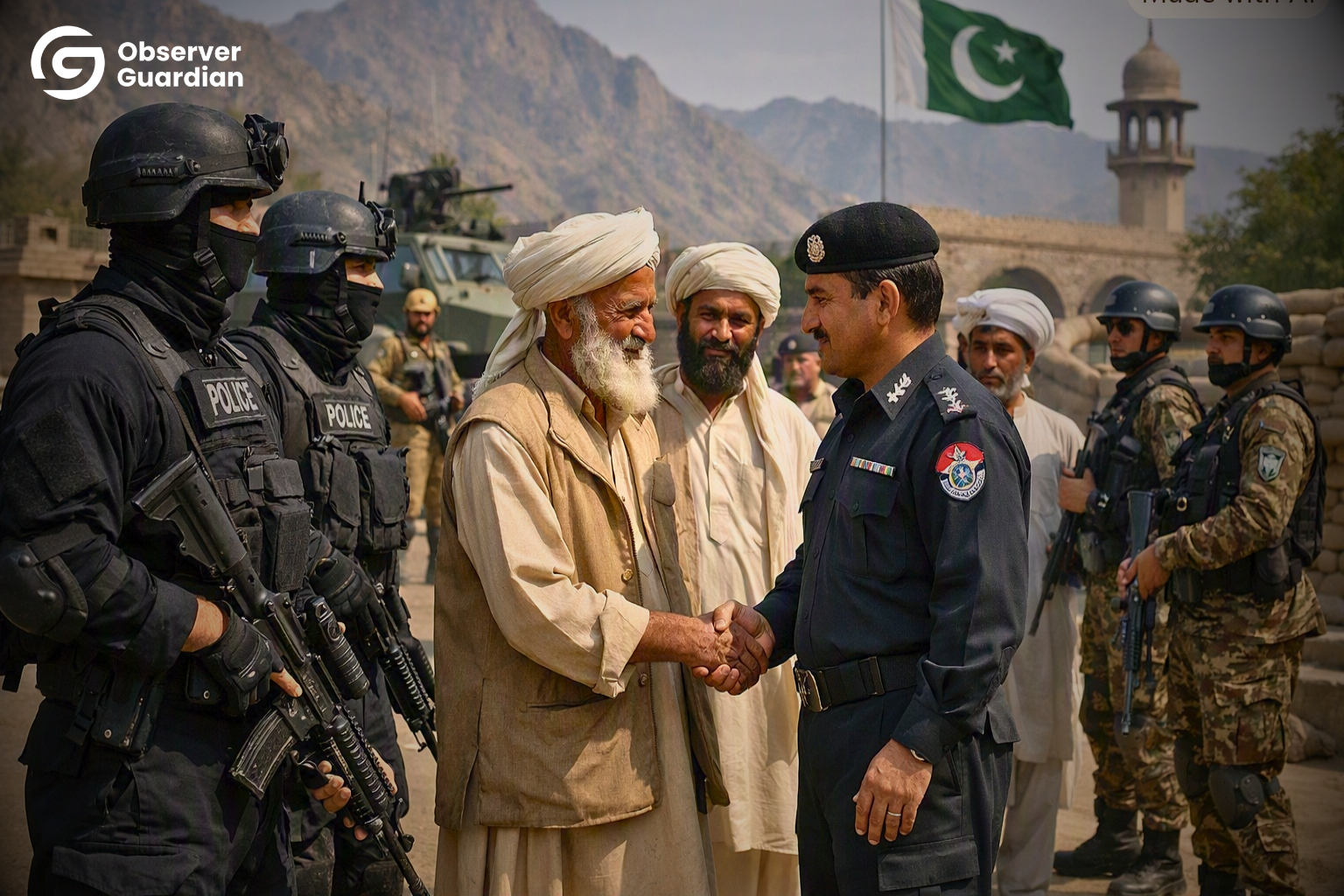
The Chief Secretary’s engagement of tribal elders and prominent local notables through structured jirgas was politically intelligent. In a region where community legitimacy shapes public perception more than press releases ever could, bringing respected voices to the table sent a message no administrative order can replicate: this is not the state versus the people, this is the state and the people against those who prey on both. Elected representatives MNAs and MPAs played an active role in channeling public sentiment away from sympathy for the outlawed groups.
Simultaneously, the IGP KP and RPO Bannu moved with institutional precision. Targeted transfers, FIR registrations against key instigators, and specific apprehensions ensured accountability was not performative. The deployment of Federal Constabulary units to protect vital installations in Bannu and Lakki Marwat, district jails, judicial complexes, the DC office, the High Court bench, the grid station, prevented the crisis from being weaponized to disrupt civilian governance.
The information war was managed as well. Rather than ceding the digital space to the self styled committees and their carefully packaged narratives, state institutions moved to counter false propaganda with documented reality, exposing these groups for what they actually were rather than what they claimed to be.
Bannu in 2026: The Wider Security Context
It would be wrong to view this episode in isolation. Bannu has been among Pakistan’s most contested districts this year. In May 2026, a catastrophic suicide bombing near a security post involving over 100 fighters and an estimated 1,200 to 1,500 kilograms of explosives killed 21 security personnel and injured others. The attack was claimed by Ittehad ul Mujahideen. Security forces subsequently launched intensive intelligence based operations, killing 24 Khawarij terrorists in Bannu and adjoining areas within 24 hours in July.
Against this backdrop, a parallel armed structure inside the police system infiltrated by terminated personnel with terrorist connections, running extortion rings and sheltering wanted individuals, was not merely a law and order problem. It was an active threat multiplier in one of the country’s most kinetic security environments. Eliminating it was not administrative housekeeping. It was a strategic necessity.
The Lesson That Cannot Be Ignored
The people of Bannu and Lakki Marwat have paid an extraordinary price for the region’s instability. They deserve a state that shows up consistently, that operates through accountable institutions, and that does not subcontract their security to whoever happens to be armed and locally connected. The swift crackdown against these unauthorized groups is a step toward that promise, but it must be accompanied by something more durable.
Pakistan’s experience with proxy auxiliaries has repeatedly demonstrated one uncomfortable truth: structures created outside the formal chain of command will eventually pursue their own interests. The solution is not to abandon community engagement in security that engagement, done properly, is invaluable but to ensure any such arrangements are legally codified, rigorously vetted, and subject to the same accountability mechanisms as the formal force.
The state’s writ is not a slogan.
It is the foundation on which every citizen’s safety rests. What happened in southern KP was a reminder of what happens when that foundation develops unguarded cracks, and why filling them, firmly and transparently, is not optional.
The crackdown in Bannu and Lakki Marwat is not the end of this story. But it is, at least, a necessary and overdue beginning.
Disclaimer: The views and opinions expressed in this article are exclusively those of the author and do not reflect the official stance, policies, or perspectives of the Platform.