
Afghanistan’s political and security landscape is becoming increasingly difficult for the Taliban to portray as settled. A concentrated series of reported resistance operations across Kapisa, Helmand, Zabul, Badakhshan and Herat between September 9 and 11 suggests that armed and political opposition remains capable of operating across widely separated parts of the country. The significance lies less in the casualty figures claimed by individual groups than in the geographical reach, frequency and variety of their activities.
In Kapisa, the Afghanistan Freedom Front, or AFF, said it attacked a Taliban checkpoint at the site of a former Afghan National Army base in Tagab district on September 9, claiming three Taliban personnel were killed and two wounded. Subsequent reporting carried the AFF account, although casualty claims from Afghanistan’s competing armed actors remain difficult to verify independently. The episode nevertheless matters because Tagab has historically been a difficult environment for governments attempting to establish durable local control.
The more important development is that Kapisa was not an isolated case. The Afghanistan United Front, or AUF, has reported targeted operations in the south, including Helmand and Zabul. Such incidents indicate that opposition activity is not restricted to the traditional northern strongholds usually associated with anti-Taliban resistance. AUF itself said at the beginning of September that it had conducted dozens of operations across numerous provinces since launching its latest military campaign in August. If that operational spread continues, the Taliban will face a security problem different from a localized insurgency that can simply be contained within one valley or province.
Badakhshan offers another indication of this pressure. On September 10, the National Resistance Front said its fighters attacked a Taliban checkpoint in Yaftal Payan district, producing a clash that lasted around forty minutes. The NRF claimed three Taliban personnel were wounded. Local sources cited by Afghanistan International confirmed that fighting had occurred, although the Taliban did not publicly respond to the group’s casualty claim. The incident is particularly notable because Badakhshan has witnessed repeated resistance activity in recent months, making it one of the more persistent areas of armed opposition to Taliban authority.
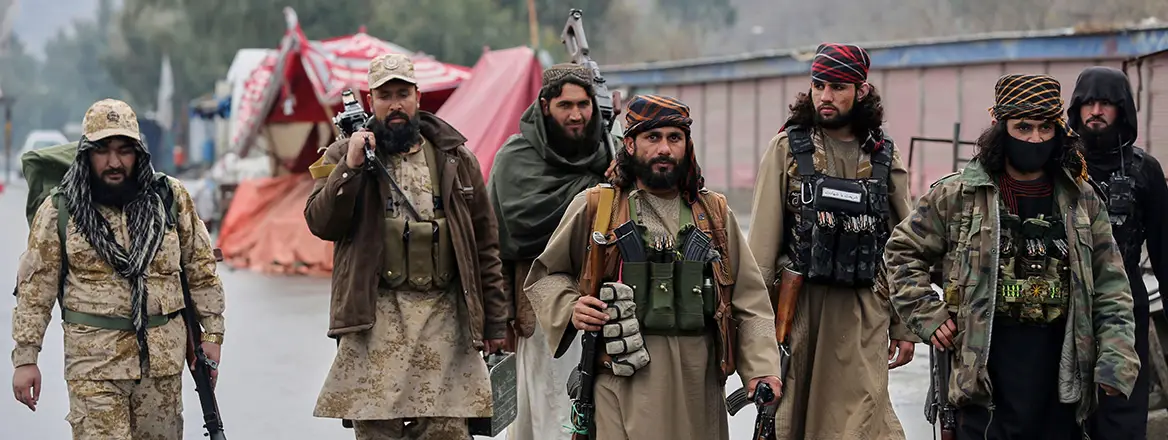
What is emerging is therefore a pattern rather than a collection of unrelated security incidents. Different resistance organizations appear to be probing different parts of the Taliban’s security architecture. Checkpoints, individual security personnel and military facilities have all become targets. For the Taliban, even relatively small attacks create a cumulative burden. More personnel must be assigned to protection, movements become more cautious, intelligence networks must cover larger areas, and commanders cannot assume that provinces considered quiet will necessarily remain so.
Herat adds another dimension altogether. Instead of relying only on armed action, AUF supporters reportedly distributed leadership messages and religious scholars’ fatwas at 28 locations across Herat city on September 11, including prominent commercial and public areas. Reporting on the activity described it as part of a broader attempt to challenge Taliban authority through political and religious messaging. This is potentially more consequential than it initially appears.
The Taliban’s authority has always rested on more than physical coercion. Its leaders have presented their rule as possessing religious legitimacy, social order and the ability to end decades of warfare. Opposition groups therefore understand that challenging Taliban rule requires competing not merely for territory but for legitimacy. When anti-Taliban messages appear inside a major urban centre such as Herat, the intended audience extends beyond fighters. The message is directed toward residents, religious constituencies, former state employees and those who may privately question the political order but remain unwilling to express opposition publicly.
This does not mean that Afghanistan is on the verge of a nationwide military reversal. The Taliban retain overwhelming advantages in manpower, weapons, territorial control and state institutions. Resistance organizations remain fragmented, their casualty claims require independent scrutiny, and sporadic attacks should not automatically be interpreted as evidence of an imminent strategic breakthrough. Serious analysis must distinguish between the existence of resistance and its ability to fundamentally alter the balance of power.
Yet the Taliban face another problem. Their political narrative depends heavily on the idea that organized resistance has effectively disappeared. Even limited but repeated attacks undermine that claim. A government may retain physical control while still facing persistent political insecurity. The more often armed groups demonstrate the ability to strike in different provinces, the more difficult it becomes to present Afghanistan as a country where coercive authority is completely uncontested.
The geographical diversity of the latest reported operations is therefore significant. Kapisa represents terrain close to the capital and historically associated with resistance. Badakhshan demonstrates continued instability in the northeast. Helmand and Zabul carry symbolic weight because they lie within areas traditionally associated with Taliban strength. Herat demonstrates that opposition networks are also attempting to enter the information, religious and political space of major cities.
For ordinary Afghans, however, another cycle of armed confrontation offers no simple solution. Afghanistan has already endured decades of war, displacement and institutional destruction. Sustainable stability cannot ultimately be produced by checkpoints, intelligence raids or military victories alone. Nor can political opposition build lasting legitimacy simply through armed attacks. Afghanistan requires representative institutions, political participation, protection of basic rights and mechanisms through which grievances can be addressed without violence.
The developments between September 9 and 11 nevertheless reveal something important. Taliban control remains extensive, but control should not be confused with uncontested legitimacy. Resistance groups remain active, their methods are becoming increasingly multidimensional, and their operations are appearing across geographically disconnected provinces. The immediate military consequences may remain limited, but the political message is harder to dismiss. Five years after returning to Kabul, the Taliban still confront Afghans prepared to challenge their monopoly over political authority, religious interpretation and the country’s future.