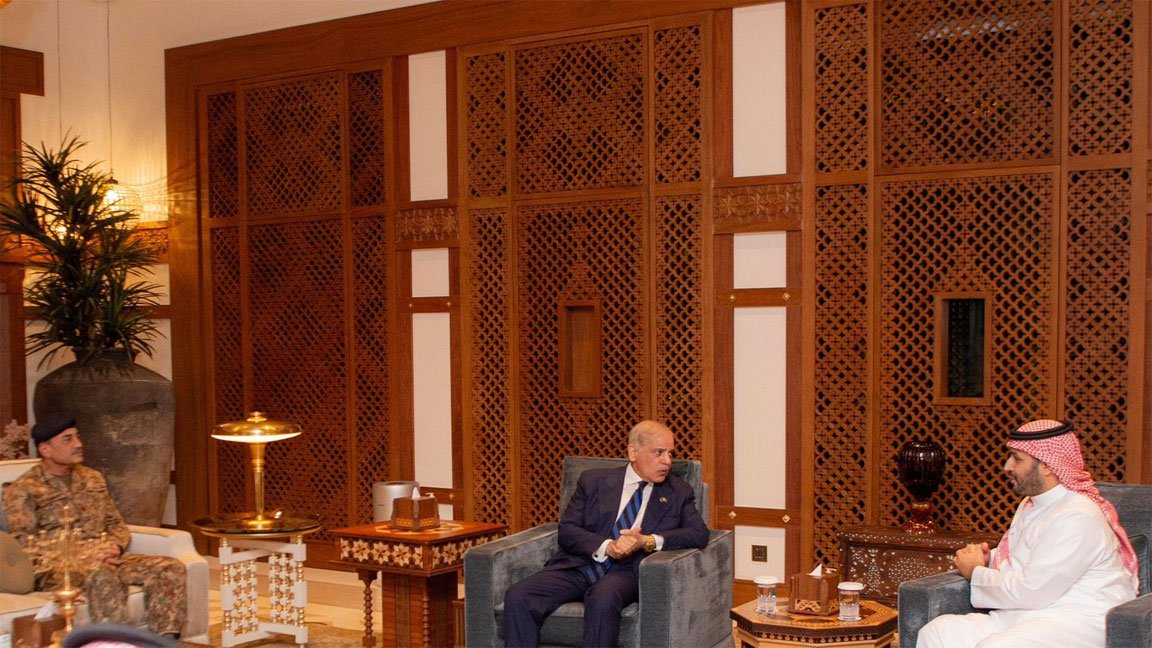

The latest escalation involving Yemen’s Houthis and Saudi Arabia has once again brought the security of the Arabian Peninsula and the Red Sea into sharp focus. For Pakistan, the issue carries particular significance because of its longstanding relations with Saudi Arabia, its concern for the security of the holy cities, and its broader interest in stability across the Middle East. Islamabad has responded by condemning Houthi attacks against the Kingdom and reiterating its support for Saudi sovereignty, territorial integrity, security and prosperity. Addressing the United Nations Security Council on September 15, Pakistan’s Permanent Representative, Ambassador Asim Iftikhar Ahmad, said the continuing attacks and military developments around Yemen had brought the conflict to an “extremely dangerous juncture.”
The concern has become even more pronounced following developments around Makkah and the Madinah region. Saudi authorities said air defences intercepted and destroyed a Houthi drone south of Makkah before it entered restricted airspace on September 15. The Houthis, however, denied that they were threatening Makkah or other Islamic holy sites. The Organisation of Islamic Cooperation subsequently condemned what it described as attacks against Makkah and the Madinah region. Whatever the competing accounts surrounding individual targets, the prospect of armed escalation reaching areas surrounding Islam’s holiest cities introduces an exceptionally sensitive dimension into an already dangerous regional conflict.
Pakistan’s response is also rooted in its wider relationship with the Kingdom. In an official statement issued on September 8, Islamabad condemned Houthi attacks against civilian and economic targets in Abha, Khamis Mushait, Jazan and Najran. Pakistan described those attacks as violations of Saudi sovereignty and territorial integrity and reaffirmed solidarity with the Saudi leadership, government and people. The language reflects continuity rather than a sudden diplomatic reaction. Saudi Arabia has remained one of Pakistan’s closest partners in the Muslim world, with cooperation extending across diplomatic, economic, defence and people-to-people relations.
There is also an established international legal framework governing the debate over self-defence. Article 51 of the United Nations Charter recognises the inherent right of individual or collective self-defence when an armed attack occurs, while the exercise of that right remains subject to international law. Pakistan has explicitly framed its position within this framework, saying that Saudi Arabia has the right to take necessary measures to defend its territory, protect its population and safeguard national assets. This formulation places Pakistan’s diplomatic position within the language of sovereignty and international law rather than treating the crisis merely as a matter of bilateral political alignment.
Yet the implications extend far beyond Saudi territory. The increasingly volatile situation around the Bab al-Mandab Strait represents a serious challenge for international security and commerce. The narrow waterway connects the Red Sea with the Gulf of Aden and forms a critical maritime corridor linking Asian and Middle Eastern trade with Europe. The United Nations warned on September 15 that developments around Bab al-Mandab were increasing instability and that navigational rights and freedoms in the Red Sea must be protected in accordance with international law. Pakistan has similarly warned that instability around the strait could affect global trade, supply chains and energy security.
That economic dimension is particularly important. A conflict concentrated geographically in Yemen can quickly acquire international consequences when missiles, drones and maritime insecurity begin affecting major shipping lanes and energy infrastructure. Insurance costs rise, vessels reconsider routes, supply chains become vulnerable and energy markets respond to uncertainty. The September attacks on Saudi infrastructure have already intensified concerns about the security of regional energy networks. This is why Pakistan’s statements at the Security Council have linked Saudi security not only with regional peace but also with the stability of the wider global economy.
Military containment alone, however, does not address Yemen’s underlying political crisis. The renewed violence comes after years in which the UN-led process had sought to preserve the relative calm that followed the 2022 truce. Renewed fighting has also worsened the humanitarian situation inside Yemen, with the United Nations reporting large-scale displacement during the latest escalation. Any sustainable framework therefore has to address both cross-border security and Yemen’s unresolved internal conflict.
Pakistan has accordingly continued to support an inclusive, Yemeni-led and Yemeni-owned political process under United Nations auspices. That position combines two strands of Islamabad’s diplomacy. The first is support for Saudi Arabia’s sovereignty and security. The second is support for de-escalation, dialogue and a negotiated settlement in Yemen. Pakistan’s UN representative has stressed the need to preserve diplomatic space even as the security situation deteriorates, arguing that political engagement must acquire greater urgency as the danger of wider escalation grows.
The present crisis therefore tests more than the security relationship between Pakistan and Saudi Arabia. It raises questions about the protection of civilian areas, freedom of navigation, energy security and the possibility of preventing Yemen from becoming another front in a broader regional confrontation. Pakistan’s current position is clear in its official statements: solidarity with Saudi Arabia’s sovereignty and security, opposition to attacks on civilian and economic infrastructure, concern over threats to maritime commerce, and continued support for a UN-facilitated political process in Yemen. In a region where military escalation can rapidly cross borders and disrupt economies far beyond the Middle East, those different dimensions of the crisis cannot be considered in isolation.