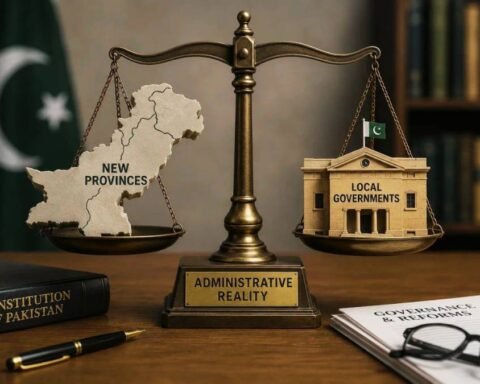

Pakistan’s debate over new provinces is often presented as a dispute over geography. In reality, it is much more about power. Changing provincial boundaries would alter who controls budgets, appointments, contracts, bureaucratic influence and political patronage. That is why proposals for smaller administrative units repeatedly generate resistance from political parties, provincial elites and groups whose influence is tied to the existing system.
The resistance is not uniform. In Sindh, the Pakistan People’s Party views the province’s existing boundaries as politically significant, while Sindhi nationalist groups fear that any division could weaken provincial identity and affect control over resources. In Khyber Pakhtunkhwa, reservations over a Hazara province are connected to concerns about political weight and regional identity. Punjab has its own contradictions. Some political leaders support Bahawalpur or South Punjab, but a substantial division of the province would inevitably reduce Lahore’s political and administrative dominance.
This diversity of opinion is understandable. Provincial boundaries are closely connected with history, language and identity. But political sensitivity should not become an excuse to ignore a deeper problem. Pakistan’s administrative system is struggling to serve a population of more than 240 million through four very large provinces, each containing areas with vastly different economic, social and geographical conditions.
The constitutional barriers are substantial as well. Article 239 requires a two thirds majority in both houses of Parliament for a constitutional amendment. When the boundaries of an existing province are involved, the concerned provincial assembly must also approve the change by a two thirds majority. New provinces, therefore, cannot be created through slogans or symbolic resolutions. They require serious political negotiation and broad constitutional consensus. Yet constitutional difficulty does not prove that the existing administrative structure is efficient. It simply means reform has to be carefully designed.
The strongest argument for smaller provinces is administrative rather than ethnic. New units should be considered according to population, geography, economic viability, distance from administrative centres and the quality of public service delivery. A reform process built around these criteria would be less divisive than one based primarily on ethnicity or language.
There are legitimate concerns about cost. Every new province would require an assembly, cabinet, secretariat, judicial structures and additional administrative machinery. These costs should not be dismissed. Any proposal must demonstrate that new institutions will improve service delivery sufficiently to justify the expenditure. Smaller government units should not become an excuse for creating more ministerial positions and another layer of bureaucracy.
The more serious question concerns resources. The NFC pool does not automatically expand when new provinces are created. The share allocated to provinces would have to be distributed among a larger number of administrative units. This makes fiscal design critical. Without legal guarantees for district and local government funding, new provinces could simply reproduce the same centralised model on a smaller geographical scale. That would defeat the purpose of reform.
The real test is devolution. Article 140-A requires political, administrative and financial authority to be transferred to elected local governments. Yet in practice, provincial governments remain reluctant to surrender meaningful control over money and decision-making. This is one reason why citizens continue to depend on provincial capitals for matters that should be resolved much closer to home.
Water supply, sanitation, local roads, registration services and small development schemes should be handled effectively at union and tehsil levels. Education, primary healthcare and district development should be subject to stronger local oversight. A resident of Rajanpur should not have to depend excessively on Lahore for routine administrative decisions. The same principle applies to Thar and Karachi, Chitral and Peshawar, or Gwadar and Quetta.
Smaller provinces could reduce administrative distance, but they would achieve little if authority remained concentrated in a new provincial capital. Changing the signboard on a secretariat is not reform. Power has to move further downward.
This is also where minority protections become essential. Any redrawing of administrative boundaries can change the demographic balance of an area. Communities that are currently part of a provincial majority could suddenly find themselves in a minority. Constitutional safeguards, representation, cultural protection and strong local governments are therefore necessary parts of any serious proposal.
Public consultation is equally important. Proposals for new provinces should not emerge only during election campaigns. Citizens need to know what boundaries are proposed, what the new institutions will cost, how resources will be distributed and which powers will remain with provincial capitals. Without transparency, the debate will continue to be viewed as an exercise in political engineering.
Pakistan ultimately faces a choice that is larger than the question of how many provinces it should have. It must decide whether its system of governance will continue to concentrate authority in a few capitals or bring the state closer to citizens. The answer may involve additional provinces, stronger district governments or a combination of both. What matters is the principle behind the reform.
The objective is not to create new identities or weaken old ones. It is to make public institutions more accessible, accountable and responsive. A smaller province should reduce administrative distance. A stronger local government should place decisions closer to neighbourhoods, towns and districts. Together, they can create a more balanced federation.
Pakistan does not need a different map simply for the sake of changing the map. It needs a governance structure capable of serving its population effectively. The real measure of reform will not be how many provincial boundaries are drawn, but whether citizens receive faster services, fairer access to resources and a clearer line of accountability. The map is only a means. Better government is the destination.