
Pakistan’s governance problem is often discussed in terms of weak institutions, poor service delivery, limited accountability and uneven development. Yet one structural issue receives far less attention than it deserves. The country has grown enormously, while its basic provincial arrangement has remained largely unchanged. According to the 2023 census, Pakistan has a population of about 241.5 million. Punjab alone has nearly 127.7 million people, Sindh about 55.7 million, Khyber Pakhtunkhwa around 40.9 million and Balochistan almost 14.9 million. In 1998, Pakistan’s population stood at roughly 132.4 million. In only twenty five years, the population increased by more than 100 million people.
The administrative system has not expanded at the same pace. Pakistan still relies on four provinces to govern a population larger than that of many major countries combined. This does not automatically prove that more provinces are necessary, but it does justify a serious examination of whether the existing arrangement remains suitable for present day governance. The debate should not begin with provincial identity or political competition. It should begin with a much simpler question. How close is government to the ordinary citizen?
For someone living in Rajanpur, Lahore can feel very far away. The same applies to residents of Thar in relation to Karachi, Chitral in relation to Peshawar, or Gwadar in relation to Quetta. The problem is not merely the number of kilometres involved. Administrative distance means waiting for approvals, depending on provincial departments located hundreds of kilometres away and competing with much larger population centres for government attention. In such circumstances, citizens may technically belong to a province while remaining far removed from the institutions that make important decisions about their lives.
Representation also becomes increasingly difficult as population grows. Pakistan currently has 266 directly elected general seats in the National Assembly. On a simple national average, this amounts to roughly one general seat for every 900,000 people, although constituency populations naturally vary. Representatives are therefore expected to serve extremely large populations with different economic, geographic and social concerns. Similar pressures exist at the provincial level, where enormous administrative units have to balance the demands of major metropolitan centres with remote districts that may have entirely different priorities.
The problem becomes even more visible when public money is considered. Under the Seventh National Finance Commission Award, provinces receive 57.5 percent of the divisible pool, while the federal share is 42.5 percent. Of the provincial share, Punjab receives 51.74 percent, Sindh 24.55 percent, Khyber Pakhtunkhwa 14.62 percent and Balochistan 9.09 percent. Population remains the dominant factor in the distribution formula, alongside poverty and backwardness, revenue generation and inverse population density.
But transferring money from Islamabad to a provincial capital is only half the journey. The more important question is what happens afterwards. Does development spending reach neglected districts? Do remote communities receive a fair share of infrastructure, schools, hospitals and employment programmes? Does a district have sufficient authority to decide what it needs most? Governance should ultimately be measured not by how much money enters a provincial account, but by whether public resources produce visible improvements in citizens’ lives.
This is where the case for smaller administrative units deserves consideration. A new province could bring an elected assembly, provincial departments, development authorities and decision makers closer to regions that currently operate on the margins of larger provincial systems. Southern Punjab, Bahawalpur and Hazara have repeatedly appeared in public discussions for precisely this reason. Other regions may raise different administrative demands. Such proposals, however, should be assessed through transparent criteria rather than political convenience. Population, geography, economic viability, administrative accessibility, cultural concerns and the financial cost of establishing new institutions all deserve careful examination.
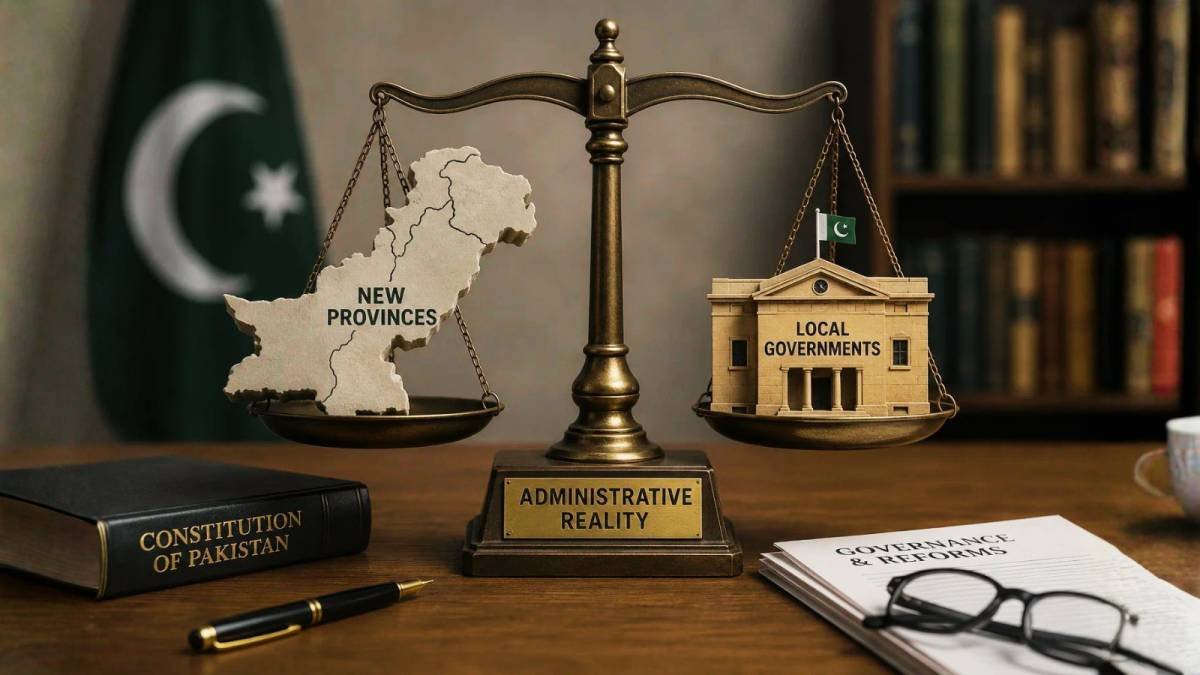
New provinces, however, cannot become a substitute for local government. Creating another provincial capital while keeping authority concentrated in its secretariat would simply reproduce the existing problem on a smaller map. Pakistan’s Constitution already provides an important foundation for deeper decentralisation. Article 140A requires every province to establish a local government system and devolve political, administrative and financial responsibility and authority to elected local representatives. The principle is clear. Government should not stop at the provincial capital.
A meaningful reform model would therefore combine two levels of decentralisation. Smaller provincial units could reduce the distance between provincial decision makers and neglected regions, while empowered districts, tehsils and municipal governments could handle matters that directly affect communities. Schools, sanitation, local roads, basic health facilities, water supply, municipal planning and other everyday services often require local knowledge rather than distant bureaucratic supervision.
There are legitimate concerns about creating new provinces. New assemblies, secretariats, police structures and administrative departments cost money. Boundaries can become politically sensitive. Questions over water, assets, jobs and revenue sharing may generate disagreement. None of these concerns should be dismissed. They are precisely why any restructuring should emerge through constitutional procedures, public consultation and transparent financial planning rather than hurried political bargaining.
The debate should therefore move beyond the simplistic choice between keeping four provinces forever or drawing new lines on the map. Pakistan’s real objective should be a system in which authority follows responsibility and resources follow citizens. The success of reform should be judged by practical outcomes. Can a farmer resolve a land issue more quickly? Can a patient reach a functioning public hospital? Can a student find quality education closer to home? Can a district influence its own development priorities? Can citizens clearly identify who is responsible when public services fail?
Pakistan has outgrown many assumptions on which its older administrative structure was built. Its population is larger, its cities are expanding and citizens expect more from government. New provinces may form part of the response, but only when accompanied by genuine devolution and stronger local institutions. The purpose should not be to divide Pakistan into smaller pieces. It should be to shorten the distance between the state and the people it exists to serve.