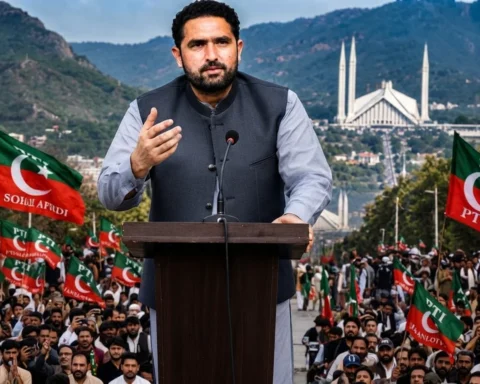
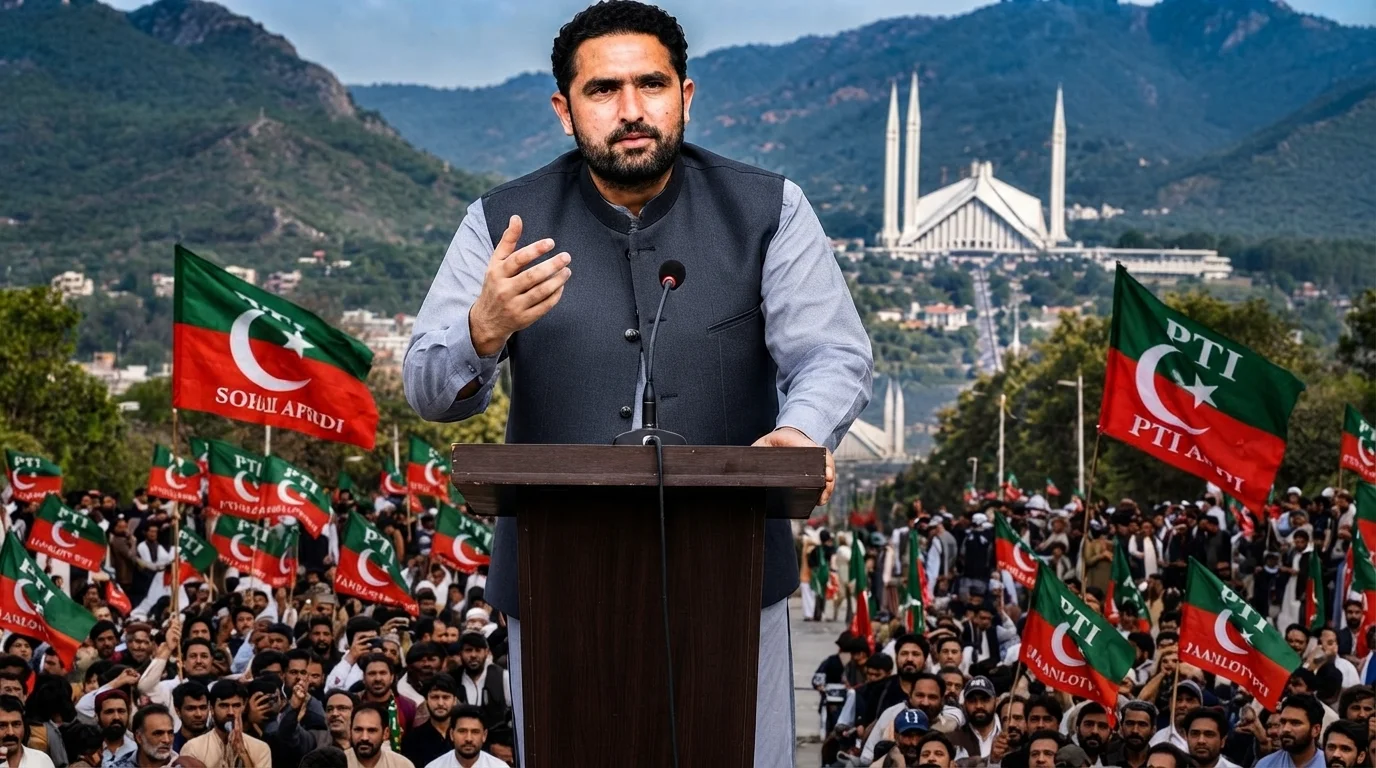

Pakistan Tehreek e Insaf is no stranger to long marches. Over the past several years, the party has turned street politics into something of a defining art form, gathering workers, building momentum, threatening Islamabad, then pivoting at the last moment. But the crisis unfolding ahead of the October 4 march from Peshawar is something different. This is not a tactical maneuver. This is a party that does not know where it is going, literally and figuratively.
Reports emerging from inside PTI’s own ranks paint a disturbing picture. Senior leaders, when asked about the march’s destination, cannot give a straight answer. Is the final stop Swabi? Or is this a full push toward Islamabad? The Chief Minister of Khyber Pakhtunkhwa, Sohail Afridi, has reportedly not communicated the strategy to his own colleagues. When party members press him for answers, his response, according to sources cited by Geo News, is that he himself has not been briefed. The man leading the march does not know where the march ends. If that is not a leadership crisis, it is hard to say what is.
This ambiguity has real consequences.
A long march without a clear destination is not a protest.
It is a procession without purpose. Political mobilization requires a narrative that workers can own and repeat. “March to Swabi and wait” is not that narrative. It breeds confusion among supporters, and confusion on the street is dangerous.
Shaukat Yousafzai, a senior PTI figure and the party’s provincial information secretary in KPK, has said out loud what others are apparently whispering. In a formal letter to PTI Chairman Barrister Gohar and other senior leadership, he urged an immediate postponement of the October 4 march. His reasoning was pointed: the security situation is volatile, the risks to workers are real, and proceeding recklessly could hand the federal government a pretext to impose emergency rule or move against the party altogether. He warned plainly that the march could “turn bloody.” He referenced Imran Khan’s own precedent of calling off a previous march to protect workers’ lives, and asked why the same instinct should not apply now.
The party’s response to Yousafzai was not reassuring. CM Afridi reportedly expressed displeasure at the letter. The KPK information minister dismissed it as a “personal opinion.” On social media, Yousafzai was accused of selling out. He broke down on live television while describing the trolling. A senior party man raising legitimate safety concerns gets tears in return for his loyalty, this tells you something about PTI’s internal culture right now.
Then there is the financial reality. In the Peshawar meeting, CM Afridi disclosed that PTI’s official bank account has been closed. Members of the assembly will need to personally bear the expenses for workers and logistics connected to the long march. This is not a minor logistical footnote. A party that cannot keep its central bank account operational is a party operating under severe institutional pressure. Financing a sustained street movement without organized party funds is a recipe for chaos, unequal burden sharing, and resentment within the ranks.
The march’s political stakes are also extraordinarily high. PTI’s KPK provincial government is, for now, the party’s only real seat of power. Analysts and insiders alike acknowledge the fear within PTI that a confrontational push toward Islamabad could give the federal government grounds to move against that government. The threat of Governor’s Rule or worse, emergency provisions, is not abstract scaremongering. Yousafzai himself cited this risk in formal correspondence. Reports have also suggested that a number of alternative candidates are quietly positioning themselves in case the provincial government collapses or is dissolved under extraordinary circumstances.
What is the federal government’s position? Law Minister Azam Nazeer Tarar has publicly said the government had not refused talks, but objects to PTI’s demand for Imran Khan’s release as a precondition. PTI Senator Ali Zafar has described the postponement as an opportunity for the government to engage. There is, at least in theory, a window for dialogue. But windows close, and PTI’s internal chaos is not making it easy to negotiate from strength.
There is also the question of what KPK’s people are actually experiencing while this political drama plays out. Citizens in the province have voiced genuine frustration. Security remains a serious concern, with terrorist attacks continuing to claim lives. Development work in merged tribal districts remains slow. Roads are broken. Schools and hospitals in outlying areas function poorly. These are not partisan complaints, they are the lived experience of millions of people. When the party’s energy and provincial resources are being directed toward a march on Islamabad, with no clear destination and no agreed strategy, it is legitimate to ask whether the province is receiving the governance it needs.
This is not an argument against political protest. Democratic societies need the freedom to mobilize, to march, to demand accountability from those in power. PTI’s founding demand, the release of Imran Khan and a fair judicial process, remains a legitimate political cause that millions of Pakistanis identify with. But means matter. A march that its own leadership cannot explain, that its own senior members are quietly begging to postpone, that is funded out of individual politicians’ pockets because the party account is closed, this is not a show of strength. It is a demonstration of institutional fragility dressed up as defiance.
Shaukat Yousafzai’s letter, whatever one thinks of its timing, was an act of responsibility. He is not calling on his party to surrender. He is calling on it to think. The distinction matters enormously. PTI’s history includes moments when it pulled back from the brink and lived to fight another day, and moments when it walked into confrontations that cost it far more than it gained. The October 4 march, as currently constituted, looks more like the latter than the former.
KPK is too important, and the moment is too delicate, for a party to march blindly into an uncertain destination. Leadership is not just about announcing dates with a defiant tone.
Leadership is knowing where you are going and having a plan for when you get there.
Right now, PTI has the tone. What it is missing is the plan.