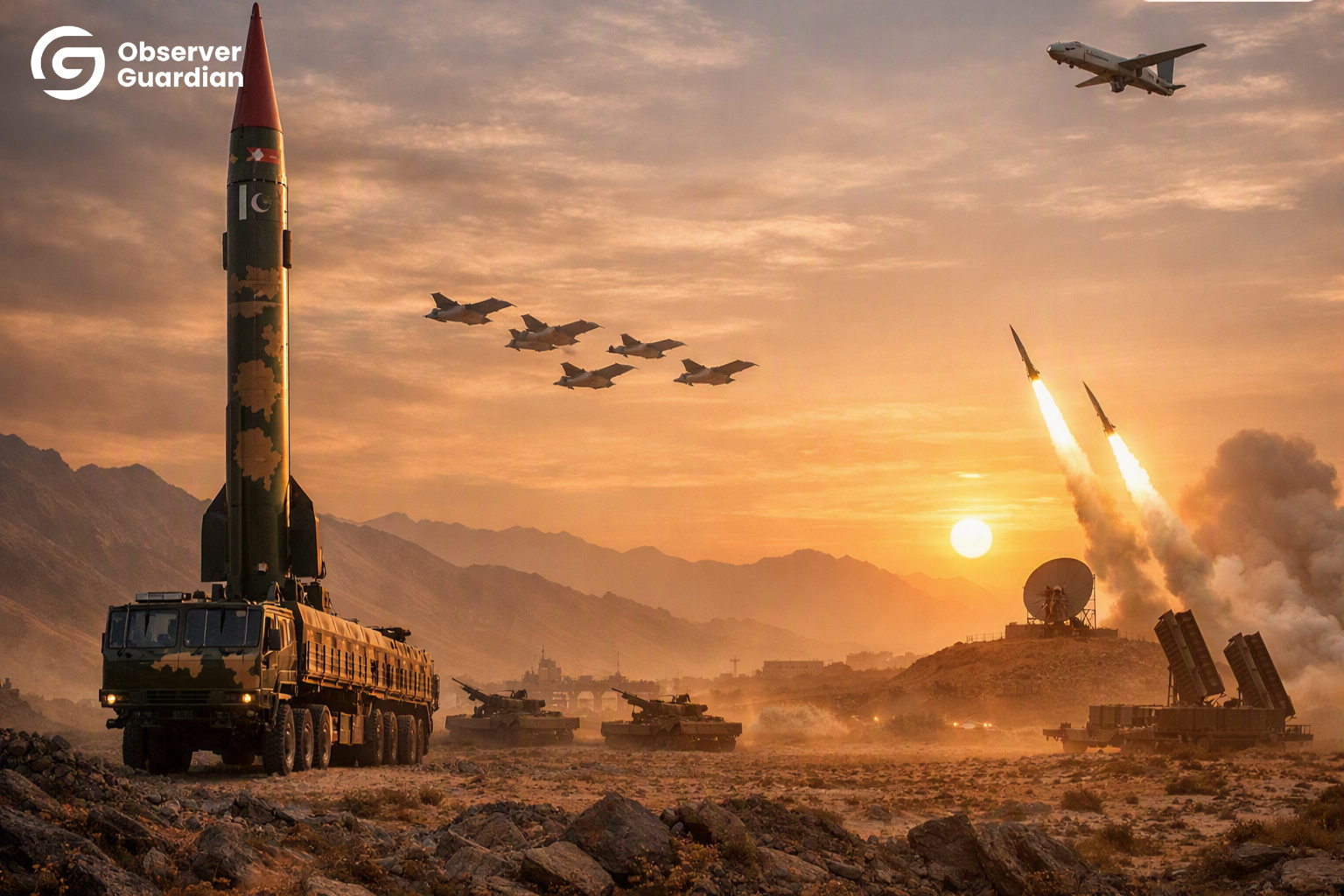
There is a particular kind of intellectual malpractice that dresses itself in academic language while serving a pre determined conclusion. Sadia Tasleem’s recent piece in the Bulletin of the Atomic Scientists, grandly titled “How the Bomb Failed to Deliver Security in Pakistan,” is a textbook example. The argument sounds rigorous on the surface. But peel back the framing and what you find is not analysis it is advocacy, shaped by a school of thought that has spent years working toward a singular goal: undermining confidence in Pakistan’s strategic deterrent.
Let us be precise about what Tasleem is actually claiming. Her central argument is that the May 2025 conflict “highlighted the limitations of Pakistan’s nuclear arsenal,” that nuclear weapons “failed to deter deep cross border strikes,” and that Pakistan’s strategic elite has been quietly shifting its narrative away from nuclear achievements toward conventional military success. From this, she concludes the bomb has failed.
The problem is not that her observations are entirely false. The problem is that she is measuring a hammer by how well it performs as a screwdriver.
Deterrence Was Never Designed to Prevent Everything
The foundational error in Tasleem’s thesis is one of basic definitional confusion.
Full Spectrum Deterrence is not Full Spectrum Security. These are not interchangeable concepts.
Pakistan’s nuclear posture was designed with a specific, bounded purpose: to prevent a full scale conventional war from spiraling into an existential conflict, and to deter India from crossing the threshold into total war. It was never not in any official doctrine, not in any serious academic formulation meant to prevent every instance of military friction along a 3,300 kilometer border.
On that actual measure, deterrence worked at exactly the level at which it was designed to work. It prevented a general war and an uncontrolled vertical escalation, and kept nuclear weapons in the background. That is the job description. That is what succeeded.
The May 2025 conflict demonstrated that limited war under the nuclear shadow is now a practical reality rather than a theoretical possibility. This is not a failure of deterrence. It is deterrence functioning within the logic of nuclear strategy as it has been understood since Bernard Brodie a logic that accepts the existence of limited conventional exchanges precisely because the nuclear backstop makes total war irrational.
What the Nuclear Shadow Actually Constrained
Those who argue deterrence “failed” in May 2025 must grapple with the counterfactual: what would have happened without it? The answer, informed by seventy five years of nuclear deterrence theory and the history of every India Pakistan confrontation since 1998, is clear. Without the nuclear overhang, India’s strikes would not have been “limited.” There would have been no carefully bounded operation. There would have been no ceasefire brokered through diplomatic channels. Both sides understood that pushing beyond established limits would activate that deterrent and that understanding is precisely what kept the conflict from becoming catastrophic.
De-escalation came through a hotline call between the Directors General of Military Operations, paving the way for a ceasefire. Diplomacy amplified military messaging, reinforcing Pakistan’s image as a rational, responsible actor. That structured de escalation did not happen in a vacuum. It happened because both capitals understood the existential stakes. That is deterrence working.
Moreover, Pakistan’s response in May 2025 was itself a demonstration of deterrence credibility. Pakistan’s response was swift but measured: forceful enough to make clear it would not tolerate aggression, yet cautious enough to avoid the slope of war. A state whose deterrent had genuinely collapsed would not have had that kind of calibrated space to operate in. It would have been paralyzed or it would have overreacted. Pakistan did neither.
The School of Thought Behind the Argument
Tasleem’s article does not appear in a vacuum either. It is the latest product of a sustained intellectual project that uses the language of arms control and nonproliferation to arrive, reliably, at one destination: questioning Pakistan’s need for strategic capabilities. Her affiliation with nonproliferation networks, her framing that consistently privileges Western anxieties about Pakistani tactical nuclear weapons over Pakistani security realities, and her selection of evidence in this piece all reflect a framework that begins with the conclusion and works backward.
Pakistan’s nuclear doctrine is often read through alarmist shortcuts: tactical nuclear weapons, crisis instability, command and control anxieties. The strategic reality, however, is far less hysterical: Pakistan’s nuclear capability emerged to offset an enduring asymmetry with India. Its purpose is defensive, India specific, and tied to the prevention of a major war in South Asia. Tasleem knows this. She has written on Pakistani nuclear doctrine for years. Her selective use of the May 2025 evidence therefore cannot be attributed to ignorance. It reflects a choice.
The Real Lesson of May 2025
The genuine lesson from May 2025 is not that nuclear deterrence failed. It is that deterrence, like any strategic instrument, requires constant adaptation. The argument that conventional deterrence needs to be given greater importance does not suggest abandoning nuclear deterrence or pursuing unrealistic conventional parity with India. Pakistan’s strategic community understands this distinction even if Tasleem does not wish to acknowledge it.
Pakistan’s modernization is less about a bigger arsenal than about survivability, redundancy, second strike credibility, and reinforcing conventional deterrence and resilience amid drones, precision strike, missile defense, cyber, AI enabled ISR, and information manipulation. This is not the behavior of a state that has concluded its nuclear posture failed. This is the behavior of a state that takes deterrence seriously enough to keep investing in its credibility.
Pakistan’s program is focused on “full spectrum deterrence,” a posture that includes both strategic and tactical (low yield) nuclear options, and Pakistan is working on a credible nuclear triad. These are the decisions of a strategic establishment that understands the environment it operates in one where India has Rafale jets, S 400 systems, hypersonic programs, and a declared policy of “no nuclear blackmail.”
Conclusion
The question deterrence theory asks is not: did conflict happen? It asks: what did the presence of nuclear weapons constrain? In May 2025, the answer is unambiguous. It constrained the conflict to a limited exchange. It prevented the war from becoming a general one. It kept both sides inside the bounds of a crisis that could be diplomatically managed.
Pakistan’s nuclear deterrent did not fail in May 2025; the crisis showed it still prevents full scale war while leaving dangerous space for limited conventional exchanges.
That dangerous space is a challenge. It is a real one, and it deserves serious strategic thinking. But confusing a challenge for a failure is not analysis. And producing arguments designed to erode public and institutional confidence in Pakistan’s most fundamental security guarantee timed precisely when India is consolidating what it calls a “new normal” of punitive strikes is not scholarship either.
تہمت لگا کے ماں پہ جو دشمن سے داد لے ایسے سخن فروش کو مر جانا چاہیے
Nuclear deterrence did not fail in May 2025. Those who claim otherwise owe their readers a more honest accounting of what deterrence is actually designed to do.
Disclaimer: The views and opinions expressed in this article are exclusively those of the author and do not reflect the official stance, policies, or perspectives of the Platform.