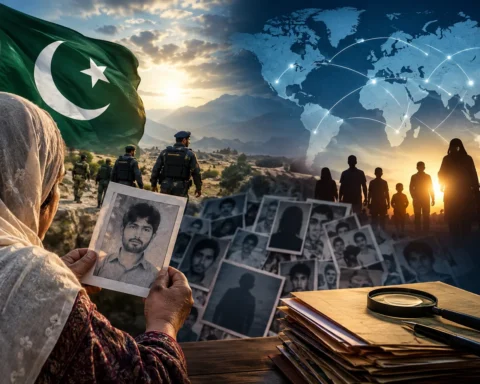
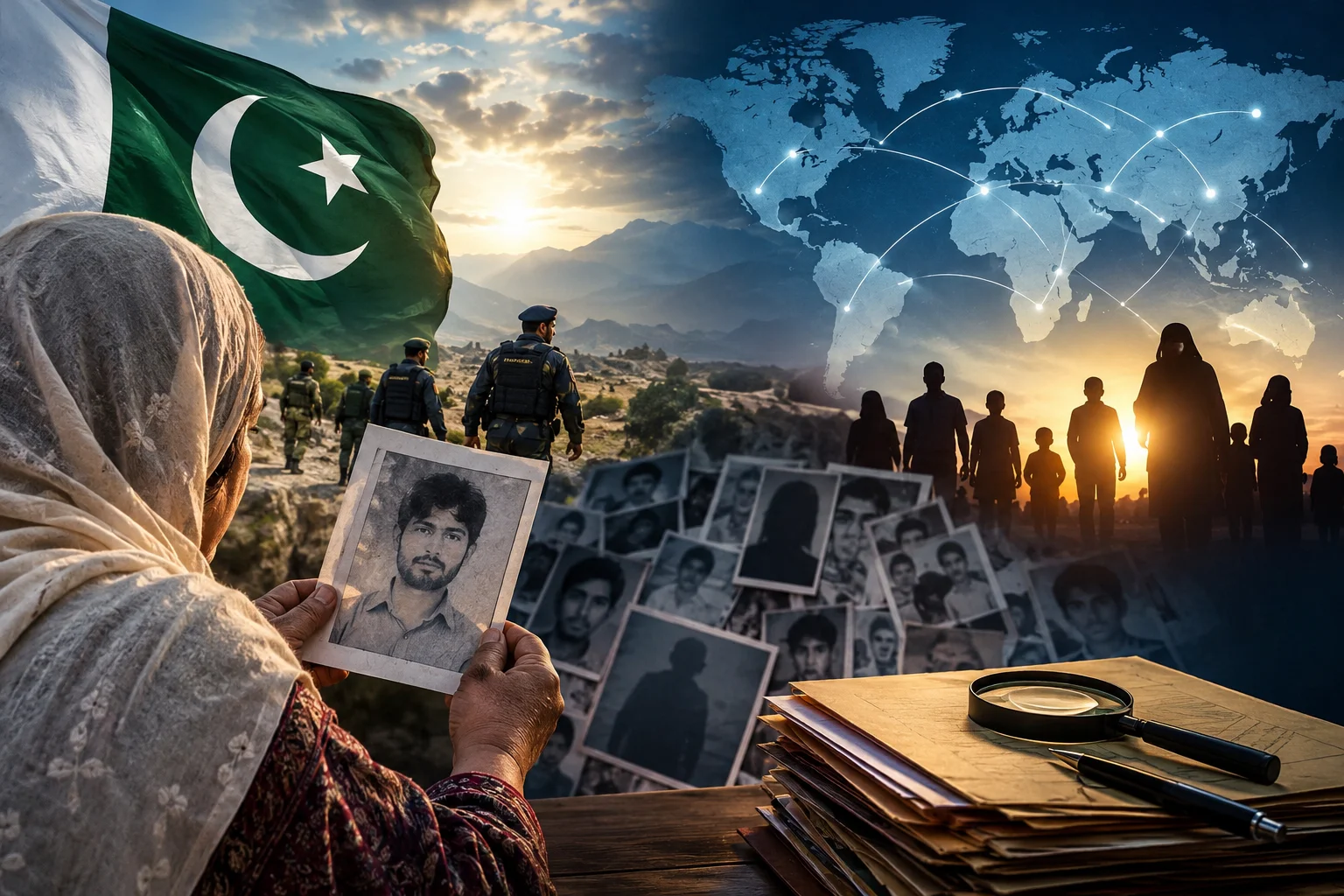

There is a version of Pakistan’s missing persons story that gets told endlessly in Western capitals, NGO reports, and the diaspora echo chambers of European cities. It is a story of a predatory state that swallows its own citizens whole, leaving grieving families with nothing but silence. It is emotionally powerful, politically convenient, and when measured against the actual data, deeply misleading.
This is not to say the problem does not exist. It does. Families have suffered real anguish, real uncertainty, and in some cases real injustice. But the deliberate conflation of every missing person with an enforced disappearance, and the framing of every case as evidence of a systematic state policy, has moved well beyond legitimate human rights advocacy into something closer to coordinated narrative warfare.
Let us start with the global context, because it matters. Missing persons are not a Pakistani phenomenon. The United States carries over 500,000 missing person cases at any given time, with roughly 100,000 still active. The United Kingdom registers a new missing person every 90 seconds, around 300,000 cases annually. India, a country that has not fought a war on its own soil, with no TTP or Khawarij insurgency consuming its borderlands, still reports over 350,000 missing person cases every year, roughly 2,130 people vanishing every single day. Nobody is holding UN panel discussions about New Delhi’s “systematic enforced disappearances.” The UN has recorded missing person cases across 115 countries. The question worth asking is: why does Pakistan face a disproportionate share of the international heat?
The answer lies in who is doing the framing and why. Khawarij linked political fronts, Baloch separatist activists operating from European cities under asylum protections, and a web of Western lobbyists have been extraordinarily effective at manufacturing a narrative of institutionalised terror. Their strategy is simple: take every missing person case, whether it involves a declared terrorist, an illegal migrant to Iran, a criminal absconder, or even a child custody dispute, and stamp it “enforced disappearance by the Pakistani state.” Repeat this across social media, UN side events, and sympathetic international media until it becomes received wisdom.
The actual data tells a different story.
Pakistan’s Commission of Inquiry on Enforced Disappearances (CoIED), reconstituted in August 2025 under new leadership, has to date received 10,636 cases since its inception in March 2011, of which 8,986 have been disposed of, with 1,650 remaining under investigation.
That is an overall resolution rate approaching 85 percent. Critically, the year 2024 saw only 379 new cases registered, the lowest count in six years, while the commission actually resolved more than it received, closing 427 cases in the same period. These are not the statistics of a state running an industrial disappearance machine. These are the statistics of a state making measurable, incremental progress under extraordinarily difficult conditions.
The provincial breakdown dismantles one particular propaganda pillar. Balochistan, the province most heavily featured in international condemnation, has had 2,284 of its 2,752 reported cases resolved, leaving 468 pending. That is a resolution rate exceeding 82 percent in the very province painted as ground zero for state atrocities. Baloch separatist lobbies have built an entire international campaign around a province where Pakistan has demonstrably resolved the overwhelming majority of registered cases.
Understanding why the numbers get inflated requires understanding what is actually inside many of these “missing person” cases. A significant portion involves individuals who joined proscribed terrorist organisations, TTP, BLA and affiliated Khawarij networks, and were either killed in operations or buried by their own accomplices without informing families. Others involve people who voluntarily traveled to FATA, Afghanistan, or Syria to fight and died there. Still others are illegal migrants who crossed into Iran or beyond and simply never came back. Criminal absconders, proclaimed offenders, and individuals who simply left home of their own accord round out a category that accounts for, by internal assessments, somewhere between 70 and 80 percent of all reported cases. The tragedy of these families is real. But the attribution to the state is false.
Pakistan has also been building the institutional scaffolding to close the gaps that do exist. The Anti Terrorism (Balochistan Amendment) Act 2025 introduced a 90 day preventive detention framework for inquiry, ensuring that terrorism suspects are held within a defined legal perimeter rather than in procedural limbo. Punjab followed with the Anti Terrorism (Punjab Amendment) Bill 2026, which the Punjab Assembly passed on August 31, creating a special security case mechanism and introducing faceless court protections for judges, prosecutors, and witnesses in high risk terrorism proceedings. These are direct institutional responses to the vulnerability that has long plagued Pakistan’s terrorism prosecution, judges threatened, witnesses silenced, prosecutors targeted. Pakistan has spent more than two decades fighting terrorism, losing approximately 83,000 lives between 2001 and 2022 and suffering economic losses exceeding Rs 35 trillion. A prosecution rate of 8.7 percent against that backdrop is not indifference, it is a system under siege.
The reconstituted commission is also working toward a uniform national policy to address disappearances swiftly across all regions, while a dedicated welfare cell has been set up to process pension claims and documentation for families of missing persons. A Rs 5 billion financial support package approved by the federal cabinet in August 2024 is being distributed to deserving families through the commission. These are not the actions of a government trying to hide something.
None of this means the issue is closed or that accountability should stop. Where genuine enforced disappearances occur, the law must reach those responsible. The CoIED’s mandate includes directing criminal cases against officials responsible for proven disappearances, and that mechanism should be used rigorously. Families deserve answers, not press conferences.
But there is a difference between demanding accountability and weaponising grief for political ends.
Pakistan has fought on the frontlines of a generational war against Khawarij terrorists who operate across porous borders, target civilians in mosques and markets, and embed themselves within communities. The legal and institutional architecture being built today, commissions, welfare cells, preventive detention frameworks, faceless courts, reflects a state trying to close the gap between a brutal security environment and the rule of law.
That story deserves to be told just as loudly as the one being manufactured in European lobbying offices.