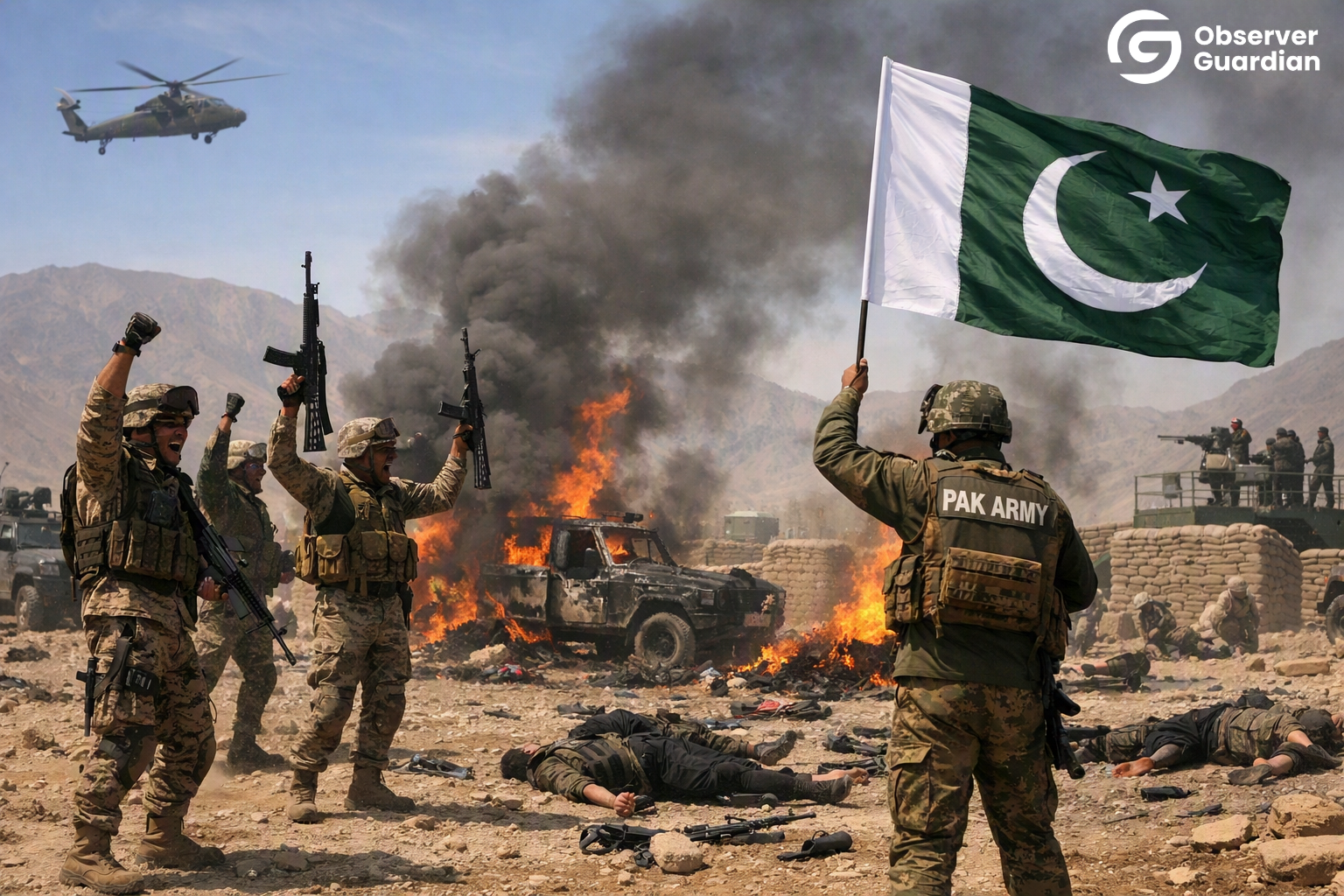
There is something deeply telling about what happened on N85 in Panjgur on August 22, 2026. Fitna al Hindustan terrorists attempted a raid on a security post and walked straight into a wall. The attack was foiled, the attackers suffered heavy losses, and one brave soldier embraced Shahadat, standing firm as Pakistan’s finest have always done. That soldier’s sacrifice must not be reduced to a footnote. It is the full stop at the end of a sentence that says: this nation will not yield.
But let us look at the bigger picture, because that picture tells a story FAH would rather you not see.
In the days immediately preceding this foiled assault, security forces conducted a series of high tempo joint intelligence driven operations along with police, as part of a relentless counter terrorism campaign aimed at eliminating Indian proxies, Fitna al Khawarij and Fitna al Hindustan. The results were devastating for the terrorists. Security forces, in coordination with police, killed 49 terrorists in a series of intelligence based operations across Khyber Pakhtunkhwa and Balochistan over the past few days. Of these, 37 terrorists belonging to the Indian sponsored Fitna al Hindustan were killed in 10 intelligence based operations conducted in Mastung, Mach, Khuzdar and Panjgur districts. Significant quantities of weapons, explosive drums, and remote detonation equipment were seized and destroyed at the sites.
This is not a stray success. This is a pattern and it is a pattern that is breaking FAH.
Consider what August 2026 has looked like for Pakistan’s security apparatus in Balochistan alone. On August 9, security forces killed 15 terrorists in intelligence based operations across Mastung, Bolan, Washuk, Awaran, Sibi, Khuzdar, Harnai and Noshki under Operation Radd ul Fitna 3. Then on August 10, security forces killed five terrorists, including a key commander identified as Wazir, son of Jamal, during an intelligence based operation in Balochistan’s Panjgur district under Operation Radd ul Fitna 3. By August 12, 18 terrorists affiliated with Fitna al Hindustan were killed in Surab after a vehicle borne IED detonated prematurely while still being prepared a moment of grim irony that captured just how disorganised and desperate these networks have become. On August 18, security forces killed eight terrorists after surrounding and targeting a terrorist hideout in the mountainous region between Ziarat and Harnai. Then came August 20, when motorcycle borne terrorists were en route to execute a terrorist attack but were targeted using advanced weapons in the Kali Suran area of Panjgur another plot stopped cold. And now, on August 22, the N85 raid ended the same way: failure for the terrorists, loss for their networks, and a reaffirmation of security forces’ iron will.
The tempo is relentless, and it is working.
What does this tell us about FAH’s current state The answer is uncomfortable for the terrorists and should be. Groups under pressure do not become more sophisticated they become more reckless. Attacking a well defended security post along a national highway in broad visibility is not a strategic move. It is a gamble born of desperation, of networks that are shrinking, commanders that are being eliminated, and supply lines that are being severed. Security forces recovered a large quantity of weapons, ammunition and improvised explosive devices from the terrorists, which were defused at the site a recurring theme across every major operation this month, underscoring just how much material these groups are losing to operations they cannot replace.
The broader security data adds crucial context. A report by the Centre for Research and Security Studies identified Khyber Pakhtunkhwa and Balochistan as Pakistan’s primary violence hotspots during the second quarter of 2026, together accounting for nearly 96 percent of all violence related fatalities recorded nationwide. These numbers cannot be dismissed, nor should they be. The challenge is real. But the response has also been real, and it has been formidable.
Operations form part of Pakistan’s continuing counter terrorism campaign under Azm e Istehkam, a framework approved by the Federal Apex Committee under the National Action Plan, focused on dismantling militant infrastructure, disrupting terrorist activity and preventing further attacks.
This is not a reactive, ad hoc campaign scrambling from one incident to the next. This is a deliberate, structured, intelligence led dismantling of FAH’s operational capacity across Balochistan. The enemy is not just being killed it is being mapped, tracked, pre empted, and denied sanctuary. After each operation, security forces launch sanitisation operations to eliminate any remaining terrorist threats and ensure security in the region. The message being sent is simple and unambiguous: there will be no gaps, no breathing room, no safe corners.
The N85 attack in Panjgur on August 22 must be understood within this frame. It was not a sign of FAH’s strength. It was a sign of its deterioration. Groups that are gaining ground do not throw fighters at fortified security posts hoping something sticks. They do that when they have run out of better options when their commanders are dead, their weapons stocks are depleted, and their networks are fractured.
The attack failed, as have so many others before it this month. And with each failure, the credibility of these terrorists erodes further among whatever support base they imagined they had.
The soldier who embraced Shahadat on N85 deserves this country’s deepest respect and gratitude. His sacrifice is not in vain. It is part of a campaign that is visibly, measurably, and irreversibly degrading the capacity of Fitna al Hindustan to threaten the people of Balochistan. Security forces remain resolute and unwavering in their commitment to defend the nation’s frontiers, and this counter terrorism campaign will continue until the threat of foreign sponsored terrorism is eliminated from the country.
Panjgur is being cleared. Pakistan is pushing back and it is winning.
Disclaimer: The views and opinions expressed in this article are exclusively those of the author and do not reflect the official stance, policies, or perspectives of the Platform.